
December 30, 2025 - PBS News Hour full episode
12/30/2025 | 57m 46sVideo has Closed Captions
December 30, 2025 - PBS News Hour full episode
Tuesday on the News Hour, the U.S. increases pressure on the Maduro regime with a strike inside Venezuela. Federal agents intensify investigations of alleged fraud of taxpayer money in Minnesota. Plus, the U.S. announces a new way to deliver humanitarian aid around the world.
Problems playing video? | Closed Captioning Feedback
Problems playing video? | Closed Captioning Feedback
Major corporate funding for the PBS News Hour is provided by BDO, BNSF, Consumer Cellular, American Cruise Lines, and Raymond James. Funding for the PBS NewsHour Weekend is provided by...
December 30, 2025 - PBS News Hour full episode
12/30/2025 | 57m 46sVideo has Closed Captions
Tuesday on the News Hour, the U.S. increases pressure on the Maduro regime with a strike inside Venezuela. Federal agents intensify investigations of alleged fraud of taxpayer money in Minnesota. Plus, the U.S. announces a new way to deliver humanitarian aid around the world.
Problems playing video? | Closed Captioning Feedback
How to Watch PBS News Hour
PBS News Hour is available to stream on pbs.org and the free PBS App, available on iPhone, Apple TV, Android TV, Android smartphones, Amazon Fire TV, Amazon Fire Tablet, Roku, Samsung Smart TV, and Vizio.
Providing Support for PBS.org
Learn Moreabout PBS online sponsorshipNICK SCHIFRIN: Good evening.
I'm Nick Schifrin.
Geoff Bennett and Amna Nawaz are away.
On the "News Hour" tonight: The U.S.
increases pressure on the Maduro regime with a strike inside Venezuela.
Federal agents intensify investigations of alleged fraud of taxpayer money in Minnesota.
And the U.S.
announces a new way to deliver humanitarian aid around the world, with a much lower, at least initial, contribution than in the past.
JEREMY KONYNDYK, President, Refugees International: If this $2 billion is the end of the story and it's all the U.S.
is going to provide, that is catastrophic, frankly.
(BREAK) NICK SCHIFRIN: Welcome to the "News Hour."
It is exceedingly rare that a U.S.
president would announce covert action publicly, but that is what President Trump did yesterday when he acknowledged a strike on a port facility in Venezuela.
And, today, media outlets reported it was the CIA that launched the drone strike on an alleged drug facility.
It comes as the Trump administration is targeting not only drug smugglers across the region, but also Venezuelan President Nicolas Maduro himself.
For months, the U.S.
has built up the Caribbean's largest armada in half-a-century, 30 strikes on what the U.S.
calls narco-terrorist drug boats, the latest in the Eastern Pacific just last night, the capture of two sanctioned Venezuelan oil tankers and the chasing of a third tanker that today reportedly requested Russian protection.
And, today, news the CIA reportedly launched a drone strike along the Venezuelan coast, the reported target, a storage facility operated by the transnational gang Tren de Aragua, which the Trump administration connects, without public evidence, to Venezuelan President Nicolas Maduro.
DONALD TRUMP, President of the United States: There was a major explosion in the dock area where they load the boats up with drugs.
They load the boats up with drugs.
So we hit all the boats.
And now we hit the area.
It's the implementation area.
That's where they implement.
And that is no longer around.
ELLIOTT ABRAMS, Council on Foreign Relations: If the amount of drug trafficking comes down significantly in the Caribbean, and I think it must, the regime is going to have a lot less money to throw around.
NICK SCHIFRIN: Elliott Abrams was the first Trump administration's special envoy for Venezuela and is today a senior fellow for the Council on Foreign Relations.
He supports the pressure campaign that is targeting Venezuela's chief source of revenue as a way to weaken Maduro's grip on power and force him to step down.
ELLIOTT ABRAMS: The economy of Venezuela will get worse and the finances of the Maduro regime will get worse and that will increase public pressure and internal pressure in the regime, that at some point there are either mass demonstrations or somebody in the military acts or the regime basically decides, we don't know how far Trump is willing to go with this.
Let's make a deal now.
NICK SCHIFRIN: But the administration's critics argue the pressure campaign's tactics are illegal and its goals are imperialist.
DANIEL HELLINGER, Professor Emeritus of International Relations Webster University: It's straightforward territorial intervention.
It's the kind of thing that was characteristic of the United States in the Caribbean region back in the beginnings of the 20th century.
NICK SCHIFRIN: Daniel Hellinger is a Webster University professor emeritus who says Maduro is not the threat that the U.S.
alleges.
DANIEL HELLINGER: I don't think he's sort of the kingpin that they're trying to portray him to be.
Venezuela does not traffic in fentanyl to any significant degree and that most of what comes out of Venezuela is more likely to be marijuana or cocaine, and even that doesn't even come towards the United States.
NICK SCHIFRIN: Maduro himself this week has been trying to laugh or sing past the pressure in between boasts and bravado.
NICOLAS MADURO, Venezuelan President (through translator): Our military have a glorious history as emancipating humanist invincible warriors.
Today, our armed forces are more prepared than ever to continue winning peace, sovereignty and territorial integrity for our people.
NICK SCHIFRIN: And opponents of the Trump administration's policy predict that, if Maduro is ousted, there will be chaos.
DANIEL HELLINGER: Venezuela is a heavily armed society in the civilian sector.
There are going to be parts of the Venezuelan military that will retreat into guerrilla warfare.
And there's just a very dense population in Caracas, where crime is a serious problem, and there's lots of lots of firearms around.
So it'll get messy.
ELLIOTT ABRAMS: The warnings that there will be civil war in Venezuela and massive amounts of violence I think are wrong, that, if Maduro falls, Edmundo Gonzalez, who was elected last year, will become president.
And the opposition is planning for that right now and planning for what a democratic transition will look like.
As long as the Maduro regime is there, we are not going to get its cooperation in reducing drug trafficking.
You're going to see the continuing flow of migrants, eight million down, and there's no reason that it can't go to nine or 10 or 12 million over the coming years.
And you're going to see continuing cooperation between the regime and Cuba, Iran, Russia, China.
NICK SCHIFRIN: Maduro has not acknowledged the alleged CIA strike, perhaps to avoid further escalation, but more confrontation is coming, as the U.S.
is promising more pressure.
In other news today: Strong winds and heavy snow envelop much of the Great Lakes and Northeast, leaving tens of thousands without power.
Some areas in Western and Upstate New York have seen more than a foot of snow, causing whiteout conditions on the road.
And there were more disruptions to air travel today, with more than 5,000 flights delayed.
Forecasters say a wave of arctic air is set to bring snow for some in the Central and Eastern U.S.
ahead of the new year.
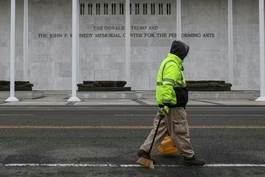
More artists are canceling shows at the Kennedy Center after President Trump's name was added to the Washington, D.C.-based arts facility.
Jazz band The Cookers have called off their New Year's Eve show.
The group did not specifically mention the name change, but stress their commitment to music that bridges division.
This comes after musician Chuck Redd canceled his Christmas Eve performance, citing the addition of Trump's name.
The center's president, Trump ally Richard Grenell, has threatened Redd with a $1 million lawsuit.
New England Patriots star Stefon Diggs is facing strangulation and other criminal charges stemming from an incident earlier this month.
That's according to court records revealed today.
A lawyer for the wide receiver says he - - quote -- "categorically denies the allegations."
And the Patriots are standing by Diggs, saying in a statement: "We support Stefon."
The 32-year-old is set to be arraigned next month.
He's played a major part in helping the Patriots reach the playoffs this season.
The United Arab Emirates is pulling its remaining forces out of Yemen after Saudi Arabia attacked an Emirati shipment in a Yemeni port.
Black smoke could be seen in Mukalla earlier today, where Saudi officials say two vessels from the UAE had delivered weapons and vehicles meant for a Yemeni separatist group.
It's not clear if there are any casualties.
The strike is an escalation in tensions between Saudi Arabia and the UAE and threatens to reignite the civil war in Yemen.
The head of Yemen's Presidential Council, which is Saudi-backed, said a defense pact with the UAE would be canceled.
RASHAD AL-ALIMI, Yemeni Presidential Leadership Council (through translator): Well, we appreciate the previous role of the United Arab Emirates and its efforts as a member of the Saudi-led coalition supporting legitimacy, its role has now unfortunately become directed against our great people, as it has provided explicit support for the rebellion and fueled internal strife, threatening our security and stability.
NICK SCHIFRIN: The UAE denied providing weapons to the separatists, saying that the shipment contained only vehicles meant for Emirati forces within Yemen.
Israel today said it will suspend the operations of dozens of humanitarian organizations in Gaza starting January 1.
That includes major groups like Doctors Without Borders, Mercy Corps, and others.
Israel says the groups did not share enough information about their funding and operations and that the groups contribute only about 1 percent of all the aid going into Gaza.
Some of the affected groups have called Israel's rules arbitrary and said they could put staff in danger.
Today's announcement comes as the U.K., Canada, and other countries expressed -- quote -- "serious concern" about the lack of humanitarian aid reaching Gazans.
Israel says it is upholding its commitments on aid made to President Trump.
In London and Paris, thousands of travelers were left stranded today after train operator Eurostar suspended service due to a power failure in the Channel Tunnel.
The disruption came during one of the busiest travel periods of the year.
Officials say a fault with the overhead power supply caused a train to break down inside the 31-mile tunnel.
That train was part of Eurostar's LeShuttle service, which transports vehicles under the English Channel.
Service has been partially restored, though delays are expected to continue.
George Clooney and his wife, human rights lawyer Amal Clooney, are now French citizens, as are their 8-year-old twins.
That's according to government documents issued over the weekend.
The power couple bought an estate in France in 2021.
The Hollywood star has said that French privacy laws enable the family to enjoy a quieter life than they would in the U.S., particularly when it comes to protecting their children from the paparazzi.
French law allows George Clooney to retain his American citizenship.
On Wall Street today, stocks edged lower as the end of the year approaches.
The Dow Jones industrial average gave back nearly 100 points.
The Nasdaq fell about 55 points.
The S&P 500 posted a third straight losing session.
And Tatiana Schlossberg, journalist, author, mother of two young children and granddaughter of President John F. Kennedy, has died.
Schlossberg was the daughter of Caroline Kennedy and Edwin Schlossberg and covered the environment for The New York Times and others.
Last month, she wrote a harrowing piece for The New Yorker, in which she described her battle with a rare form of leukemia.
In that same article, she was critical of her mother's cousin, Health Secretary Robert F. Kennedy Jr., saying his policies could hurt cancer patients like her.
Her passing was announced in a social media post by the John F. Kennedy Library Foundation.
Tatiana Schlossberg was 35 years old.
Still to come on the "News Hour": we look at redistricting efforts and the potential effects on the 2026 congressional elections; a small New Zealand space flight start-up aims to speed ahead of its larger competitors; and residents of Kharkiv, Ukraine, endure the scars of Russia's offensive during their fourth holiday season under full-scale war.
This week, the Trump administration dispatched federal officers to Minnesota amid renewed concerns over fraud.
The deployment comes after right-wing influencer Nick Shirley posted a video on YouTube last week claiming without proof that day care centers operated by Somali residents in Minneapolis had misappropriated more than $100 million.
In response, FBI Director Kash Patel wrote on X his agency was already investigating and that -- quote -- "This is just the tip of a very large iceberg."
And Department of Homeland Security Secretary Kristi Noem posted this video yesterday of agents on the ground in Minneapolis.
But state and city officials question Shirley's claims that come as the Somali community in Minneapolis was already facing the administration's immigration crackdown.
To break it all down, I'm joined by Jeff Meitrodt of The Minnesota Star Tribune, who's been covering this story.
Jeff Meitrodt, thanks very much.
Welcome to the "News Hour."
Federal prosecutors said earlier this month they're investigating some $9 billion worth of fraud in more than a dozen Medicaid-funded programs in Minnesota.
That is much broader, much larger than anything they have announced previously.
So explain, what's new here?
JEFF MEITRODT, Investigative Reporter, The Minnesota Star Tribune: What's new here is that a fraud problem that started with a COVID era really relief program to help kids get meals when the schools were all shut down has just spiraled into this sort of giant monster that just keeps spreading from one program to another.
It seems like there's a playbook that's been passed around out there, and dozens, if not hundreds, of criminals are figuring out how to rip out the state for -- it's certainly hundreds of millions of dollars.
And I think, at the $9 billion, my God, that's a huge lift.
I guess it's possible, but there's been a little bit of skepticism about that number too.
NICK SCHIFRIN: In the video, Nick Shirley visits several day cares.
Some appear closed and some turn him away when he asks to see children.
And he seems to take this as proof that the centers are fraudulent.
What is he claiming and how does it square with your reporting?
JEFF MEITRODT: Well, it's not investigative reporting by any stretch of the imagination.
I can't imagine these day care facilities letting a stranger in the door.
That seems like a violation of all kinds of rules, state and federal, but it does make good theater.
And it does raise actually questions about the legitimacy of some of these sites.
Some of these do not look like your standard day cares, blacked-out windows, sites that are not that family-friendly.
And so it looks damning.
And it may very well be that some of these sites are not taking care of children.
It looks like a couple of them actually have been closed for some period of time.
So did he cherry-pick a list for sort of maximum impact visually that ultimately is going to turn out to be nothing?
We don't know yet.
The state hasn't shared any of their results from what they saw on the streets this week when they went and they visited those day care centers.
NICK SCHIFRIN: Have any of the sites themselves responded?
JEFF MEITRODT: Yes, we have heard from several of them.
We visited some of them today and yesterday.
They're pushing back and saying, it's business as usual here, we're still open.
My colleague was in one today that had 50 kids present, which certainly is not the narrative that we saw in the video.
And it did not look like a staged situation, like they just suddenly put in a bunch of cots for kids.
But that said, we have visited all of them.
And at least one of them had quite a history of problems, including a failure to report what looks like either the death of a child or some other kind of very serious incident.
So these look like some facilities that may have some issues.
Whether they're committing fraud, that's a different question.
NICK SCHIFRIN: As you know, Republicans have put the blame on Minnesota's Democratic governor, Tim Walz.
And here's what his office told us in part - - quote -- "Fraud is unacceptable and it is appropriate that the federal government is investigating problems in federal programs.
The governor has been combating this for years, and before the viral video, the state had already referred these cases to law enforcement."
What has the state and federal response been even before the latest allegations?
JEFF MEITRODT: Very robust at the federal level, somewhat tepid at the state level.
And so I think there's legitimate questions that have been raised about whether the state did what it needed to do at the beginning to shut this thing down.
Now, there certainly has been a lot of action at the state level recently to try to crack down, create new guardrails, to create new processes that would catch fraud and prevent these kind of things from happening again.
But a lot of critics are saying this is a little bit too little too late.
NICK SCHIFRIN: And, finally, the Somali community in Minneapolis has been demonized by the president of the United States, who has called them -- quote -- "garbage."
He said: "We don't want them in our country."
And here's what Ahmed Samatar told our Fred de Sam Lazaro these new allegations.
He's a Somali professor at Macalester College in St.
Paul.
He's lived in Minnesota for over 30 years.
AHMED SAMATAR, Macalester College: The consequences could be frightening for many Somalis, especially young people who would think that they were born here, they're living the life of a normal citizen, going to school and getting along with life, and, therefore, should now have to watch their back all the time because they are targeted as an unwanted foreign group of people.
That's the danger.
NICK SCHIFRIN: How is this renewed attention affecting the Somali community?
JEFF MEITRODT: Absolutely.
They have been under siege now for weeks with this crackdown by ICE.
And I think the recent video, I mean, based on the hate mail that I'm getting for the stories that we have done that have raised some questions about both things that the state have done, statements that the feds have made, I can't imagine what it's like to be a Somali person in our community right now.
Minnesota is home to the largest Somali community in the United States.
Over 100,000 folks are living here.
They're police officers.
They're teachers.
A handful of them are criminals.
But it's paining the entire community with a very broad brush.
NICK SCHIFRIN: Jeff Meitrodt is with The Minnesota Star Tribune.
Thank you very much.
JEFF MEITRODT: Thank you.
NICK SCHIFRIN: This week, the U.S.
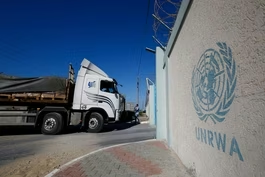
pledged $2 billion in humanitarian aid to the United Nations as part of a deal that will also overhaul how the U.S.
funds foreign aid work going forward.
The move comes after the U.S.
paused nearly all of its contributions earlier this year, leaving the U.N.
and other aid organizations scrambling.
William Brangham breaks it down -- William.
WILLIAM BRANGHAM: That's right, Nick.
That $2 billion is just a fraction of the $8 billion to $10 billion the U.S.
has provided to support global humanitarian work in recent years, but it would still represent the largest commitment of any single country in the world.
Yesterday, U.N.
Secretary-General Antonio Guterres welcomed the news, saying it would -- quote -- "increase our ability to save lives, deliver to the most vulnerable, and reduce human suffering."
So, to help us understand the significance of this new pledge, we are joined by Jeremy Konyndyk.
He's president of Refugees International and a former senior USAID official in both the Biden and Obama administrations.
Jeremy, welcome back to the "News Hour."
So, the U.S.
pledges $2 billion and also says all of that money must now be funneled through one U.N.
organization, the Office for Coordination of Humanitarian Affairs, or OCHA.
What do you make of that amount and of that new funding structure?
JEREMY KONYNDYK, President, Refugees International: So I think there are two different stories to those two questions.
With the new funding structure, I think there are arguments, good arguments to say that that could, if it's done right, be a pretty efficient way to deliver aid and arguably more efficient than some of the traditional ways of funneling it through this whole landscape of individual U.N.
agencies.
However, that really pales in comparison to what looks like a massive cut in U.S.
humanitarian assistance.
If you go back two years now to 2024, the final year of the Biden administration, the U.S.
provided $14 billion of global humanitarian assistance.
Now, needs in the world are just about the same as they were then.
They certainly haven't gone down.
If anything, they have gone up.
And this is $12 billion less from that $14 billion.
So, if this $2 billion is the end of the story and it's all the U.S.
is going to provide, that is catastrophic, frankly.
WILLIAM BRANGHAM: What do you think the answer to that question is going to be?
Is this $2 billion a down payment or is this it?
JEREMY KONYNDYK: That is not clear.
And that's actually quite important, because, if you are the entire U.N.
system working across these, I believe it's 17 countries that are eligible for this assistance, you really need to know if you're stretching that $2 billion out over the course of the next 12 months, or if this is just one of several payments.
You're going to plan very differently, you're going to invest very differently, you're going to allocate that money very differently if this is the first tranche of several, or if this is it for the entire year.
That kind of uncertainty is really tough for humanitarians to deal with.
And I very much hope that it's not the final word.
But I think it would be very important for the administration to make clear what their larger humanitarian funding plans are, whether that will ultimately go through this channel or others.
WILLIAM BRANGHAM: The U.S.
also said that there are 17 nations that this aid can go to, and many of those are in dire need, as designated by the U.N., but it also excluded three different nation-states, Yemen, Afghanistan, and Gaza, saying that they seem -- they're suspect about the governance in those places.
What do you make of that, that exclusion?
JEREMY KONYNDYK: I think Gaza is a bit of a unique category, because the U.S.
has been funding there, just through other channels directly to NGOs, and, hopefully, that will continue.
I'm more troubled by the exclusion of Yemen and Afghanistan.
These are countries where obviously the current administration has a very adversarial relationship with the de facto authorities in both of those places, but that shouldn't be a reason why civilians in those countries, who have massive needs, should suffer.
It's almost a double condemnation of Afghan women, for example.
On the one hand, they have to live under Taliban-imposed gender apartheid, and, on the other hand, because of that Taliban government, which they did not choose, now the U.S.
is pulling aid from them as well.
For many, many years, traditionally, across administrations, the U.S.
has drawn a distinction between a country's government and a country's people, and we want to support the people, even if we are at odds with the government.
This really demolishes that distinction, and I think that does huge damage to America's moral leadership and strategic leadership in the world in the long run, because people will remember that even after governments change.
WILLIAM BRANGHAM: One of the other accusations the Trump administration has made is that this new streamlined process will eliminate what they argue is the woke ideology in humanitarian aid, the gender ideology, that climate change -- that, in fact, no aid can go directly to climate-related projects.
Again, what do you make of that exclusion?
JEREMY KONYNDYK: I think it's -- on one level, it's silly.
And on another level, it really misunderstands why those things are important.
It's silly in the sense that the role of gender considerations in humanitarian aid, climate considerations in humanitarian aid is not about woke ideology.
And, frankly, there was not a huge difference in U.S.
humanitarian funding priorities from the first Trump administration into the Biden administration.
There was, I would say, continuity of probably 90-plus percent of the programs that were being funded.
But, more importantly, gender considerations are really important.
There is huge, huge, mass sexual violence happening in Sudan right now, mass sexual violence that happened over the past few years in the war in Tigray, mass sexual violence happening right now in Eastern Congo.
That's what we mean when we're talking about gender programs.
I would hope that rape survivors deserve U.S.
support.
I would hope as well that the administration understands that the role of climate change in humanitarian action is that it causes more droughts, which mean more people starve.
And if we ignore that, we're not ignoring -- they're not -- they're not writing out some so-called woke ideology.
What they're writing out is starvation and sexual violence and things that are really fundamental dimensions of humanitarian response.
WILLIAM BRANGHAM: All right, that is Jeremy Konyndyk of Refugees International.
Always great to speak with you.
Thank you so much.
JEREMY KONYNDYK: Thank you.
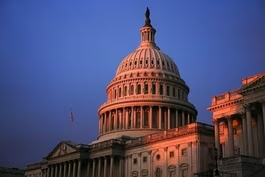
NICK SCHIFRIN: The end of 2025 brings us to the beginning of a midterm election year.
And that means questions about whether power will shift in Washington.
Dozens of members of Congress are heading toward the exit, and a handful of states are shaking up their political maps to try and lock in partisan gains.
Lisa Desjardins is here to walk through the numbers at the super screen.
Lisa, thank you very much.
So let's start with what is certain.
Where is redistricting in place and which party benefits?
LISA DESJARDINS: We have talked a lot about the two biggest states involved here, Texas, where Republicans began this redistricting war, and California, where Democrats responded.
In each of those states, the parties respectively expect to pick up between three and five seats.
But let's talk about the three states that have also re-mapped.
Those are for Republicans Ohio and North Carolina, where they expect to pick up a couple of seats.
But Democrats also have an opportunity as well, Utah, where a court-ordered map means they could pick up a seat around Salt Lake City.
So take these five states where new maps will be in place, and what do you get?
Here's a cheat sheet.
This is a way to think about this math.
The Republicans, these are where they expect to pick up.
But if you look at it, their Texas gains really are washed out by the California for Republicans.
Same thing, North Carolina, that basically is canceled out by the potential in Utah.
That leaves us with Ohio, where The Cook Political Report forecasts that Republicans stand to either have a wash or pick up a couple of seats.
And that's the story right now of where these maps stand.
Essentially, Republicans either will have a wash or pick up a couple with the maps certainly in place.
NICK SCHIFRIN: OK, so the states where it's locked in may give Republicans an edge.
But what about all the states where the efforts are still in progress?
LISA DESJARDINS: This is the right question, because I think this is where people get confused and start to flatline.
This is what we especially want to clear up.
Let's look at the Republican opportunities still in play.
There are five states we're watching.
They're all right here.
Some, like Florida, involve state legislatures.
Others involve court orders that we are waiting for.
One state that is not in this circle, Indiana.
You will remember the Trump administration wanted a Republican map there, but they're not getting it because state Senate Republicans rejected it.
Now, let's look at what's still in play for Democrats we're watching.
Right here, there's three states, Virginia, where a new Democratic governor will be inaugurated next month.
Maryland, we're watching and Wisconsin.
Now, I'm not going to do all the math for all these states because this is complicated and it's uncertain which of these states will actually redistrict.
But this map tells the story anyway.
You see more red and pink here.
There are more opportunities for Republicans than Democrats.
However, it does come with risk.
In places like Texas, Republicans are putting new seats on the board by watering down the Republican content of some of their safe seats.
Democrats are hoping that maybe that makes them more vulnerable.
NICK SCHIFRIN: All right, so upheaval in the maps, but also upheaval among members of Congress.
We have a long list of retirements already.
What does that look like and what does it mean?
LISA DESJARDINS: Nick, we're a near record pace right now for this midterm.
And there's some big names.
Moderates like Don Bacon, Jared Golden, they're fed up with Congress and leaving, but also some on the ideological ends of the spectrum, big-name conservatives, including Marjorie Taylor Greene, who is leaving at the beginning of January, Nancy Pelosi, former speaker of the House.
Also want to point out Lloyd Doggett, Texas Democrat, leaving because he's been redistricted out of his own seat.
This is the who, but I think the number actually tells a more important story.
Right now, by my count, we know 46 different members of this House are leaving of their own accord, not returning.
Most of them, as you see here, that red bar, are Republicans.
How does that compare?
We looked back at the end of December for the last two midterm cycles.
Here's what you see.
This figure is much higher than we saw four years ago when Joe Biden was in office.
But look at this.
It's very close to where we were in 2017 under President Trump.
And, again, it was mostly Republicans leaving.
Why might that matter?
I'm glad you asked.
Actually, I asked that.
But in 2018, after we saw these large number of retirements, what happened?
Republicans lost 40 seats.
It was a wave election.
There are not that many seats in play now because of redistricting.
But Republicans and -- Democrats, rather, really like their chances, because, in order to flip the House to regain control, Democrats only need to net three seats in the 2026 election.
So the big takeaways here, Nick, one, House Republicans do stand to gain from their efforts to redraw maps around the country, but their own members are telling a different story.
Their message is they're leaving for the exits.
Does not look like they expect with certainty to be in the majority.
NICK SCHIFRIN: Lisa Desjardins, breaking it down, as always, for us brilliantly at the super screen, thanks so much.
LISA DESJARDINS: You're welcome.
NICK SCHIFRIN: The private space economy is growing significantly, and 2026 could be a big year.
The first private space station is expected to launch next spring.
New commercial space flights will be offered, for the very wealthy, of course, and SpaceX is thinking of a public stock offering, smaller start-ups beginning to make a name for themselves as well.
And our science correspondent, Miles O'Brien, has the story of one in New Zealand catching some attention of its own.
MILES O'BRIEN: Hi, Michael.
What's this room called?
MICHAEL PEARSON, Engineering Manager, Rocket Lab: So this is the Mission Control Center.
MILES O'BRIEN: Another day, another pair of launches on tap for the world's second most frequent flier to space after SpaceX, Rocket Lab.
Launch director Michael Pearson showed me their mission control room for the rocket they call Electron.
MICHAEL PEARSON: It's ramping up and up, so last year, we did 16 launches.
This year, we're doing 20 or so.
We will continue to accelerate that, and before long we will be doing one a week, maybe more.
MILES O'BRIEN: Brisk, but still well short of the record-setting pace set by SpaceX.
Elon Musk's company has logged more than 160 Falcon 9 launches this year.
MAN: Starlink deploy confirmed.
MILES O'BRIEN: Most of them to deploy its Starlink Internet constellation.
MICHAEL PEARSON: With SpaceX, they have unlimited money and unlimited people, right?
We have had to be a bit more scrappy.
MILES O'BRIEN: Scrappy, it reflects the culture of its country of origin, New Zealand and its CEO, Peter Beck, a rocket company founder who didn't begin with billion-dollar deep pockets.
Beck grew up in a small town in Southern New Zealand telling anyone who would listen that he wanted to build rockets.
I imagine there was some skepticism.
PETER BECK, Founder and CEO, Rocket Lab: That's an understatement.
There was no trodden or obvious pathway.
Had to start from zero and build it up, growing this company in adversity.
MILES O'BRIEN: He founded the company in 2006.
His second hire was Shaun O'Donnell, now the chief engineer of special projects.
SHAUN O'DONNELL, Chief Engineer for Special Projects, Rocket Lab: So this facility is called APC, our Auckland Production Complex.
MILES O'BRIEN: So all electrons flow through here, right?
SHAUN O'DONNELL: That's right, yes.
The final assembly and testing all happens here.
MILES O'BRIEN: He gave me a tour of their bustling rocket factory.
SHAUN O'DONNELL: We designed this facility to be able to build one Electron launch vehicle a week.
MILES O'BRIEN: He took me to the power pack, which houses nine Rutherford engines.
They are 3-D printed, so they can be manufactured faster at scale, the first of their kind to reach orbit.
The rocket itself is the first orbital vehicle made entirely from carbon composite materials.
SHAUN O'DONNELL: So, very lightweight construction, which differs from a lot of the rockets, which are made out of aluminum.
MILES O'BRIEN: Electron has enjoyed a long run of smooth sailing off the launchpad, 74 successful missions out of 78 attempts, a 95 percent reliability rate in an inherently risky business.
SHAUN O'DONNELL: The main purpose of the fairing is to predict the payload.
MILES O'BRIEN: O'Donnell took me to the fairing, the pointy end of the rocket.
Electron is built to deliver small payloads, weighing no more than about 660 pounds, to low-Earth orbit.
It may not look like much, but the miniaturization of electronics and sensors has dramatically shrunk satellites.
Rocket Lab has carved out a near-monopoly in launching small communications, Earth imaging, and sensing platforms for private customers, NASA, and national security agencies.
So is that a function of not having the resources to go bigger, or did you truly see a market niche there?
PETER BECK: Both.
We have no money.
Therefore, we have to think.
MILES O'BRIEN: That line comes from the legendary New Zealand physicist Ernest Rutherford, the namesake of the Electron engines.
First backed by venture capital, Rocket Lab became a U.S.
company in 2013 and went public in 2021 with a roughly $4 billion valuation.
It's now a $37 billion company with 2,500 employees, growing fast, but still much smaller than SpaceX with 13,000 employees and an $800 billion valuation.
PETER BECK: Well, we're certainly not going to outspend them, so we have to out-innovate, out-think and out hustle.
And we go about things in a way that we can afford to do them.
And we continually scale and build bigger and bigger and bigger.
MILES O'BRIEN: Rocket Lab is getting bigger with a holistic approach to space.
It launched NASA's CAPSTONE mission to the moon, built the satellites for the ESCAPADE mission to Mars, and is planning a privately funded mission to Venus.
Beck's goal?
To be an end-to-end player in space.
PETER BECK: You're able to build a satellite using your own components, launch the satellite on your own rocket and operate the satellite in orbit.
So, for us, this is where we have been driving methodically to go.
MILES O'BRIEN: But to get there, they need a bigger rocket.
And that is what they're building right now.
It's called Neutron.
So, at this point, you have a basic design, but the design work doesn't end.
Is that the idea?
SHAUN D'MELLO, Vice President of Neutron, Rocket Lab: The design really never ends.
MILES O'BRIEN: Shaun D'Mello is the vice president in charge of the Neutron program.
The rocket is designed to deliver nearly 29,000 pounds of payload to low-Earth orbit, 40 times more than Electron.
This right now is a missing piece for Rocket Lab, isn't it?
SHAUN D'MELLO: Yes, it's quite literally the big piece, one of the big pieces of the puzzle here.
It closes that loop on being end-to-end.
MILES O'BRIEN: It's not as large as SpaceX's Falcon 9, which can carry about 50,000 pounds to orbit.
But Neutron would put Rocket Lab in the same league.
SHAUN D'MELLO: There is a pretty significant demand for launch right now.
There's only a handful of launch vehicles available.
Basically, You have Falcon 9 launching at a high rate, and the market's looking for more alternatives.
MILES O'BRIEN: Like Electron, Neutron is built mainly from carbon composites and uses 3-D-printed engines.
While it won't be human-rated at the outset, the design preserves that option for the future.
CARISSA BRYCE CHRISTENSEN, Founder and CEO, BryceTech: Launch historically is a hard place to make money.
I think this is going to be a challenging trip.
MILES O'BRIEN: Carissa Christensen is founder and CEO of BryceTech, a space and defense consulting firm.
Rocket Lab's timing is opportune.
The commercial space sector is reaching escape velocity thanks to a deliberate shift in NASA policy accelerated by the cosmic ambitions of billionaires like Richard Branson, Elon Musk, and Jeff Bezos.
CARISSA BRYCE CHRISTENSEN: What we're seeing now is the results of about a decade of investment by venture capital firms and super angel billionaires that's led to an unprecedented growth in the number of companies, growth in the number of launches, growth in the number of satellites.
We're at a moment where we're waiting to see if the revenues catch up with the investment.
MILES O'BRIEN: The global space economy is now more than $600 billion annually, with nearly 80 percent driven by commercial providers.
That momentum was underscored recently by Blue Origin's successful debut of its long-awaited New Glenn rocket, signaling growing competition beyond SpaceX.
So where do you see your company in 2035?
PETER BECK: Well, we have been unashamedly stating we're trying to build the biggest space company in the world.
That's what we're trying to do.
MILES O'BRIEN: You want to beat SpaceX?
PETER BECK: No, I don't see it about beating SpaceX.
The definition of success here for me is building this long-living, multigenerational space company that just keeps having impact year after year after year after year.
MILES O'BRIEN: The company hopes Neutron will arrive on its launchpad at Wallops Island, Virginia, in the first quarter of 2026.
It aims to launch soon after that.
The space economy is looking up.
For the "PBS News Hour," I'm Miles O'Brien in Auckland, New Zealand.
NICK SCHIFRIN: Less than 20 miles from the Russian border is Kharkiv.
It is Ukraine's most bombarded city and has suffered great trauma from Russia's four-year onslaught.
Special correspondent Jack Hewson was one of the few international reporters inside the city at the beginning of the full-scale invasion.
And he reports now that, despite great loss among the city's soldiers and citizens, its holiday culture lives on.
JACK HEWSON: Now enduring its fourth Christmas at war, Kharkiv has learned to live with its scars.
Some are obvious, shattered buildings, the strike points of missiles, shells and drones.
Others are carried on the bodies and in the minds of its people.
We first met Nikita Rozhenko in the first weeks of the war, a formerly pro-Russian city councillor whose politics flipped in an instant when Russia invaded and he signed up to fight for Ukraine.
NIKITA ROZHENKO, Kharkiv City Councillor (through translator): Russians, please come here if you dare.
We will send you back in plastic bags.
JACK HEWSON: Later, he was deployed across Donetsk and Kharkiv provinces, working in logistics, ferrying ammunition and equipment to the front.
But on a fateful day in 2023, the car he was travelling in en route to a position near Izium was hit.
NIKITA ROZHENKO (through translator): They found me crawling along the road.
My car was wrecked somewhere in the bushes.
At that moment, it seems I recognized everyone and reported to them that I had no eye.
A local doctor there said: "Why did you even bring him here?
He's practically a corpse.
There's nothing we can do."
JACK HEWSON: Nikita remembers none of this.
It was only two weeks later, when he woke up in a Kharkiv hospital, that he was told what had happened.
He had lost an eye, he had suffered a fractured skull, bleeding on the brain and broken vertebrae in his neck and back.
Doctors warned it was unclear whether he would regain his faculties or be paralyzed.
It was a harrowing time.
NIKITA ROZHENKO (through translator): In the hospital, there were wounded people everywhere.
Someone wakes up and realizes he has no leg or no arm.
Someone screams from pain.
I had thoughts of self-pity, asking why this happened to me, why I survived, why I couldn't just die easily and not endure this suffering.
JACK HEWSON: Despite losing nearly 60 pounds and unable to eat solid food for more than a month, Nikita knew he had to leave hospital and start building himself back up.
He dedicated himself to gaining weight, rebuilding atrophied muscle and returning to the gym as soon as he could.
NIKITA ROZHENKO (through translator): I thought, OK, it is what it is.
You survived.
Now you have to reclaim your life.
JACK HEWSON: Nikita has had to relearn how to live in a body changed by war.
Under near daily bombardment, less than 20 miles from the Russian border, Kharkiv has been forced to do the same.
Celebrating Christmas here has become an act of civic resistance, not just to survive, but to insist on living.
Kharkiv is Ukraine's most bombarded city.
In November, there were more than 40 strikes on this place, which is why they are holding this Christmas concert down here in the metro station, so people can enjoy themselves and the festivities in some degree of safety.
The meaning of these gatherings has changed.
After years of loss and constant trauma, public moments of culture and togetherness carry a new weight.
They are moments of release and of hope.
LYUDMILA, Kharkiv Resident (through translator): For the first time in years of war, I attended this concert.
I was in Kharkiv the whole time.
These are tears of happiness.
I wish everyone peace and to never know explosions.
JACK HEWSON: The war has taken many things from Nikita and Kharkiv, but the city and its people have found their own ways to endure.
We asked Nikita if he had a Christmas message.
NIKITA ROZHENKO: You need to find faith, maybe, if you believe in God, if you don't believe in God, just to believe in yourself.
Keep yourself kind in your heart, no matter what around you.
JACK HEWSON: Is there anything that you would say to anyone going through a difficult time like Kharkiv is going through?
NIKITA ROZHENKO (through translator): I want to say that just one message.
It will not be always like that.
You just need to move forward.
JACK HEWSON: For the "PBS News Hour," I'm Jack Hewson in Kharkiv, Ukraine.
NICK SCHIFRIN: Finally from us: a culture at risk.
Gaza has suffered through catastrophic war since the October 7 Hamas terror attack on Israel.
It has been a war that has severely damaged or destroyed much of a rich artistic history.
Senior arts correspondent Jeffrey Brown looks at the loss, but also the hope that the arts could create a better future.
It's part of our arts and series culture, Canvas.
JEFFREY BROWN: A tapestry of color and coastline, old city markets and ancient monuments, a place layered with more than 5,000 years of history.
For the outside world, Gaza was known as a conflict zone, besieged for 16 years even before the war.
But it was also filled with life, both everyday and extraordinary.
Now much of it looks apocalyptic.
According to the U.N., nearly two years of Israeli bombardment has destroyed 90 percent of its built environment, its infrastructure, residential buildings.
And as of November 2025, UNESCO has verified damage to 145 historical, religious and archaeological sites.
Palestinian officials say the actual number is much higher.
MAHMOUD HAWARI, Palestinian Archaeologist (through translator): Gaza is not just a place of war and conflict.
It is a place where cultural heritage has flourished for thousands of years.
JEFFREY BROWN: Mahmoud Hawari is a professor of archaeology who teaches at several Palestinian universities and has spent decades studying Gaza's ancient past.
He said the destruction is not just a humanitarian catastrophe, but an erasure of civilization's memory.
MAHMOUD HAWARI: This is a huge loss not only for the people of Gaza, but also for humanity, because these buildings and this history of Gaza belonging to human history and the human contribution to civilization as a whole.
JEFFREY BROWN: From Bronze Age artifacts to Byzantine churches, Gaza's archaeological richness embodies the sweep of Mediterranean history.
MAHMOUD HAWARI: In the last 2,000 years, it was an important port on the Mediterranean that brought merchandise from the East to the West.
For example, the Roman Empire needed incense and spices that came from India through Arabia and into the port of Gaza and to the rest of the Mediterranean.
In the Byzantine times, it was a learning center for Christianity.
In the Islamic times, also it was a flourishing center of culture and learning.
And the buildings and the archaeological sites in Gaza testified to these facts.
JEFFREY BROWN: Among the lost treasures, the ancient ports of Anthedon dating back 1,000 years, sixth century churches in Jabalia in Central Gaza.
The 1,600-year-old Church of st.
Porphyrius was thought to be the world's third oldest church.
An Israeli strike in the first few weeks of the war destroyed it.
The seventh century Great Omari Mosque, a crusader church turned early Islamic mosque with its towering minaret and marble columns now in ruins.
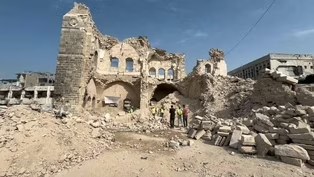
The 14th century Hamam al-Sammara, an Ottoman era bath house noted for its arched ceilings, marble floors and heated systems, now a pile of rocks.
The Khan Yunis Caravanserai, a medieval gathering hub for merchants from around the world, reduced to rubble.
And the Pasha Palace in Gaza City, first built in the mid-13th century, a seat of power during the Mamluk and Ottoman periods.
Today, it's a shell of its past glory, a historic structure reduced to rubble.
It used to serve as a museum of history in Gaza and housed thousands of rare artifacts.
Now local archaeologists are undertaking the impossible task of recovery.
They told the "News Hour" that so far, out of 17,000 precious artifacts, just 20 have been found in the rubble.
HAMOUDA AL-DAHDAR, General Director, Pasha Palace Restoration Project (through translator): Most of the artifacts were bulldozed and stolen inside those rooms.
Of course, the extent of the destruction is more than 70 percent of the area of the place, but now we are striving to restore this place to the way it was more than before.
MAHMOUD HAWARI: I hope that this cease-fire holds for some time, so that archaeologists can make an informed assessment of the real damage on the ground.
But the decimation of archaeological and historical buildings is staggering, and we will have to grapple with for many generations to come.
JEFFREY BROWN: Beyond heritage sites, Gaza's modern cultural ecosystem, universities, libraries, galleries, studios, art schools, has been nearly wiped out.
A recent report by PEN America, an advocacy organization promoting free expression around the world, documents the destruction or heavy damage to 36 major cultural, educational and heritage sites.
PEN America concludes that many of the sites appear to have been deliberately targeted, in breach of international law protecting cultural property.
In a statement to "News Hour," the Israel Defense Forces said Hamas stores weapons inside civilian buildings and that -- quote - - "Sites of cultural heritage and locations of historical and cultural significance are treated with the utmost sensitivity by the IDF."
Meanwhile, for contemporary artists who've survived the war, the destruction is deeply personal.
SHAREEF SARHAN, Gazan Artist (through translator): Me and all my colleagues around me, we lost thousands of our artworks because of the laws of either our studios or our houses.
JEFFREY BROWN: In Madrid, Spain, far from the ruins of Gaza City, artist Shareef Sarhan lives in exile.
SHAREEF SARHAN (through translator): No artist hasn't experienced loss of art.
We all also experience loss and suffering from the conditions we are living in.
Therefore, this is a case of two losses, the loss of family or loved ones, and the loss of the artist's soul, his work and his art.
JEFFREY BROWN: In addition to making his own work, Sarhan ran the Shababeek Gallery that once held nearly 1,000 artworks, a heartbeat of Gaza's contemporary art scene.
One Israeli airstrike in October 2023 erased a generation's creed of archive.
Yet Sarhan insists Gaza's memory should not be reduced to rubble and suffering.
We don't hear too much about Gaza's culture or art.
What should you want -- what do you want people to know?
How rich is that culture?
How varied is it?
SHAREEF SARHAN (through translator): Here are two images of Gaza.
The first image is always known in the media, which is that of war, destruction, siege and suffering that people go through.
And the second image is a beautiful Gaza, a Gaza that has hope, love and art.
And no one talks about this image that is always in Gaza.
JEFFREY BROWN: Before the war, Sarhan built one of Gaza's most iconic public artworks, the Gaza Lighthouse installation crafted from concrete, metal and remnants of earlier conflicts, it too destroyed in this war.
SHAREEF SARHAN (through translator): This work has become over the years a symbol of beauty and freedom in Gaza.
Many people took pictures of it, as if it had become Gaza's monument.
MAI EL-SHAER, Artist: Imagine you live all your life there in place, your school, your childhood, your friends, your family, everything.
And suddenly it's completely destroyed.
It's completely gone.
JEFFREY BROWN: In Cape Town, South Africa, 23-year-old artist Mai El-Shaer carries her own fragments of loss from her hometown of Rafah.
In her new exhibition in exile called Violet Dreams, Mai captures the dual pain of what's lost and the uncertainty of where to go from here.
MAI EL-SHAER, Gazan Artist: Between what's going now in my country and for my people and what I'm facing now in a new place that I have to survive in, and start from scratch.
JEFFREY BROWN: Mae first fled Gaza for Egypt, where she worked with children from Gaza.
MAI EL-SHAER: When I went to Egypt, I just stopped doing anything, literally anything.
I couldn't even paint because I was really, really stuck in survival guilt.
And then I met these children, and I was like, at least they make me feel like I have to survive because of them.
After all of these things, I tried to -- back to paint again step by step.
I just felt again that I deserve to live.
JEFFREY BROWN: For Mae and others, Palestinian art is a form of record-keeping and resistance, a way to insist that behind the statistics are human beings.
MAI EL-SHAER: I want to speak about Palestine and the people that I know.
I don't want just to stay silent, because they deserve to live.
They deserve that people remember them.
They are not just the numbers.
People have to see them.
JEFFREY BROWN: For his part, artist Shareef Sarhan looks forward to rebuilding one day.
SHAREEF SARHAN (through translator): I feel hopeful.
Without hope, I can't live.
You always have to feel hopeful to have a good future.
Maybe sometimes you feel a little depressed, but hope is what propels you to have a good future.
So I am always hopeful.
JEFFREY BROWN: For the "PBS News Hour," I'm Jeffrey Brown.
NICK SCHIFRIN: Hope for a better future.
And that's the "News Hour" for tonight.
I'm Nick Schifrin.
On behalf of the entire "News Hour" team, I hope you had a good day.
Have a good night.
Thank you for joining us.
Artists hope to preserve, rebuild Gaza’s cultural heritage
Video has Closed Captions
Clip: 12/30/2025 | 9m 40s | Artists hope to preserve and rebuild Gaza’s cultural heritage (9m 40s)

Federal agents probe Minnesota child care fund allegations
Video has Closed Captions
Clip: 12/30/2025 | 6m 46s | Federal agents probe fraud allegations targeting Somali child care providers in Minnesota (6m 46s)

How Kharkiv preserves faith and culture under Russia's siege
Video has Closed Captions
Clip: 12/30/2025 | 4m 49s | How Kharkiv keeps faith and culture alive as Russia's siege continues (4m 49s)
How retirements and redistricting could impact the midterms
Video has Closed Captions
Clip: 12/30/2025 | 5m 5s | How retirements and redistricting could impact the 2026 midterms (5m 5s)

Inside Rocket Lab's effort to outpace larger space rivals
Video has Closed Captions
Clip: 12/30/2025 | 8m 39s | Inside Rocket Lab's effort to outpace larger space rivals (8m 39s)
News Wrap: More artists cancel Kennedy Center shows
Video has Closed Captions
Clip: 12/30/2025 | 5m 39s | News Wrap: More artists cancel Kennedy Center shows after Trump's name added to building (5m 39s)

U.S. increases pressure on Maduro with Venezuela strike
Video has Closed Captions
Clip: 12/30/2025 | 5m 1s | With strike inside Venezuela, U.S. increases pressure on Maduro regime (5m 1s)
U.S. unveils new plan for delivering humanitarian aid
Video has Closed Captions
Clip: 12/30/2025 | 7m 1s | U.S. unveils new plan for humanitarian aid after pausing contributions earlier this year (7m 1s)
Providing Support for PBS.org
Learn Moreabout PBS online sponsorship
- News and Public Affairs

FRONTLINE is investigative journalism that questions, explains and changes our world.

- News and Public Affairs

Today's top journalists discuss Washington's current political events and public affairs.











Support for PBS provided by:
Major corporate funding for the PBS News Hour is provided by BDO, BNSF, Consumer Cellular, American Cruise Lines, and Raymond James. Funding for the PBS NewsHour Weekend is provided by...