
How Eating Plants Shaped Life on Land | Life and Death on Pangea
The first herbivorous vertebrates evolve on the side of the amniote family tree leading to mammals.
From
How Eating Plants Shaped Life on Land | Life and Death on Pangea
Season 9 Episode 2 | 25m 37sVideo has Closed Captions
The first herbivorous vertebrates evolve on the side of the amniote family tree leading to mammals.
The first herbivorous vertebrates evolve on the side of the amniote family tree leading to mammals. Alongside them come apex predators, like Dimetrodon. But the Early Permian Period ends in a mystery: is it an extinction event or just a fossil gap?
From
Problems playing video? | Closed Captioning Feedback
Problems playing video? | Closed Captioning Feedback
How Eating Plants Shaped Life on Land | Life and Death on Pangea
Season 9 Episode 2 | 25m 37sVideo has Closed Captions
The first herbivorous vertebrates evolve on the side of the amniote family tree leading to mammals. Alongside them come apex predators, like Dimetrodon. But the Early Permian Period ends in a mystery: is it an extinction event or just a fossil gap?
From
Problems playing video? | Closed Captioning Feedback
Where to Watch Eons
Eons is available to stream on pbs.org and the PBS app.
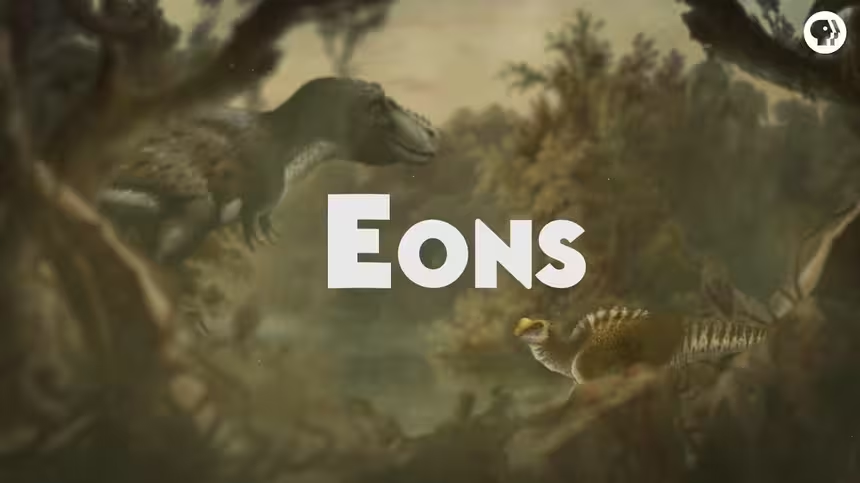
Welcome to Eons!
Join hosts Michelle Barboza-Ramirez, Kallie Moore, and Blake de Pastino as they take you on a journey through the history of life on Earth. From the dawn of life in the Archaean Eon through the Mesozoic Era — the so-called “Age of Dinosaurs” -- right up to the end of the most recent Ice Age.Providing Support for PBS.org
Learn Moreabout PBS online sponsorship♪ Kallie Moore: Around 300 million years ago, at the dawn of the Permian Period, life on the newly-formed supercontinent of Pangaea was in the throes of an ecological revolution.
A lifestyle that had never existed before invertebrates emerged-- one that's been extremely common ever since: herbivory.
[Elephant trumpets] Now, it feels hard to imagine life on land without plant-eaters.
Herbivores eating plants and then carnivores eating the herbivores seems like such a foundational part of how ecosystems work that it must be a tale as old as time, right?
Well, actually, no.
Just like every other complex behavior, eating plants had to start at some point.
♪ Michelle Barboza-Ramirez: The early evolutionary experiments in herbivory probably began just before the Permian did, in the swamps of the Late Carboniferous Period.
And by the Early Permian, just a few million years later, it had become clear that these experiments were a resounding success.
Plant eating was spreading fast.
♪ One of the first big herbivores to ever live on land was Edaphosaurus.
Now, Edaphosaurus may look like some kind of strangely-built proto-dinosaur, but it's actually more closely related to you and me than to any dino or any other kind of reptile.
It belonged to a group informally known as pelycosaurs that exploded in diversity as the Late Carboniferous transitioned into the Early Permian.
♪ Gabriel-Philip Santos: By some estimates, pelycosaurs represent around 70% of all known amniotes from this time, far outnumbering the early reptiles on the sauropsid side of the family tree.
Long before the era of the dinosaurs, when the reptile side would rise to ecological prominence, the Early Permian saw the mammal side reign over the land.
And herbivores like Edaphosaurus were ecological pioneers.
From their time onwards, wherever there were a lot of plants around on land, there were species that made a living by eating them.
♪ Kallie: The first herbivores from the era of ancient life left an ecological legacy that has stood the test of time, but many of the species themselves would not.
Michelle: Because the Early Permian would end with most of the pelycosaurs vanishing under mysterious circumstances and a new group rising to replace them.
This drastic evolutionary shift would be a major milestone in the story of our ancient proto-mammal ancestors, marking another step towards us true mammals.
Oh, my heavens!
This is a baby Dimetrodon toe.
Shut the front door.
[Laughter] Michelle: Ah!
But this shift would also come to be known as one of the Period's biggest enigmas, too, because right around this pivotal moment in our evolutionary history, the fossil record suddenly goes dark.
♪ [Growling] ♪ Gabriel: The basic structure of modern terrestrial ecosystems is often depicted as a simple pyramid.
Plants are at the base, with the herbivores who feed on the plants one step up from there.
Above them are carnivores who feed mostly on the herbivores, as well as on each other, sometimes.
Finally, you have apex predators who sit right at the peak with no one above them, and who eat, well, whoever they want.
But this "classic" food chain structure didn't emerge all at once, and it hasn't always been the ecological rule.
♪ Instead, it developed in phases over hundreds of millions of years, only coming together fully in the Early Permian Period, just under 300 million years ago.
Because, while we take it for granted today, this kind of multi-layered food chain is actually really complex, and a whole lot had to happen for it to form.
First, plants had to colonize the land, which they did by at least 470 million years ago, in the Ordovician Period.
Then, animals had to follow.
Invertebrates were the first animals to make the jump, becoming established on land by the Silurian Period, more than 420 million years ago.
But they probably weren't eating much living plant material in those days-- they were carnivores who hunted and scavenged and/or detritivores who fed on dead, decomposing biomass.
Even when the early four-legged amphibious vertebrates began to crawl out of the water around 375 million years ago in the Late Devonian Period, they too had a basically all-meat diet.
And through most of the Carboniferous Period that followed, the dominant amphibians that flourished in the tropical swamps still lived in this dog-eat-dog world-- or frog-eat-frog world, if you will.
But as the Carboniferous came to a close and gave way to the Early Permian, herbivory suddenly exploded onto the scene.
Blake de Pastino: We're in Seymour, Texas, in North Central Texas, not far off from the Oklahoma border.
These towns tend to have these small museums that most folks outside of, say, the county, don't know about.
But you see the exhibits, and you get a taste of, like, what the local natural history is.
The Whiteside is unique, because it is the place-- in North America, at least-- where you can get hands-on encounters with the Permian Period and discover your connection to it.
Help me understand-- that's what I'm wondering about-- is, like, how does a group of organisms acquire the ability to digest plant material and make a living off of it?
So, in the Early Permian, even in the Late Carboniferous, we see this ecological arms race happening, where we see conifers starting to appear, and then as these conifers are exploding, animals start to develop adaptations to be able to process these new plants.
♪ Blake: About 300 million years ago, early terrestrial animals began eating living leaves, roots, and seeds, changing the ecological game forever.
Herbivory evolved independently in multiple lineages around this same time and with some similar evolutionary effects on the species themselves because a carnivore can't just wake up one morning and start eating plants full-time.
If you're a meat-eater, you're shedding teeth, so they lose their teeth when feeding.
So, if you're a plant-eater, having teeth fall out of your mouth is not gonna help you when you're chewing up conifers and roots and things like that.
So, animals that are herbivores start to develop these really deep-rooted teeth that are thicker enamel, stronger, so that they can adapt to eating thicker things and not lose their teeth consistently.
Blake: Several of the earliest herbivore lineages developed much bigger and wider barrel-shaped bodies as they made the switch to a plant-based diet, like our pelycosaur friend Edaphosaurus, for example.
Their expanded guts house trillions of symbiotic microbes that help them break down the otherwise indigestible parts of their food, like cellulose, which makes up part of the cell walls of plants.
Now, the fossil record can't directly tell us how exactly the ancestors of these ancient animals independently gained their microbial partners, but scientists have a few ideas.
Animal species that foraged in dead organic matter would have regularly ingested microbes that were breaking down plant litter, and some of these microbes could have survived in their guts, eventually putting their cellulose-digesting skills to work for the benefit of their animal hosts.
And animal species that fed on insects could also have acquired their cellulose-digesting microbes from the guts of insects that they ate.
However it happened, this partnership got started multiple times in multiple vertebrate lineages in the Late Carboniferous, giving them a boost on their journey toward a fully vegetarian lifestyle.
Kallie: And developing a huge gut to use as a bacterial fermentation chamber is an adaptation that many big land herbivores have repeatedly evolved ever since, to squeeze all the nutrients they can out of a plant-based diet.
Think Triceratops in the Mesozoic, or bison and rhinos today.
Blake: And Edaphosaurus wasn't alone in ballooning up around this time, as his ancestors made the switch from eating meat-- like insects--to plants.
Many other vertebrate lineages also started living large on land, as they independently transitioned to herbivory.
These included Cotylorhynchus, which was another pelycosaur from the synapsid side of the family tree that belonged to a different subgroup called the caseids.
Caseids like Cotylorhynchus made the switch to herbivory independently from their edaphosaurid cousins, but the two pelycosaur lineages developed some similar traits along the way, like big, sprawling, barrel-shaped bodies with relatively tiny heads.
Beyond just pelycosaurs, another early herbivore called Diadectes is also known from this period, filling a similar niche.
But while these earliest herbivores converged on some similar physical traits, like becoming big and bulky, they also evolved some totally different ones on their independent journeys toward vegetarian life.
♪ Take their teeth, for example.
Edaphosaurus had dense clusters of peg-like teeth both in the lower jaw and on the roof of their mouth, called dental batteries.
We can tell from the amount of wear on its teeth that it was using them to grind and crush plant material and continually replacing them over the course of its life.
But the leaf-shaped teeth of Cotylorhynchus show a completely different dental setup.
Instead of massive dental batteries, it had fewer teeth that show no signs of wear from contact with each other, and they don't seem to have been regularly replaced either.
Rather than crushing and grinding plant material between rows and clusters of cheap, replaceable teeth, Cotylorhynchus must have been doing something very different.
Some scientists think that, after cropping off a mouthful of plant material, it used a big, tough tongue to press the food up against several large and slender teeth on the roof of its mouth, which broke it up enough for digestion.
And other lineages of early herbivores from this time also had their own unique combination of dental adaptations.
There's no one single way of being an herbivore, after all.
And different lineages found themselves evolving different solutions to similar problems, as they made the transition.
This is one of the most famous bonebeds in the entire world.
This is the world-famous Craddock Bonebed.
Evolutionarily, this is essentially where your roots come from as mammals.
This is an episode in the history of life that will have deep ramifications for all land dominant animals from here on out.
Everything we know about land dominance is because of the critters that you guys are going to be digging today.
It's a pretty amazing place.
♪ Michelle: So, life on land had gained its first big plant-munching herbivores that now roam the Early Permian landscape, including right here, in what are now the Red Beds of Texas, and which have been a feature of our planet in some form or another ever since.
But alongside them evolved another link in the food chain.
Earth's first large terrestrial apex predators had arrived.
They were also pelycosaurs, but their ancestors had remained meat-eaters, growing in size in parallel with their newly herbivorous edaphosaurid and caseid cousins.
And perhaps the most iconic of these was Dimetrodon.
Chris: Crazy to think that this is, you know-- when you think about Permian and Dimetrodons, wherever you are in the world, if you see a Dimetrodon skeleton in a museum, there's a good chance it came from right here.
Wow, that's incredible.
Michelle: Dimetrodon is the world's first-known fully terrestrial carnivore to fill the role of apex predator, the first to rise to the very top of the new complex food chain that had emerged on land.
So, today, we are at the Craddock Bonebeds.
This is an amazing field site that I'm so excited we got to come visit.
You're looking at this stuff that is hundreds of millions of years old, weathering out of the side of a rock, a rock that tells you what environment you're in, and bones that tell you what animals were in that environment.
It's--it's time travel, right?
Geologists, we say that when you're looking at the rocks, when you're looking at stratigraphy, you can read them like chapters of a book.
All of a sudden, you get to see the world not just as it is now, but as it has been throughout eons and as it might be in the future.
And being able to connect to that, just--it's unlocking all these new layers to the world that I live in.
One of the things I was going to ask, like, one of the things I find really just kind of compelling and fun about paleontology is just, like, the farther down you dig, typically, the farther back in time you go.
So, where in time are we, between, like, that hilltop and here?
Chris: Yeah.
So we're Lower Clear Fork, which is Lower Permian, roughly 287 million years ago.
So, 287 million years, we're, you know, reaching the apex of size for Dimetrodon.
So, Dimetrodons have been around for about 20 million years now, and their sizes have been getting bigger over the course of the last 15, 20 million years.
And in the Lower Clear Fork where you guys are, we're at the last breath of Dimetrodon.
So, we are seeing the last big push of Dimetrodon.
They get to their biggest size.
We see Dimetrodon grandis, which is the largest, and then, you know, wait about 10 million years, and, you know, they're all gone.
So, this is the last act.
Michelle: This is their peak.
Blake: Wow.
Oh, my gosh!
Ahh!
[Michelle laughs] What did you find?
I don't know, a tiny little-- something diagnostic.
Holly Simon: Y'all, you got a toe bone.
Chris: This is a ba-- a baby Dimetrodon toe.
Shut the front door.
[Laughter] Ah!
What?!
Blake: That's awesome.
Chris: So, that's a little toe.
We love toes.
Wow.
We love toes.
I love toes now too.
[Laughter] ♪ Well, unlike my co-hosts and colleagues, I'm not a scientist.
My background is in science writing, science journalism.
Most science writers would tell you that we do what we do out of an abiding curiosity about the world, and that's probably the case for me.
I am not a skilled fossil hunter.
[Laughter] [Michelle laughs] Blake: I don't have those kinds of eyes, but my colleagues do.
When I go on a dig with them, it's humbling how easily they find fossils.
Chris: It's most likely a Dimetrodon rib.
My first Permian bone was a Dimetrodon?
Yep, absolutely.
The very first thing you found was Dimetrodon.
So, the caliche rind on this tells you, you know-- There's another one.
Wow, they really are just everywhere.
And once MB and Chris started finding fossils, then I kind of picked up on what I was looking for.
And then you realize how many there are.
And you can see the details.
You can see the porosity of the bones, you know?
Michelle: Oh, yeah.
[Laughs] Chris: This is important.
Permian is important.
You've got to take care of the Permian bones.
[Lisping] Fossils stick.
Rocks don't stick.
Blake: And by the end of the day, I was able to tell, generally, what part of the Dimetrodon this fossil was from.
And that was impressive, considering that, like, at the beginning of the day, I didn't know a bone from a stick.
That's a claw.
That's a Dimetrodon claw.
Ooh, yeah, look at that.
Chh.
That is a killing claw.
They've only been on the planet for 20 million years, and they've already evolved claws that can do everything they need it to in a matter of seconds.
Blake: Wow.
Holly: Super cool.
Blake: And I found it.
[Laughter] That's right.
Holly: Yeah.
Amazing--amazing job.
Chris: You're the one that picked it up first, so... Michelle: It was the T-Rex or the tiger of its time.
And just like with the earliest herbivores, Dimetrodon moving into a new, groundbreaking ecological niche came with some radical physical adaptations.
Dimetrodon developed a big, powerful skull with deep jaws lined with multiple types of teeth adapted for different aspects of its predatory lifestyle.
These included large, sharp canines for striking and stabbing prey, as well as shearing teeth for slicing meat into digestible chunks.
Having differentiated teeth is a trait found in many modern and ancient animals, but this was yet another innovation that first appeared in Dimetrodon and its relatives.
The differences in these teeth aren't as obvious as they are in carnivorous mammals today, but they had to start somewhere.
♪ So, for the past couple of weeks, we've been slowly digging this shelf, and Holly's been finding some incredible skeletons and parts of bones, and so, we just need to expand that shelf a little bit more, and what's so lovely about digging in Permian clays is that it's very easy to dig, which makes it easy to expose bones very quickly.
So, we're gonna expand this shelf and find some more incredible stuff and see what you guys come up with.
Wow, okay, here it goes.
Oh, it is a huge bone.
Geez, yep, it's still going, which is exciting.
Chris: What...?
What is it?
It's a joint.
Oh, man, that looks like a tooth-socket.
Oh, that is a tooth-socket.
Holy shoot!
[Michelle laughs] That's a skull.
Holy crap.
Oh, my God.
Look at that, that's a tooth-socket.
Yeah.
Oh, geez, that's a big skull.
You've been digging Permian for 4 minutes, and you found a Dimetrodon skull.
It's amazing how fossiliferous this site is-- and that's a real word, by the way, "fossiliferous."
It's just, like, chock full of stuff.
There's a rib here in front of a spine there, in front of a skull there.
It's fantastic.
And the mudstone is kind of crumbling away.
It makes it really easy to get at the bones and dig through them.
Mudstone is a type of rock that forms from, as the name would have it, mud, which means that it's in a really gentle sort of environment.
I mean, think about where you would find mud when you're out in the world today, right?
You're by a lake bed, you're in areas where there's not a lot of energy.
And for fossils, that's amazing.
That means you don't have big waves or anything that's gonna come and disturb these corpses that are left behind that we can find 300 million years later as fossils.
So, can you tell me more about Dimetrodon's role in the ecosystem here?
The food pyramid, he's obviously the king.
He eats everything and anything.
He's just recycling all the organisms in this ecosystem, putting it back into the ecosystem.
So, ultimately, you know, his role here is to keep the population down.
You know, you're population control.
Michelle: The Early Permian saw an array of pelycosaurs, living different kinds of lifestyles, dominate the landscape and flourish within the ecological revolution that was unfolding.
But as this time came to a close around 273 million years ago, their reign ended under suspicious circumstances.
Chris: Dimetrodon goes extinct right at the end of the Early Permian, along with Edaphosaurus and Diadectes.
There's a gap.
♪ Michelle: The fossil record of land animals seems to go virtually blank for about 5 million years.
And when it picks back up in the Middle Permian, most of the once abundant pelycosaurs have disappeared.
In their place is a new, thriving group of synapsids called the therapsids.
Therapsids evolved from a lineage of pelycosaurs that seemed to have emerged diversified and taken over ecosystems during those 5 million years, while almost all of the older pelycosaur lineages vanished.
And this turnover was a crucial plot twist in the story of the rise of mammals later on, because therapsids had a host of new traits compared to their pelycosaur ancestors and relatives.
Therapsids were often faster and more agile, with their legs positioned more directly under their bodies and less sprawled at their sides, giving them a greater range of motion than their pelycosaur ancestors.
Their skulls had changed too, becoming stronger and more robust, with teeth that were increasingly specialized for different roles.
They may even have had better hearing, a more sensitive sense of smell, and a faster growth rate.
With Dimetrodon, it's all about the jaw joints, and so, jaw joints are extremely important at this point.
With the therapsids, something interesting is really happening.
These joints are starting to shrink, and those joints are going to move up into the back of the skull and turn into the eardrum.
So, once you start to shrink those jaw joints back here, you're making room up here, which means you're getting a bigger brain.
So, with your brain getting larger, your joints getting smaller and moving into your ears, you're adapting extremely quickly to the things that are happening around you.
You're not only becoming an apex predator, but you're redefining how you are becoming a predator.
In short, they were becoming increasingly mammal-like.
But how and why this transition from pelycosaurs to therapsids actually occurred has been a long-standing mystery in the field of paleontology.
♪ Gabriel: This void in the fossil record is known as Olson's Gap, after Everett C. Olson, the researcher who first proposed this ecological changeover.
And the debate over what it represents basically boils down to two competing ideas.
Hypothesis one is that Olson's Gap is the result of geological bad luck.
We are simply missing any good fossil sites that cover this chapter of time.
It's annoying, but it happens.
The problem is that our fossil sites from either side of the Gap also come from completely different places too.
The Early Permian fossil sites that record the reign of the pelycosaurs almost all come from North America and Western Europe, which, at the time, were at Pangea's equator, whereas the Middle Permian fossils, when the therapsids first show up, mostly come from higher latitude areas in what's now Russia and South Africa.
So, while the disappearance of the pelycosaur from the fossil record and the appearance of the therapsids might seem dramatic, under the Olson's Gap scenario, this could just be because our fossil record shifts to different environments in different places over the course of this time.
This gives the illusion of a stark shift, but perhaps we're just glimpsing fragments of a longer, more gradual and complex transition.
There's a lot of scientists out there that say there is no gap.
And there are a lot of scientists that say, yeah, there is a gap.
And it's all looking at the different fossil records all over the world.
In hypothesis two, Olson's Gap should really be thought of as "Olson's Extinction."
According to this idea, the global shift in life on land observed between the Early and Middle Permian isn't just a result of sampling bias.
It actually represents a genuine mass extinction that caused a global turnover in terrestrial animal life.
Paleontologists are still debating whether the gap or the extinction hypothesis has more support, but we do have a chance at solving this mystery, at least.
With more digging and more discoveries in places that have historically been undersampled, we may yet turn up fossils that end up filling the Gap.
♪ A good rule of thumb is, when you see a bone in the side of a hill, like this... Stop digging.
Right.
You don't want to dig underneath of the bone, because it could collapse and fall out of the wall.
So, a good rule of thumb is we want to dig on top of the bone, so we can uncover it before we take it out.
Blake: When I came here, I understood the science behind what we were doing here.
I had written and read about the Permian.
I knew what had happened there, so I understood it in sort of an abstract, cognitive sense.
But what I didn't know what to expect was the experience of actually going on a dig in the Permian, which I've never encountered before.
I've never had the opportunity to do this before.
And I got to hold in my hand the bones of what seems like my most direct terrestrial ancestor, right?
Like, the animal that conquered land, figured out how to make a living on land and become an apex predator.
And, like, I am related to this organism.
And that is something I've never experienced before.
The other thing that never gets old is, like, I'm holding part of an animal that lived a quarter of a billion years ago.
And you are the first human beings to ever see these bones, you know?
Hey, man.
[Laughs] There's 7-plus billion people on the planet, and you're the first ones in this entire population on Earth to see these bones.
So, the Early Permian Period was a time of firsts for planet Earth.
Life on the supercontinent of Pangaea gained its first big herbivores, its first big apex predators, and a new ecological framework that's stuck around ever since.
And Permian life may have even faced its first major challenge too.
But out of it emerged the therapsids.
And while the origins of the therapsids may be blurry and mysterious, the rest of their story through the Permian is a tale of enormous ecological success, diversification, and evolutionary innovation.
And it's a story that, in a sense, is still unfolding to this day through the last surviving therapsid lineage-- us mammals.
But many twists and turns were still in store for these early therapsids in the Middle Permian Period.
They were about to enter a golden age, but at the Permian's end, they, along with every other living thing on Earth, would have to face and survive the most severe mass extinction of all time.
♪ ♪ "Eons" "Life and Death on Pangea" is available on Amazon Prime video ♪















Support for PBS provided by: