WCNY Specials
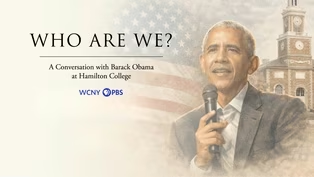
Who Are We? A Conversation with Barack Obama at Hamilton College
Preview | 56m 51sVideo has Closed Captions
Former President Barack Obama told an audience in upstate New York that he had a few things to say.
Former President Barack Obama waited 72 days into the second term of President Donald Trump before commenting publicly on the actions of the new administration. In a talk at Hamilton College, a small liberal arts school in upstate New York, Obama told the audience he had a few things to say.
Problems playing video? | Closed Captioning Feedback
Problems playing video? | Closed Captioning Feedback
WCNY Specials is a local public television program presented by WCNY
WCNY Specials
Who Are We? A Conversation with Barack Obama at Hamilton College
Preview | 56m 51sVideo has Closed Captions
Former President Barack Obama waited 72 days into the second term of President Donald Trump before commenting publicly on the actions of the new administration. In a talk at Hamilton College, a small liberal arts school in upstate New York, Obama told the audience he had a few things to say.
Problems playing video? | Closed Captioning Feedback
How to Watch WCNY Specials
WCNY Specials is available to stream on pbs.org and the free PBS App, available on iPhone, Apple TV, Android TV, Android smartphones, Amazon Fire TV, Amazon Fire Tablet, Roku, Samsung Smart TV, and Vizio.
Congratulations, Mr.
President.
[ Applause ].
>> PRES.
TRUMP: The golden age of America begins right now.
[ Applause ].
Today I will sign a series of historic executive orders... STEVEN TEPPER: A little more than two months after Donald J. Trump began his second term as president of the United States, a former president, Barack Obama came to a small town in upstate New York to have a conversation with the college president.
Earlier that day, the Trump administration had imposed sweeping tariffs.
PRES.
TRUMP: In other words, they charge us, we charge them.
We charge them less, so how can anybody be upset?
STEVEN TEPPER: And the stock market had responded with its sharpest decline in four years.
Obama arrived at Hamilton College, far from the noise of Washington, D.C., and the turbulence of Wall Street for what was billed as a general talk with college president Steven Tepper in front of a largely student audience.
[ Applause ] PRES.
BARACK OBAMA: Thank you.
[ Applause ] Thank you, Hamilton.
Whoo!
Okay, I'm fired up.
>> It was incredibly exciting.
There's so much anticipation, so much buzz on campus and in the community.
No matter what side of the aisle you're on, I think the students see him as sort of, Michael Jordan of democracy.
I expected the conversation to be at a very high level, that we would talk about his foundation, that we were talking about leadership in this moment, that it would feel a little bit more like a commencement, you know, set of remarks trying to inspire our students.
And of course, it had elements of that, but the remarks went further and deeper than I think I could have imagined.
>> I think that's interesting that Obama chose to come to a small liberal arts college in upstate New York to have this conversation.
We're not a swing state.
This isn't that politically important place from that sense.
It's not a big research institution or university.
He chose not to give a speech, but rather have a conversation And I think to do so not in the kind of heated moment just in January of 2025, but a few months later, was an opportunity to be more reflective.
I think about presidential, voices, right, whether that's current presidents or ex-presidents, former president as carrying tremendous weight in defining not just the past, but also the present and sketching out, kind of laying out a vision of what America might be, right, who it might include where it might go from here, what the stakes are of, of, laying claim to that identity.
>> You think about some of these other presidential speeches.
It seems to me, what's always interesting is, that some of them really didn't register in the moment that they were delivered, right.
And so sometimes what's fascinating is how a speech gains importance or gains resonance in the years that followed.
STEVEN TEPPER: It's hard to understand the identity of an ever-changing America precisely because it's ever changing.
But there are sort of long standing, trajectories involved.
If we think about 250 years ago or the Constitution founding era, the nation, the people, the country, was established with sort of a ethos.
And one important part of it certainly, is precisely the sort of conversation, ongoing conversation about exactly who we are.
STEVEN TEPPER: It's a very noisy World where, you know, we're scrolling, doom scrolling every day, news headlines, and sometimes a leader has to step above that and focus our attention on what really matters, what is at stake.
PRES.
OBAMA: This is first time I've been speaking publicly for a while.
I've been watching a little bit.
[ dramatic music ] [ dramatic music ] [ dramatic music ] [ dramatic music ] [ dramatic music ].
STEVEN TEPPER: It appears that many people in this country have lost not only trust in government, but maybe even more importantly, the relevance of democratic norms that undergird our government.
Why has that happened?
Does it matter?
PRES.
OBAMA: Let me preface this by saying, what everybody knows, which is I have deep differences of opinion with my most immediate successor and who is now the president once again.
And so, there are a host of policies that we could be discussing where I have strong opinions.
At least for most of my lifetime, I'd say the post-World War II era, there was a broad consensus between Democrats, Republicans Conservatives.
Liberals, around a certain set of rules where we settle our differences, right.
That there are some bonds that transcend party or region or ideology.
That there was a creed that we all stuck to, and that basic notion of American democracy as embodied in our Constitution and our Bill of Rights said, all of us count, all of us have dignity, all of us have worth.
That we're going to set up a System in which there's rule of law and separation of powers and an independent judiciary, and there these freedoms, a freedom of speech and expression.
[Recording of Pres.
Franklin D. Roosevelt]: Freedom of every person to worship God in his own way.
Freedom from want.
Freedom from fear.
PRES.
OBAMA: If we go before the law that there will be an impartial process to make decisions, and we all stuck to more or less.
We all said even though that ideal wasn't always observed, that that was the right ideal to have.
And I do believe that our commitment to those principles has eroded.
I think it eroded, in part, because the government itself got really big, and what that meant is sometimes it felt distant and unresponsive, and rules are a hassle.
Some of the rules aren't smart, and people get frustrated.
I think part of what happened also is -- is that it's easier to observe it's easier to agree to disagree and have forbearance to people who you don't agree with if they all sort of look like you.
And now it's a little harder to agree to disagree without being disagreeable if your sense is that person isn't like me, doesn't look like me, maybe doesn't think exactly the way I think.
I'm more prone to feeling attacked or threatened.
And so that I think changed -- it made us a little more tribal in our politics.
And then the economy wasn't working for everybody.
Now, that in part, had to do with the fact that government wasn't as responsive as it should have been and inequality grew.
And then finally, media.
I think one of the most important aspects of our democratic practice is having a well-informed citizenry which is reliant on a free, objective, effective press.
And that started getting attacked.
So you combine all those factors together, and we saw it over the course of decades.
But obviously it's gotten a lot worse now.
And when I watch some of what's going on now, it does not -- look, I don't think, what we just witnessed in terms of economic policy and tariffs is going to be good for America, but that's a specific policy.
I'm more deeply concerned with a federal government that threatens universities if they don't give up students who are exercising their right to free speech.
[ Applause ] I am more troubled -- the idea that a White House can say to law firms, if you represent parties that we don't like, we're going to pull all our business or bar you from representing people effectively, behavior is contrary to the basic compact we have as Americans.
Imagine if I had done any of this.
Like, let me just, I just want to be clear about this.
Imagine that.
Imagine if I had pulled Fox News' credentials from the White House press corps.
You're laughing, but this is what's happening.
Imagine if I had said to law firms that were representing parties that were upset with policies my administration had initiated, that you will not be allowed into government buildings.
We will punish you economically for dissenting from the Affordable Care Act or the Iran deal.
We will ferret out students who protest against my policies.
It's unimaginable that the same parties that are silent now would have tolerated behavior like that from me, or a whole bunch of my predecessors.
[ Applause ] So -- and I say this, I say this not on a partisan basis.
This has to do with something more precious, which is, who are we as a country and what values do we stand for?
[Recording of Ronald Reagan] Ours was the first revolution in the history of mankind that truly reversed the course of government.
And with three little words, "We the People" We the people tell the government what to do.
It doesn't tell us.
We the people are the driver, the government is the car.
And we decide where it should go and by what route and how fast.
STEVEN TEPPER: Reagan's observation that it in our system it really is the people that drive the car is certainly dead on.
The expectation from day one was that the people would be driving the car.
The car is constructed, perhaps before they get there, or on going the earlier generations.
And that structure dictates some of what you can do and how fast you can go and how quickly you can turn.
But it absolutely has to be, and has been, the people ultimately driving where we go, for better and for worse from day one.
PRES.
OBAMA: This is not just an abstraction, and I think this is one of the challenges that we have.
And I saw this even before the last election.
I think people tend to think, democracy, rule of law, independent judiciary, freedom of the press.
That's all abstract stuff, because it's not affecting the price of eggs.
Well, you know what?
It's about to affect the price of eggs.
One of the things that has distinguished us in the past has been this basic idea that we are a rules-based society.
What that means is that, you know what?
I can support one candidate instead of another, and I don't have to worry that the police are going to come harass me or my customers.
That's what happens in other places.
That's what happens in Russia.
We take for granted the idea that we don't have to pay bribes or hire somebody's cousin, in order to get a business permit.
That's how we built the economy we did.
That's why this place worked.
And it has very concrete impacts on all of our lives.
STEVEN TEPPER: What are those core things that we have believed in as America, that we have invested in, that we have worked for.
This is a moment to remember those things and to feel like we have to have the courage to defend those.
PRES.
OBAMA: Let me just close this portion of my remarks by saying it is up to all of us to fix this.
[ Applause ] It's not going to be because somebody comes and saves you.
The most important office in this democracy is the citizen, the ordinary person who says, no, that's not right.
STEVEN TEPPER: If you look at the course of history, individual people have made the difference over and over again.
It's the citizen.
And every one of us is a citizen, and every one of us has a responsibility to act as a citizen, whether that's voting or marching, or telling others the way we feel, the way we think, the way we act.
And so, I think that's the most important thing is that as citizens, we all have a responsibility in a democracy.
RECORDING OF JFK: And it is the responsibility of all citizens in all sections of this country to respect the rights of others and respect the law of the land.
STEVEN TEPPER: A good friend of mine once said, we come a long way, and we have a long way to go.
I think that's partly what keeps me going as an American is that in times of difficulty, there rises up within the American people a hope to be better.
And I have that hope about America.
And I know lots of other people do, that whatever is going on in this country that we are lucky to be Americans.
so for 36 years I wore the blue uniform of a U.S.
Army soldier, and I believe in this country.
I fought for this country not because it's always right, but the because the promise of America is always there.
And that promise of America is still there today.
And I think President Obama talked about that promise of America, too, which is that we are not always right.
But on the whole, we become more right over time.
America can make a claim that we become more right over time.
Precisely because, and only because we keep questioning whether we're right.
[ RECORDING OF FRANKLIN D. ROOSEVELT]: Since the beginning of our American history, we have been engaged in change in a perpetual, peaceful revolution, a revolution which goes on steadily, quietly adjusting itself to changing conditions without the concentration camp or the quicklime in the ditch.
PRES.
OBAMA: I do think one of the reasons that our commitment to democratic ideals has eroded is that we got pretty comfortable and complacent.
It has been easy during most of our lifetimes, to say you are a progressive or say you are for social justice or say you're for free speech and not have to pay a price for it.
And now we're at one of those moments where, you know what?
It's not enough just to say you're for something.
You may actually have to do something and possibly sacrifice a little bit.
So, yeah, if you're a law firm being threatened, you might have to say, okay, we will lose some business because we're going to stand for a principle.
[ Applause ] If you are a university, If you are a university, you may have to figure out, are we, in fact, doing things right?
Have we in fact violated, our own values, our own code violated the law in some fashion?
If not, and you're just being intimidated by you should be able to say, well, that's why we got this big endowment.
[ Applause ] We'll stand up for what we believe in, and then we'll pay our researchers for a while out of that endowment, and we'll give up the extra wing or the fancy gymnasium.
Yeah, we can delay that for a couple of years because, you know, academic freedom might be a little more important.
[RECORDING OF PRES.
EISENHOWER: May we be ever unswerving in devotion to principle.
Confident but humble with power.
Diligent in pursuit of the nation's great goals.
PRES.
OBAMA: For most of human history, and to this day, in most of places in the world, there is a cost to challenging the powers that be, particularly if they're abusing that power.
And I've noticed this among some wealthier folks who after George Floyd, they were right there and a bunch of companies were talking about how they cared about diversity, and they wanted to do this, and they were all for that.
And they are mute right now.
What that tells me is, it was okay when it was cool and trendy.
And when it's not, not so much at all.
And that, I think, is what we have to -- of us has to examine in our own hearts.
This is all right.
We say we're for equality.
Are we willing to fight for it?
Are we going to risk something for it?
We say that we're for rule of law.
Are we going to stick to that when it's tough, not when it's easy.
We believe in freedom of speech.
Do we stand up for freedom of speech when the other person talking is saying stuff that infuriates us and is wrong and hurtful, do we still believe in it?
And that for university students and for your generation, I think that's important because part of how we got confused around some of these issues is that those who claimed to be fighting on behalf of social justice and freedom of speech and equality, sometimes we didn't observe it ourselves.
I have been absolutely clear throughout my presidency post-presidency, the idea of canceling a speaker who comes to your campus, trying to shout them down and not letting them speak, even if I find their ideas obnoxious.
Well, not only is that not what Universities should be about, that's not what America should be about.
You let them speak, and then you tell them why they're wrong.
That's how you win the argument.
[ RECORDING OF Pres.
JOHN F. KENNEDY ] JR.
]: There are few earthly things more beautiful than a university, wrote John Masefield in his tribute to English universities, and his words are equally true today.
He did not refer to towers or to campuses.
He admired the splendid beauty of a university because it was, he said, a place where those who hate ignorance may strive to know; where those who perceive truth may strive to make others see.
PRES.
OBAMA: The delicacy of sensibilities in classrooms.
Michelle and I talk about this all the time.
Let me tell you, you will deal with people in the world who don't like you and say mean things about you.
You better get used to it.
Don't be in the classroom thinking I can't be triggered.
And then you get on the job.
You will have horrible bosses on occasion, or coworkers who say obnoxious things.
And it may turn out that in some cases, they're actually good people that just didn't use the right word for something or need to be educated on something.
Well, you need to get used to that here.
So some of these principles are ones in which it's not just one side or the other that hasn't been true to, I think, our founding principles.
I think in some cases, we've all been guilty of it, some more than others.
And it's important now for us to refocus our attention on who are we and what we believe.
>> I think what's really significant about the conversation that Obama had with President Tepper at Hamilton College on that evening is that he decided to take that opportunity to speak, not just give a speech about the current state of American politics but to engage in a conversation, in front of an audience, largely of students who had been children during his presidency, giving them a kind of strategy a set of guiding ideas for how they might survive the current moment or perhaps, that may be better put, would be to transform the current political moment.
STEVEN TEPPER: It's been eight years in office, eight years out of office, and polarization is at the highest level ever.
It seems like the partisan wedge just keeps digging in, getting deeper.
You talked about the norms in Washington, and but it also feels like that ability to see each other, to be curious about one another, has broken down beyond Washington.
What are the strategies for bridging those divides right now?
PRES.
OBAMA: Well, you mentioned the first one, which is just being curious and listening to other people and getting their stories and getting context.
Everybody's got a family member who says crazy stuff.
We don't just see them through that single lens, we also see the wonderful things that they can -- you may have an uncle who at Thanksgiving is just wacky, but is also that stand-up guy who helped you learn how to play hockey or is always there to haul people around, you know, during a snowstorm or is generous to a fault with his friends.
That's him too, and I think this relates to one of the contributors of polarization, but certainly it's not the entire cause, but it is an accelerant.
And that's what's happened with media.
When I started my presidential campaign, the two dominant social media platforms were Myspace and Meetup.
For those of you not familiar with Meetup the name of the platform kind of gives it away.
You actually meet up after you've contacted somebody.
So what would end up happening would be, let's say the Idahoans for Obama were hosting this first meeting in the church basement or someplace, and people would show up, and they'd look around the room and you'd have like a middle-aged Army veteran with a crew cut, and you'd have a black woman with a nose ring, and you'd have a mom with some kids in a stroller.
And it turned out that whatever your idea of an Obama supporter was, wasn't as neat and tidy as you thought.
But once you had a chance to sit down and meet them and have a conversation with them and heard their stories, not only did you get a new perspective about who Obama voters were, but you got a new perspective about who your neighbors were.
And then those people who met up, now they had to go knock on doors with people who were even more different.
So today, we have these siloed communities online that never meet, and all they're doing is reinforcing over and over again the ideas that everybody agrees with.
And anybody who strays from the orthodoxy or the dogma that exists online can be attacked, often viciously, because it's easier to go after somebody if you're not sitting with them face to face, and they might punch you in the nose.
Or at least look hurt, and it makes you embarrassed that you were such a jerk.
So, I say all this to say that the more we can encourage, I believe space, institutions, practices that just get people talking to each other and working together on something in the real world, the more likely we are to break down some of that polarization and rebuild trust and have a bunch of mediating institutions.
They used to do that, whether it's places of worship, churches, synagogues, mosques Unions, rotary clubs, bowling leagues.
A lot of the decline in those voluntary associations, mediating institutions because it's so much -- not even having to shop, I'm calling DoorDash.
You don't even have just the casual interaction with the person at the store that might give you some sense of, oh, that person who doesn't look like me isn't scary, actually.
You go to that church, oh, yeah, my kids in a little league too.
Those are the things that that pull us out of our isolation.
Obviously Covid made this worse.
Which is why we have to be that much more intentional and now trying to get back to that kind of interaction and being intentional about doing it.
STEVEN TEPPER: We will only be able to advance as a democracy if we get beyond social media, get beyond the very caricatures that we create, in short, snippets of text and images and instead, try to see the depth of every human.
Everybody has a relative who they care about.
Everybody has the same feelings of love and frustration and struggle and and aspiration, and that makes us all human, and we share this common journey.
And I think he was telling everybody open your eyes and your ears and ask questions and be curious and try to know someone beyond the surface.
[ RECORDING OF PRES.
JOHN F. KENNEDY, JR.
]: So let us not be blind to our differences, but let us also direct attention to our common interests and the means by which those differences can be resolved.
And if we cannot end now our differences, at least we can help make the world safe for diversity.
For in the final analysis, our most basic common link is that we all inhabit this small planet.
We all breathe the same air.
We all cherish our children's futures, and we are all mortal.
PRES.
OBAMA: I mentioned that after World War II, there was a consensus in this country around just the basics of democracy.
Even if we had disagreements on tax policy or abortion or what have you, there was an agreement in terms of how our societies and our politics needed to function.
One of the remarkable things about America is that we did the same to a great degree for the world.
I mean, all of you have grown up in an international order that was largely created by the United States and its allies after World War II, out of the carnage that destroyed Europe and destroyed much of Asia.
And it was so shocking that I think people pulled back and they said, all right, the United States, we're the most powerful country at this point, but a lot of our competitors are destroyed.
We were relatively protected, because of geography.
And so we'll set up a rules-based system internationally that allows for freedom of navigation and rules governing trade.
And we're going to have an alliance with Europe, including our former enemies, and in Asia, including our former enemies, because even though we are the most powerful country, we know that having seen what happened in World War II, we're better off if we can figure out how to get everybody to cooperate.
And this is an important moment because in the last two months, we have seen a U.S.
government actively try to destroy that order and discredit it.
And the thinking, I gather, is that somehow, since we are the strongest, we're going to be better off if we can just bully people into doing whatever we want and dictate the terms of trade all the time.
And if we see a piece of land we like, who's going to stop us; Greenland looks good.
And what that doesn't seem to be registering right now in some of our decision makers is the fact that that was a huge force multiplier for us.
[ RECORDING OF Pres.
RONALD REAGAN: Adenauer Erhard,writer, and other leaders understood the practical importance of liberty that just as truth can flourish, only when the journalist is given freedom of speech, so prosperity can come about only when the farmer and businessmen enjoy economic freedom.
[ Applause ].
The German leaders reduced tariffs, expanded free trade, lowered taxes.
From 1950 to 1960 alone, the standard of living in West Germany and Berlin doubled PRES.
OBAMA: Even people who didn't like us and disagreed with us oftentimes went along with us because they said, you know what?
The system that's set up, it's actually helped us grow.
It helped China lift a billion people out of poverty.
It meant that if there was a pandemic or a disease like Ebola, that there was an international system to try to fix that.
And so, at the foundation, we've been getting leaders not just in the United States, but from every continent to practice this notion that if we all agree on certain core values of everybody's got dignity, everybody's got worth, rule of law is a good thing.
Sometimes it's in your self-interest to help people who have less than you, because they're less likely then to attack you or get sick and spread diseases that hit your kids and that cooperation, or at least competition that is based on some agreement about not blowing each other up, or invading each other, that that ultimately is going to be better for all of us.
[RECORDING OF PRES.
DWIGHT D. EISENHOWER]: During the long lane of the history yet to be written, America knows that this world of ours, ever growing smaller, must avoid becoming a community of dreadful fear and hate and be instead a proud confederation of mutual trust and respect.
Such a confederation must be one of equals.
The weakest must come to the conference table with the same confidence as do we, protected as we are by our moral, economic and military strength.
PRES.
OBAMA: I'm going to -- and I know we're going over time, but I like I said, I haven't spoke to people in a while now, I've been I've been writing.
[ Applause ] I think this other idea that might makes right, and the powerful bully the weak, and you grab what you can if nobody can stop you, that is sort of been the default rule for most of human history.
I mean, democracy is pretty recent in its vintage.
An international order where you cooperate instead of fight.
It's new, and so it's a little bit fragile.
So, it's not surprising that when things are disruptive and people get scared, and just in the same way that sometimes those who are running democratic institutions in the United States, didn't always do things right.
The same was true for how we manage international affairs.
Sometimes there were countries like China that did cheat on trade, and they needed to be dealt with.
You had to push back on that.
There were times where we did dumb things and did bully people despite our ideals or tried to reorganize entire countries in ways that were destined to fail.
But overall, this system we set up created the wealthiest, healthiest, most peaceful era in human history.
[ Applause ].
[ RECORDING OF PRES.
RONALD REAGAN: In the Philippines, in South and Central America, democracy has been given a rebirth throughout the Pacific.
Free markets are working miracle after miracle of economic growth in the industrialized nations, a technological revolution is taking place, a revolution marked by rapid dramatic advances in computers and telecommunications.
Today thus represents a moment of hope.
We in the West stand ready to cooperate with the East, to promote true openness, to break down barriers that separate people, to create a safer, freer world.
PRES.
OBAMA: There's a whole bunch of stuff we need to fix internationally in particular.
One of the challenges of globalization was the fact that it did accelerate inequality.
And it was very good for corporations that could operate internationally.
But they oftentimes weren't willing to share that bounty with their own populations.
And so the populations, if you're a worker in the United States and you saw, okay, I'm getting cheap flat screen TVs and I'm glad that the stock market is booming, but I was laid off my factory job.
We did not take care of those folks.
But that wasn't a problem of globalization per se, that was a failure of policy here in the United States to help that we didn't do enough to help people who weren't benefiting from globalization.
And that was a failure globally and a failure here in the United States.
That's going to need to be fixed.
But the main message that we try to impart on leaders in the foundation is that these values of cooperation and rule of law and an adherence to facts and hopefulness, optimism about the ability of humans to work together and solve their problems, and the belief that we are all God's children.
I know that these days, the idea of inclusion has somehow has been deemed illegal.
But you know what?
I believe in it.
[ Applause ].
I believe that people, regardless of their skin color or gender or sexual orientation or nationalities or how they worship God, that that they all have worth, and that I can communicate with them and cooperate with them.
Those values that we think are the values that are worth fighting for, and that will ultimately, lead to better outcomes.
And I guess there's one last quality, and this I do want to leave you with, that we've been talking a lot, particularly in this moment, to our leaders about, is resilience.
The rug in the Oval Office, each president gets to kind of design their own rug.
It's a weird custom, but is's nice.
[ Laughter ].
So, the rug on mine, I had a bunch of quotes that were stitched into the rim of the Oval rug, and one of them was a quote that that Dr.
King used.
He may not have it may not have originated with him, but that's a little bit unclear.
But he talks about "The arc of the moral universe is long, but it bends towards justice."
It obviously denotes optimism that things do get better.
There's a faith in that.
But people forget the first clause of it, which is the arc of the moral universe is long.
And what we talk about with our leaders, particularly young people, is a recognition that change does not happen overnight.
That history zigs and zags, that sometimes we take two steps forward, and then we take a step back.
> I think resilience is more than ability to pick yourself up when you've been knocked down.
STEVEN TEPPER: I think for Obama and his remarks, resilience is about having a long view and not overreacting in the moment.
We live in a moment where every single algorithm is designed to elicit immediate emotional and visceral reaction, right.
We talk about the triggers.
We talk about that language of being triggered.
Well, it's not, but it's not by accident, right?
We actually have designed a world where it's intended for us to get triggered, to have an emotional response, to have that thing that happens in your brain, because then you can capture someone's attention.
You can sell them something, you can manipulate.
I think for him, resilience is what we've always needed in the face of propaganda of one kind or another, which is to be able to take a long view, to be able to take a breath, to be able to recognize complexity, to have some intellectual humility.
That is what I heard from him when he was talking about resilience, and that, again, that sense that, change doesn't happen tomorrow.
You can't just be in favor of something because it's hip and cool and trendy.
You have to commit to it.
And if it's about equality, then it's not just a post-George Floyd moment.
It has to be it has to be long term.
Resilience is very much about your time frame.
And it's very much about the recognition that you can't allow every moment to be driven by an immediate emotional response.
[RECORDING OF PRES.
DWIGHT D. EISENHOWER]: As we peer into society's future, we, you and I, and our government, must avoid the impulse to live only for today, plundering for our own ease and convenience the precious resources of tomorrow.
We cannot mortgage the material assets of our grandchildren without risking the loss also of their political and spiritual heritage.
We want democracy to survive for all generations to come, not to become the insolvent family of tomorrow.
Usually, history zig and zags and goes up and down.
There are times of conflict, and there are times of stupidity, and there are times of danger.
And progress is slow, and it's hard.
And I guess the main message I have for all of you, which is we talk a lot about what with our leaders is, do not get discouraged because you don't fix everything all at once.
STEVEN TEPPER: We should remember that we are exactly starting the 250th anniversary of the American Revolution.
with the battles of Lexington.
Concord that happened 250 years ago.
This is a country born in violence with the American Revolution and a hugely violent, unbelievably terrible war.
If you are a citizen in New Jersey and South Carolina during this war, you are going to be upended or threatened with violence or actually had violence upon you.
So we have had a checkered history.
We have also not given freedom to many Americans throughout our past, but we have gotten better.
It is better to be a woman today than it was 75 years ago, 100 years ago, when women didn't have a vote.
Remember that 100 years ago, black Americans were being lynched regularly in the American South, and it wasn't a democracy.
>> Strictly speaking, we didn't really even live in a democracy until 1965 and the Voting Rights Act when a large portion of Americans were finally able to vote, Black men and women.
You can count on Americans, as Winston Churchill once said, to do the right thing after they've exhausted all other options.
In some sense, we can't know what the right direction is until sort of we have the perspective of history, and even then, it's up for debate.
It's up for debate right now.
What is our tradition?
What is our history?
How should we understand ourselves?
sort of ongoing effort to think and rethink about who we are.
And you can only tell from some kind of distance.
And it's not even up to individual historians or historians generally.
It has to be up to all of us.
Again, back to the 1780s and 90s, early Americans thought and were explicit that in some sense, what mattered was what posterity thought, what our progeny think three generations from now, we're like great grandchildren think of what we're doing and what we've done.
Can you feel good about the future?
Do you do you know what's going to happen coming into the future?
Well, we historians have a perfect track record of predicting the future.
We're always wrong, always wrong.
So the idea that you can predict the future with a million zillion different independent variables, you can't do it.
That's why it feels so stressful to all of us right now because we can't predict the future.
We don't know what's going to happen.
If you were thinking about you living in the Cold War and you're worried -- I remember doing duck and cover because we were worried about nuclear weapons falling on our head.
How stressful was that, incredibly stressful.
During World War II, after Pearl Harbor, we had no idea that we were going to win World War II or even how many people were going to were going to die doing it.
The Civil War several times came close to the good guys, the United States and United States Army losing that war.
You don't know what's going to happen, and that's why life is stressful because we can't predict it.
So I wish I could say we know It's going to come out all right, but I can't say that.
That's why I think what President Obama was saying is that all citizens have to act like citizens and vote and make your voice heard is so important because it could turn out differently.
[RECORDING OF PRES.
RONALD REAGAN]: As I looked at a moment ago from the Reichstag, that embodiment of German unity, I noticed words crudely spray-painted upon the wall, perhaps by a young Berliner "this wall will fall.
Beliefs become reality."
[ Applause ] [ Applause ] Yes, across Europe, this wall will fall.
For it cannot withstand faith.
It cannot withstand the truth.
The wall cannot withstand freedom.
PRES.
OBAMA: Understanding that if you work hard, you're still going to fail sometimes.
If you do the right thing, it's not always going to be rewarded.
You're going to be disappointed.
People are imperfect.
But it's worth trying.
But it's worth trying.
And if you try, not only do you usually end up getting better outcomes, but you're going to live a better life, and you're going to feel better about yourself, and you're going to find fellow travelers who share those values.
And that's as important as any of it.
STEVEN TEPPER: You don't sit down and watch a football game or a soccer game, knowing what the conclusion is, but you're still passionately cheering along your team.
I think that's where we are.
Like, we don't know where we're going to be.
We don't know what victory looks like.
But we have to recognize that we are a team, and we need to compete and it's a long game.
He said to our students, change doesn't happen tomorrow.
It's you have to be patient.
Sometimes it's one step forward and two steps back or two, ideally two steps forward and one step back.
I think from Obama always emanates a sense of hope.
I think from Obama always emanates a sense of hope.
And so even as he was very serious about the challenges to democratic norms, and again, he wasn't laying that at the footsteps of just the current administration.
I mean, he was talking about a larger thing happening in American politics and society where we've lost trust in our institutions.
We have lost patience with one another.
I think he was asking us to get beyond this moment and really start to work on rebuilding, recrafting, reimagining this democracy.
PRES.
OBAMA: So, yeah, don't get discouraged.
I know it's a little crazy right now, but we're going to be okay.
STEVEN TEPPER: Your hope continues to inspire.
[ Applause ] Can we give President Obama a big round of applause for joining us at the most important liberal arts college in the world.
[ MUSIC ]
 Now Playing
Who Are We? A Conversation with Barack Obama at Hamilton College
Video has Closed Captions
Preview | 56m 51s | Former President Barack Obama told an audience in upstate New York that he had a few things to say. (56m 51s)
My Fight for Inclusion Trailer
Video has Closed Captions
Preview: Special | 1m | My Fight for Inclusion: The Kayla McKeon Story (1m)
Great Lakes Now: Plastic in the Great Lakes
Clip: Special | 8m 24s | Learn about the effects of micro plastics in the Great Lakes (8m 24s)
Clip: Special | 6m 14s | Provisions Bakery offers gainful employment to individuals with a mental health diagnosis. (6m 14s)
Clip: Special | 5m 43s | Snack Shak is a student-led, student-run program that aims to end weekend hunger for teens (5m 43s)

Clip: Special | 4m 35s | Matthew and Jennifer McPherson are business owners who overcame difficult obstacles (4m 35s)
Clip: Special | 5m 59s | The Arc of the Ozarks is breaking down job barriers for the developmentally disabled (5m 59s)
World Interfaith Harmony Assembly | Women Transcending Bound
Clip: Special | 1m 30s | World Interfaith Harmony Week is a UN event to foster peace observed around the globe. (1m 30s)
Women and Peace Building | Women Transcending Boundaries
Clip: Special | 1m 30s | The story of a grass roots organization that seeks to nurture peace and understanding. (1m 30s)
Turning Dialogue into Action | Women Transcending Boundaries
Clip: Special | 1m 30s | How do organizations turn dialogue into positive action in the community? (1m 30s)
A Grass Roots Organization | Women Transcending Boundaries
Clip: Special | 1m 30s | Learn about the grass roots nature of Women Transcending Boundaries. (1m 30s)
Breaking Down “The Other” | Women Transcending Boundaries
Clip: Special | 1m 30s | Learn how WTB breaks down the idea of “the other” and builds relationships between people. (1m 30s)
The Beginning | Women Transcending Boundaries
Clip: Special | 1m 30s | Learn how 9/11 motivated two women to try and create something positive out of tragedy. (1m 30s)

WCNY presents The Great American Read
Preview: Special | 20s | WCNY explores authors, great literature and more (20s)
Mayor Ben Walsh Common Council Streaming
Clip: Special | 5m 38s | Syracuse Mayor Ben Walsh on the city's new service of streaming Common Council sessions. (5m 38s)
Clip: Special | 33s | NY 22nd Rep. Claudia Tenney comments on President Trump proposal for border wall. (33s)
Preview: Special | 23s | NY 22nd District Rep. Claudia Tenney speaks on February release of FISA memo. (23s)
WCNY State of the State 2018 Review
Clip: Special | 7m 55s | WCNY’s Susan Arbetter and Robert Harding of the Auburn Citizen review Gov. Cuomo's Address (7m 55s)
Clip: Special | 29s | Jim Aroune sits with the Onondaga County Executive Joanie Mahoney in our WCNY studio. (29s)
Clip: Special | 1m 44s | Jim Aroune sits with the Onondaga County Executive Joanie Mahoney in our WCNY studio. (1m 44s)
Clip: Special | 1m 26s | Jim Aroune sits with the Onondaga County Executive Joanie Mahoney in our WCNY studio. (1m 26s)
Syracuse Vet Center Readjustment Counseling Services
Clip: Special | 1m 30s | Featuring Tyler Walsh – Outreach Specialist (1m 30s)
Stickley Furniture changed the Vietnamese Refugee Experience
Clip: Special | 1m 29s | Featuring Aminy Audi – CEO and President, L. & J.G. Stickley, Inc. (1m 29s)
How Music of the Vietnam War shaped an Era
Clip: Special | 1m 30s | Featuring Art Flowers – Novelist, Essayist, Vietnam Vet and Performance Poet. (1m 30s)
Benefits of Non-Governmental Organization Exchange Programs
Clip: Special | 1m 30s | Benefits of Non-Governmental Organization Exchange Programs with Post-War Vietnam (1m 30s)

Clip: Special | 1m 30s | Art Therapy for Veterans and their Everson Museum Exhibit of Work (1m 30s)

WHAT TO KNOW ABOUT URGENT CARE
Clip: Special | 1m 30s | Dr. LouAnne Giangreco - Five Star Urgent Care Executive Medical Director (1m 30s)

WHAT TO KNOW ABOUT OBTAINING A SECOND OPINION
Clip: Special | 1m 30s | Dr. Richard Lockwood, Vice President & Chief Medical Officer Excellus BlueCross BlueShied (1m 30s)

WHAT’S NEXT AFTER A PEDIATRIC CANCER DIAGNOSIS
Clip: Special | 1m 30s | Dr. Lisa Roth, Pediatric Hematologist-Oncologist–NY Presbyterian - Weill Cornell Medicine (1m 30s)

WHAT ARE THE BENEFITS OF CARE AT A TEACHING HOSPITAL
Clip: Special | 1m 30s | Dr. Brian Bosworth, Chief of Medicine - NYU Langone Medical Center (1m 30s)

LIVING WILLS AND HEALTHCARE PROXIES
Clip: Special | 1m 30s | Derrick Seuhs, Former Chief Quality Officer – Crouse Hospital (1m 30s)
HOW COMMUNITY HEALTH ADVOCATES CAN WORK FOR YOU
Clip: Special | 1m 30s | Diane Spicer - Community Health Advocates Supervising Attorney (1m 30s)

HEALTH INFORMATION EXCHANGES vs. PATIENT PORTALS
Clip: Special | 1m 30s | Dr. Prabhjot Singh, Chair, Dept. of Health System Design and Global Health – Mount Sinai H (1m 30s)

FIRST STEPS TO ADDRESS TREATMENT CONCERNS
Clip: Special | 1m 29s | Derrick Seuhs, Former Chief Quality Officer – Crouse Hospital (1m 29s)

CLINICAL TRIALS IN PEDIATRIC ONCOLOGY
Clip: Special | 1m 30s | Dr. Lisa Roth,Pediatric Hematologist-Oncologist–NY Presbyterian-Weill Cornell Medicine (1m 30s)
Providing Support for PBS.org
Learn Moreabout PBS online sponsorship













Support for PBS provided by:
WCNY Specials is a local public television program presented by WCNY