
April 2, 2026 - Full Show
4/2/2026 | 26m 48sVideo has Closed Captions
Watch the April 2, 2026, full episode of "Chicago Tonight."
Chicago’s police superintendent faces questions over claims of officers collaborating with ICE. And local reaction to a legal challenge of birthright citizenship.
Problems playing video? | Closed Captioning Feedback
Problems playing video? | Closed Captioning Feedback
Chicago Tonight is a local public television program presented by WTTW
WTTW video streaming support provided by members and sponsors.
April 2, 2026 - Full Show
4/2/2026 | 26m 48sVideo has Closed Captions
Chicago’s police superintendent faces questions over claims of officers collaborating with ICE. And local reaction to a legal challenge of birthright citizenship.
Problems playing video? | Closed Captioning Feedback
How to Watch Chicago Tonight
Chicago Tonight is available to stream on pbs.org and the free PBS App, available on iPhone, Apple TV, Android TV, Android smartphones, Amazon Fire TV, Amazon Fire Tablet, Roku, Samsung Smart TV, and Vizio.

WTTW News Explains
In this Emmy Award-winning series, WTTW News tackles your questions — big and small — about life in the Chicago area. Our video animations guide you through local government, city history, public utilities and everything in between.Providing Support for PBS.org
Learn Moreabout PBS online sponsorship>> Hello and thanks for joining us in Chicago tonight.
I'm John that non this brand is Freeman has the evening Here's what we're looking at.
Chicago's police Superintendent Larry Snelling faces questions over allegations of officers collaborating with federal immigration agents.
A live report from the meeting.
>> Well, it's a new world.
The same constitution.
>> Local reaction as the Supreme Court hears arguments on a birthright citizenship case.
And from sales to renovations to closures.
A look at the changing landscape for some of Chicago's culture venues.
First off tonight, Chicago Police Superintendent Larry Snelling has faced months of intense criticism over allegations officers violated city law by helping federal immigration agents during aggressive raids across the city.
Now, members of the community Commission for Public Safety and Accountability.
Well, finally, question him about those interactions and what comes next.
Our Heather Sharon joins us now live from Kelly College Prep High School in Brighton Park on the city's southwest side.
For more now, Heather, this is a second special meeting of the Commission to focus on CP.
These interactions with federal immigration agents.
Remind what happened the first time around.
>> Well, it was just 48 hours after federal agents killed Renee good in Minneapolis and dozens of Chicagoans pleaded with the commission to ask the Chicago Police Department to do more to not only protect them from federal agents carrying out President Donald Trump's orders of mass deportation but also do more to protect them and not help officer or help federal agents carry out those orders.
They demanded that the commission superintendent selling attend a meeting and that finally, 3 months later is scheduled for the auditorium.
You see behind me.
>> And Heather, what do you expect to hear from the superintendent tonight?
>> Well, he has consistently said that Chicago police officers under his command to comply with Chicago welcoming ordinance, which in most cases prevents Chicago officers from helping federal agents carry out civil immigration enforcement actions.
However, he says that officers have an obligation to respond for calls for help from federal agents and to keep the peace.
He is sure to face tough questions from the commission about how he has.
We struggled at times to keep that balance.
sure many people are going to have those questions.
Now.
>> Mayor Johnson signed an executive order directing CPD to craft a new policy that would allow officers to pro federal agents for criminal misconduct.
Where does that stand?
2 months later?
>> Well, Chicago police have not finalized that draft policy.
It remains in draft form.
According to documents we at Wt Tw News have obtained Johnson said last week at a news conference in response to my questions that actually CPD does not need a new policy to enable officers to investigate federal agents for criminal misconduct.
Now, it's not exactly clear what that means because in most cases, federal agents acting reasonably in the course of their duties are protected from investigation from state and local law enforcement.
I expect we will hear a lot of questions about that tonight as well.
>> And Heather, the commission is also set to at the city's inspector general to get involved.
What do they want to see happen?
>> Well, they want the inspector general to open a probe into whether or not the welcoming city ordinance was actually violated during what the Trump administration referred to as Operation Midway Blitz, which swept the city in the fall.
Now it's not clear whether inspector general will launch that probe.
And in fact, the civilian Office of Police Accountability Now has the power to investigate those complaints after a unanimous vote by the Chicago City Council last month.
But again, it's not clear exactly how those probes will work.
We are once again in unprecedented uncharted territory here in Chicago.
>> Well, thank you, Heather, for that update.
kicks and that meeting kicks off tonight at 6.30 You can read more of Heather's coverage on our website later tonight.
Up next, the fight over birth right citizenship reaches the Supreme Court.
>> Chicago tonight is made possible in part by the Alexander and John Nichols family.
The Pope Brothers Foundation.
And the support of these donors.
>> Supreme Court justices seemed skeptical this week of an executive order aimed at ending the 14th Amendment's guarantee of birthright citizenship.
President Donald Trump signed the order on his first day in office, but multiple federal judges have blocked it.
Ruling it an uncommon ruling it unconstitutional.
The case is now in the hands of the nation's highest court with the final decision expected by June or early July.
Joining us to break down the arguments are Richard Porter attorney, longtime member of the Republican National Committee and former White House adviser to President George HW Bush and vice president quickly.
And Charles Ross, director of appellate litigation, the National Immigrant Justice Center.
Thank you both for joining us.
There's a lot to talk about.
Yeah, so let's let's get to it.
Justices appeared skeptical as I mention of arguments led by the Trump administration that would allow the executive order to stand, but they also pointed out some tough questions at the ACLU lawyer arguing the opposing side, Richard, what did you take away from Tuesday's arguments that it's a close call?
And it's interesting because this is one of those topics that I think.
>> 5 years ago and was really thinking about was just one of those those topics that we just didn't really consider.
And it was until President Trump issued the executive order that I think a lot of people step back and said, well, what is the exact scope with the 14th Amendment?
What is the 14th Amendment say?
One of the cases that interpret that provision say too, what's important is it talks about birthright citizenship for people subject to the jurisdiction of the United States subject to the jurisdiction thereof.
The question is, what does that mean?
Now?
The 14th Amendment was passed to assure that freed slaves became recognized as Citizens United States.
The circumstances of 2026 were not in the minds of the people are drafting the 14th Amendment.
Still, the language is subject is supposed to be timeless and has written a Broadway.
So what you saw the court wrestling with was what's it mean to be subject to the jurisdiction thereof and they're calling a historical precedent.
For example, Indians, we're not considered United States citizens upon birth because they were part of a tribe.
They will take on the of Americans to try to have a need of Americans.
And so the old allegiance to their own tribe.
And so by analogy, what the Trump administration was arguing is that when you owe allegiance to another sovereign to another state to another government, then if you just happen to be United States or worse, if you're here illegally, you're not allowed to be here, but you're hearing them the less that the the 14th Amendment guarantee of bump Earth does not extend to you.
And so that was the basis of the argument.
And Charles, what are your thoughts?
Well, it is the Supreme Court is what it is.
And so I think we would expected this to be a close call a few years ago.
But you think it's a cull a close call?
I don't think I don't think it's going to be a close But I you know, I wouldn't want to bet my house on >> The there's a six-member majority of the Republicans and the court is certainly willing to re examine presidents.
The one would have thought were sacrosanct.
And so decision, I mean, implications of overruling birthright citizenship with massive.
But I don't know if that matters to all of the court, although the only case they're really analyze this question with 18 90's Yeah, and it was a question >> Chinese couple that was here.
They're here and the color of law.
They were here illegally to work the same kind of laws that we have today.
their child, the question was their child who was born here while they were here, does that child in town to the 14th Amendment guarantee of health, that it was.
But that's distinguishable because of the nature of their domiciled because they were here under color of law.
There wasn't a the same issue with someone who's here illegally or Just visiting one of the things the government pointed out was that there are more than 500 companies in China alone offering trips to United States for so that you can give birth United States and their bike grant.
Here's your child.
Must do to them this wonderful thing.
If United States citizenship, when he would only bring what you have to say about that.
>> He's he's bringing in the case of 1989. don't want to respond You know, the people who show up here pregnant are likely to be turned away at the port of entry.
so exaggerated.
The idea that people are going to come on and have cut.
>> If they were going to have kids here.
The reason why they would want to do that is because China is that a very safe place to be.
And so.
let's imagine that birthright citizenship had not been the case.
the individual of Asian parents couldn't themselves become a citizen because naturalization was barred for reasons.
Becton.
So that person, if you stayed in the United States and had children, he himself not being a citizen, couldn't pass on his citizenship, his kids, his grandkids, great grandkids.
generations upon generations of undocumented.
documented people living in.
Is that really what we want to go as a country?
You know, that is a question of what's going to ask could limiting birthright citizenship, create a population of state list or non citizenship individuals in the U.S.
>> I mean that with the administration's what they're proposing on on its face, doesn't there's a no, this isn't going to be retroactive.
This is going to be prospective only and it's only going to apply people who undocumented or translator.
Second play permanent residents.
But the logic of it.
>> Doesn't stop there.
you engine jurisdiction where allegiance to.
So let's say somebody is here under color of law, but there are Chinese citizen.
their allegiance.
Let's talk about 49 because you spoke about her little bit.
Now, President Trump has said that the 14 amendment was created.
You said as well for babies.
The slaves.
>> And it isn't suited for modern-day immigration and tourism.
Is that a sound legal argument to you?
>> Well, the as I think I mean, if the words were clear on their face, you should apply them as the as the founders intended, but working in a circumstance here, which is beyond the scope of the founders imagination.
The United States represents 4.2% of the world's population.
Our poverty line is just under $17,000 for an individual just over 33,004 family of 4.
10% of Americans are below the poverty line.
85% of the rest of the world is below our poverty line.
So if you've been getting United States, you're automatically becoming wealthier person for 85% of the world's population.
So we've created this wonderful thing in America.
We generate wealth like no other society ever has.
As a result of that, there's a lot of people like to get here and tap into that.
As a matter of fact or that more than 70 billion dollars a year is being transmitted by people mostly below poverty line back to other countries from the United States.
So with this wonderful engine of prosperity, it's a great place to be we can understand why people want to be here.
But if we just open the gate, anyone can come in, you can see how we could, you know, fastly overwhelmed would overwhelm our very generous welfare systems and so forth.
And so I mean, I don't want to have been coming for decades correcting me.
What are your thoughts from what he's saying?
Well, it sort of a red herring.
And just like will open wide the doors and we had We did for 4 was kind of crazy >> Fighting they stopped enforcing the law, you know, and and, you know, the Trump administration makes these rules supposedly are going to apply to undocumented people.
Next thing, you know, it's the U.S.
citizens who good affected just as much so because those are some that is also a point of some of the arguments as we heard in hearings.
There is a is there any room in the language of Trump administration's order to revoke birthright citizenship retroactively?
>> To those who already are citizens.
>> In the order doesn't say so.
But logically speaking, if the Constitution doesn't doesn't make somebody a citizen today didn't do so yesterday either.
And it didn't do so the week before.
And so it's hard to see how the effect of this is and ultimately to permit the unraveling of a whole lot of peoples immigration history with that I think that's a red herring.
Actually.
I think you can make a prospective decision.
>> When something is uncertain like that, and they're settled expectations that people have.
I mean, someone born here and their parents were here illegally and enough.
25 or 30 years old.
You're not going travel that to think they should have.
They should that this.
This is what it is.
But I think going forward, what it does is it sets people's expectations what they can get if they come here in that circumstance.
Right?
And so people are getting what they expect in that circumstance.
important to have rules of general application that are understandable and, you know, can be easily follow.
>> And I want to mention something when Axel a disater solicitor General John our couldn't give a clear answer on whether you also mentioned it or not.
Native Americans born in the U.S.
would be citizens under Trump's executive order.
Let's take a listen to that.
>> Does need of Americans today are purse, right?
Citizens under your test.
Your friends test.
>> think so.
I mean, obviously been granted citizenship.
My statues.
>> Those that respond with statute.
I mean, the Constitution is for the outer bounds.
And so Congress can give rights beyond what's in the Constitution.
And so if they are the statute hasn't been repealed.
And so people would still have that birthright citizenship you have any thoughts on that.
Well, if we were talking about statutes, you would wonder why the Trump administration had to rely on an executive order rather than the statute passed by Congress in will be a different situation.
If we had congressional statute trying to take we birthright citizenship, you don't have that.
And to the country.
The statute says just follows the constitution.
so we don't even really need to reach the Constitution.
The statute should resolve this case and some people think it will.
It is an interesting question.
I think the you could it seems to me have a split decision here with a core holes is not a constitutional question.
And the Constitution is subject to these other.
Bring interpretations.
But the statute may have a settled interpretation that they may not want to check.
And so I think there's another way to cut the statutes can do more.
Then with the Constitution does don't have to be contiguous in terms application.
How do you expect this to to turn around how you expect to see this?
some are betting markets have a 20 to that the executive order will be in effect by August.
I almost think that's worth a bet.
But here's the problem.
actually think they're gonna have a split decision a long life where I think they're going to give a partial win.
We're going forward.
There will be the ability to limit who gets the birthright citizenship based on questions of sovereignty.
are going that.
That's all we have life.
Pretty shameful for insight.
Thank you.
>> Up next, efforts to preserve Chicago's culture venues.
Music art and movies are woven into Chicago's history and residents have been able to experience it all at venues across the city.
Chicago's culture landscape is constantly evolving.
Some well-known institutions have recently undergone changes from cells to renovations to closures many of these spaces trying to stay afloat to name a few.
The Promontory and High Park and links Hong your Roscoe village, both close last year while the double door abandoned plans to reopen in Uptown DePaul University's announced plans to close its art museum this June.
Meanwhile, the hideout sold to new ownership and a new operator announced plans to reopen the 400 theater in Rogers Park.
Joining us here to talk about all this is louder, Caroline, the lot of the director of the DePaul Art Museum and Georgia standstill.
The new operator of the 400 theater and Teri O'Brien, the new owner of the hideout.
Thank you all for joining us.
I want to start with you that to as we just mentioned, the pollen out of the art museum will be closing in June.
What is the city losing with this closure?
Thank you so much joining.
Thank you so much for having us and giving us the space to talk about this you know, our cultural organizations shape our city.
It's a reason for people to come visit.
It's a reason for students to come learn in our city.
And that's one of the big things for me is having.
>> Our students at the university lose.
That's really important aspect in his full capacity is it's running.
We've done an incredible job with our exhibitions on that have been locally internationally known bringing international the local artists.
So being able to provide a platform, particularly for those artists that aren't generally shown in some of the larger museums.
This is a really, you know, we are really important for You would say it.
>> Now, Terry, how serious is the risk of losing more music venues and Chicago?
How serious is the risk of losing more music in Chicago have more like news.
More music venues.
I mean, so obviously menus, I feel like are the heart and soul of city.
I feel like you get more culture and you get more of the Chicago experience.
Firms obvious menus, but more than just music, the hideout is that a community hall, it's so much more than music.
It's comedy.
It's community conversation and it's a really cool legacy that the 4 on our started 30 years ago feel like that.
That's more important than just music.
Now, of course, in joining you're taking on a staple in the Rogers Park community.
What would you are some of the challenges of operating a small theater?
>> I think once you know, deal with some of the buildings, it.
You know, these are these are older buildings.
400 EUR has been closed since 2023. it was originally a single screen theater over 100 years ago and it was, you know, chopped up into different pieces.
And so some of the some of the chopping might not have the best idea.
Sometimes you have to kind of retro fit and deal with, you know, just all the old building issues that are out there.
But I think it's a very viable theater.
Really letting writers Park is going to support it for sure.
>> What was your passion behind saving it?
>> Well, I started with my family's a single screen theater in Grayling, Michigan, which great grandfather founded in 1915.
And so I would there's it as a kid and then came back after college and different experiences professionally.
When I was in my early 30's and started running it and realize there are other, you know, other theater locations that you could do something similar, which is provide that kind of community space.
That also Terry mentioned the music and people really, they really need that.
They really actually right now at a theater in Big Rapids, Michigan.
They were opening tomorrow.
Although I look around the lobby be a pretty late, that's also makes president to you.
>> I like that personal story now.
Terry, you took on you took over the owner, the owner over his own of the hideout just a weeks ago.
What can people expect us to say to see at the hideout?
And you also have a personal story.
Think I was reading that you interned at the height out.
Yes, I worked there from 2015 to 2017 versus the intern.
And then the door girl, which mostly like hospitality, welcoming the band's paying out the >> I hope this isn't a lane answer.
But I want to continue the legacy that the Twins and Katie and Tim built.
So it's going to be much of the same.
But I also have more of a national perspective.
I'm an artist and a singer, songwriter, and I've spent the last 8 years of my life touring all over the country and living in Nashville.
So I've seen a lot of small music venues have fallen and with them and I feel like I can bring.
Pete, I can bring musicians and comp comedians from all over the country.
That's amazing.
Door girl you just may use mentioned or girl so door girl to to honor.
That has to be like a full circle moment for >> I want talk to you about what kind of community support have you seen since Apollo announced the museum will be closing?
Yeah, thank I will you know, having been at the museum over the last 10 years, we knew that we had built up a really incredible community, both on and off campus.
there was a letter that when Arounds that as of today, I think was up to about 38 little over.
3800 signatures ends.
You know, I think to have folks come out and really be able to show support if nothing else has really made an incredible impact on our staff, particularly during such a difficult moment, which you know is, of course, not just us, but universities across the United States Park museums, arts venues across United States.
As we're talking about here.
So and you know, to have folks come in and really be able to tell us that they enjoy our service, is that it's something that they hope can continue, that it is something that is a really critical, crucial part of the city is its most devastating to just to know how many artists, you know, crossed.
Yeah, they're know, it's one It's one of those things where I was I was married and museum.
I been like raising my what I can say and what I'm really excited about because I have been there for so long that I have seen our collection grow in incredible ways featuring internationally, but also Chicago, they have really wants to their careers through our museum.
And I'm I'm pleased to say that the university will actually be keeping the collection are no plans to tell if there are no plans to sell the building.
And are are planning on really upholding the best standards and practices for caring for that collection and using it for educational purposes.
So I know they're putting together groups of faculty and students to be able talk through kind of what the future the museum looks like.
Generally no connection to it.
Yeah, I'm I'm hopeful for those and I'm you know, for me personally, it's it's another ends and we'll see what that looks like moving forward.
>> And Jordan, what can what can independent theaters offer that chains, the change candidate?
Would you say?
>> Well, first of all, lower prices, I think is you know, besides all of this side of the community, commitment and the experience that you have when you're there, it's just not the kind of cookie cutter experience, but I guess those are kind of the 2 points I would would make.
We're just lower prices and also committed to stay there.
The on the Florida theater opens.
I don't I don't envision it closing.
There's not there's not an exit strategy.
I don't flip these things or anything.
I mean, it starts and it never stops.
>> Terry, same question for you.
I I love with Jordan's answer was I think it's less water down and it's cookie cutter.
It's there's so much culture.
It's such a part of the community and it's just a microcosm of the greater Chicago area.
And so it's just I love that we can keep it alive.
Well, thank I appreciate all of your feedback and yours.
Personal stories.
It seems like you guys all have a really connection to the work they do.
So thank you.
And that's our show for this Thursday night.
Join us tomorrow night at 5.37, for the weekend review.
>> We leave you tonight with some a Brookfield Zoo's newest residents pack of 10 African painted dog pups.
They're so cute to learn more about the danger.
Carnivores.
Yeah, you heard right?
Subscribe to our weekly Urban Nature newsletter.
Now from all of us here, Chicago tonight, I'm joined at 9 this.
Thank you for watching.
Stay healthy and safe.
What is not just good night.
>> Woes caption he's made possible by Robert a cliff and Clifford law offices, a Chicago personal injury and wrongful death.
That is a
 New
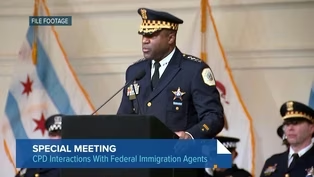
NewChicago's Top Cop Faces Questions Over Claims Officers Collaborated With ICE
Video has Closed Captions
The Community Commission for Public Safety and Accountability will question Supt. Larry Snelling. (3m 36s)
 New
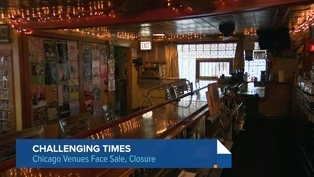
NewA Look at the Changing Landscape for Chicago's Cultural Venues
Video has Closed Captions
Some well-known institutions have recently undergone changes, from sales to renovations to closures. (8m 29s)
 New
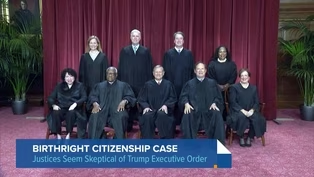
NewWhat to Know About the Birthright Citizenship Case Before the Supreme Court
Video has Closed Captions
The birthright citizenship order is part of the Trump administration’s immigration crackdown. (10m 43s)
Providing Support for PBS.org
Learn Moreabout PBS online sponsorship
- News and Public Affairs

Top journalists deliver compelling original analysis of the hour's headlines.

- News and Public Affairs

FRONTLINE is investigative journalism that questions, explains and changes our world.












Support for PBS provided by:
Chicago Tonight is a local public television program presented by WTTW
WTTW video streaming support provided by members and sponsors.