
Analyzing the Supreme Court's immigration and gun rulings
Clip: 6/25/2026 | 5m 35sVideo has Closed Captions
Analyzing the Supreme Court decisions on immigration, gun control and Monsanto
The Supreme Court handed down major decisions on Thursday, including rulings that clear the way for the Trump administration to end deportation protections for many Haitians and Syrians. The justices also ruled that Monsanto cannot be held liable in lawsuits over Roundup and struck down a Hawaii gun law. Geoff Bennett discussed more with Supreme Court analyst and SCOTUSblog co-founder Amy Howe.
Problems playing video? | Closed Captioning Feedback
Problems playing video? | Closed Captioning Feedback
Major corporate funding for the PBS News Hour is provided by BDO, BNSF, Consumer Cellular, American Cruise Lines, and Raymond James. Funding for the PBS NewsHour Weekend is provided by...
Analyzing the Supreme Court's immigration and gun rulings
Clip: 6/25/2026 | 5m 35sVideo has Closed Captions
The Supreme Court handed down major decisions on Thursday, including rulings that clear the way for the Trump administration to end deportation protections for many Haitians and Syrians. The justices also ruled that Monsanto cannot be held liable in lawsuits over Roundup and struck down a Hawaii gun law. Geoff Bennett discussed more with Supreme Court analyst and SCOTUSblog co-founder Amy Howe.
Problems playing video? | Closed Captioning Feedback
Where to Watch PBS News Hour
PBS News Hour is available to stream on pbs.org and the PBS app.
Providing Support for PBS.org
Learn Moreabout PBS online sponsorshipAMNA NAWAZ: The U.S.
Supreme Court handed down four major decisions today, including rulings that clear the way for the Trump administration to end deportation protections for many Haitians and Syrians and allow officials to continue turning back asylum seekers at the southern border.
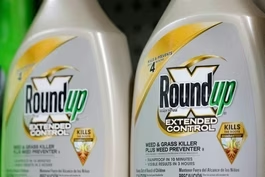
GEOFF BENNETT: The justices also ruled that Monsanto cannot be held liable in thousands of lawsuits over its weed killer Roundup.
And it struck down a Hawaii gun law in a decision that could have implications for similar laws in other states.
"News Hour" Supreme Court analyst and SCOTUSblog co-founder Amy Howe joins us now to help unpack the rulings.
Amy, it's great to have you here.
So let's start with immigration.
The court, as Amna said, they ruled that the Trump administration can revoke Temporary Protected Status for Haitians and Syrians.
The administration moved to end it last year, and now you have the court siding with them.
What more should we know about this case?
AMY HOWE: So this was an interesting case, because the court didn't actually weigh in on whether then-Secretary of Homeland Security Kristi Noem had -- was -- properly ended the designations for Haiti or Syria.
What the Supreme Court said was that there is a provision in the statute that created the Temporary Protected Status program that bars courts from even weighing in on the secretary's decision to designate a country for TPS status or to end the designation.
And Justice Alito in his decision said that applies to the claims by the Haitian and Syrian nationals.
They had argued that they weren't challenging her decision, the substance of her decision, that they were challenging whether or not she'd complied with some of the procedural requirements of the statute.
For example, this statute requires the secretary of state to consult with other agencies before she makes that determination.
But Justice Alito said that is part of the determination, and generally the recipients of the TPS program can't challenge that.
There was also a separate claim by the Haitian TPS beneficiaries that the decision to end the protections for Haiti were based on what's known as racial animus.
Some of your viewers may remember some of the baseless claims by President Donald Trump about Haitian immigrants in Springfield, Ohio, eating pets of the residents of that town.
And the Haitian TPS beneficiaries had pointed to those kinds of comments and said that the decision to end TPS status was based on racial animus.
And Justice Alito said that it was not based on racial animus.
GEOFF BENNETT: There's another immigration case I want to ask you about.
This involves the practice of what's called metering, whereby U.S.
border authorities physically turn people back at the border before they can set foot on U.S.
soil and ask for asylum.
The challengers said that that still counts as arriving under the asylum statute.
But the court's conservative justices disagreed.
How did they see it?
AMY HOWE: Yes, so Justice Alito said that -- and Justice Sonia Sotomayor in her dissenting opinion, this really came down to how you interpret the phrase arriving in the United States.
And Justice Alito said, if you look at the ordinary meaning, arriving in the United States means that you physically have entered the United States.
And he said nobody would say if a football player is tackled at the one-yard line that he has arrived in the end zone.
And Justice Sotomayor said the meaning of arrived in can mean that you are about to enter somewhere.
And she had her own example.
She said if you land at Washington Reagan National Airport, and you call a friend and you say, I am arriving in Washington, D.C., you're not actually in Washington, D.C., because you're in Virginia, which is where the airport is located, but everybody knows that that counts as arriving in Washington, D.C.
GEOFF BENNETT: Another case, another major ruling involved Monsanto, as we said, the manufacturer of the weed killer Roundup.
GEOFF BENNETT: This was a 7-2 ruling, and they said that the company cannot be sued for failing to put a cancer warning on Roundup.
We're going to talk in more detail later in the broadcast about the implications.
But how did they get to that?
How did they get to that point?
AMY HOWE: Yes, so this is what's known as preemption, the idea that federal law can Trump state law.
So the plaintiff in this case, John Durnell, had sued Monsanto for not including a cancer warning on the label.
There's a federal law called FIFRA, the Federal Insecticide, Fungicide, and Rodenticide Act, that gives the EPA the power to regulate the labeling of pesticides.
And it also includes what's called a uniformity requirement.
It said states can't include additional or different requirements on labels.
And so what the Supreme Court said was that when Durnell brought his claim under Missouri law saying that Monsanto should have included this cancer warning that that conflicted with the federal requirement, because the EPA said this is the label, Monsanto, that you need to use, and federal law trumps state law.
GEOFF BENNETT: In the 30 seconds we have left, how might other states be affected by this Hawaii gun law?
AMY HOWE: So the Hawaii gun law, there are four other states, California, New York, New Jersey, and Maryland, that have similar laws that require you to obtain permission, even if you're a licensed gun owner, before bringing your gun onto private property.
And so it's not a lot of states, but certainly California, New York, New Jersey, Maryland.
That's a lot of people.
And so those laws under the Supreme Court's ruling today would also face being unconstitutional.
GEOFF BENNETT: Amy Howe, thanks, as always, for your insights and analysis.
We appreciate it.
AMY HOWE: Thank you.
America's first hospital traces nation's history of medicine
Video has Closed Captions
America's oldest hospital preserves the nation's history of medicine and health care (5m 42s)
How the Supreme Court rulings could impact asylum
Video has Closed Captions
How the Supreme Court immigration rulings could impact asylum in the U.S. (6m 2s)
News Wrap: NPS official claims Reflecting Pool liner cut
Video has Closed Captions
News Wrap: NPS official claims Reflecting Pool liner cut with knife or razor (5m 11s)

Nonprofit aims to help workers displaced by AI
Video has Closed Captions
Nonprofit aims to help displaced workers as businesses adopt artificial intelligence (7m 58s)

Thousands feared dead in Venezuela after twin earthquakes
Video has Closed Captions
Thousands feared dead in Venezuela after twin earthquakes flatten buildings (4m 20s)

U.S. moves to reassure Gulf allies after new Hormuz shutdown
Video has Closed Captions
U.S. moves to reassure Gulf allies after latest Strait of Hormuz shutdown (8m 22s)
Venezuela's earthquake response hindered by crises
Video has Closed Captions
Venezuela's earthquake response hindered by economic and political crises (4m)
What science tells us about the health risks of Roundup
Video has Closed Captions
What science tells us about the health risks of Roundup (5m 12s)
Providing Support for PBS.org
Learn Moreabout PBS online sponsorship New Episode
- News and Public Affairs

Today's top journalists discuss Washington's current political events and public affairs.

- News and Public Affairs

FRONTLINE is investigative journalism that questions, explains and changes our world.
 New Episode
 New Episode
 New Episode
 New Episode
 New Episode
 New Episode

 New Episode
 New Episode
Support for PBS provided by:
Major corporate funding for the PBS News Hour is provided by BDO, BNSF, Consumer Cellular, American Cruise Lines, and Raymond James. Funding for the PBS NewsHour Weekend is provided by...