Crisis in Venezuela
Season 2026 Episode 2 | 54m 29sVideo has Closed Captions
What’s next for Venezuela after the dramatic fall of Nicolás Maduro?
What’s next for Venezuela after the dramatic fall of Nicolás Maduro? In a documentary from the filmmakers behind "A Dangerous Assignment," FRONTLINE and The Associated Press investigate the legacy of corruption in Venezuela, the challenges to democracy, the conflict with the U.S., and the fight over who will control the oil-rich country.
Problems playing video? | Closed Captioning Feedback
Problems playing video? | Closed Captioning Feedback
Funding for FRONTLINE is provided through the support of PBS viewers and by the Corporation for Public Broadcasting. Major funding for FRONTLINE is provided by the Ford Foundation. Additional funding...
Crisis in Venezuela
Season 2026 Episode 2 | 54m 29sVideo has Closed Captions
What’s next for Venezuela after the dramatic fall of Nicolás Maduro? In a documentary from the filmmakers behind "A Dangerous Assignment," FRONTLINE and The Associated Press investigate the legacy of corruption in Venezuela, the challenges to democracy, the conflict with the U.S., and the fight over who will control the oil-rich country.
Problems playing video? | Closed Captioning Feedback
How to Watch FRONTLINE
FRONTLINE is available to stream on pbs.org and the free PBS App, available on iPhone, Apple TV, Android TV, Android smartphones, Amazon Fire TV, Amazon Fire Tablet, Roku, Samsung Smart TV, and Vizio.
Buy Now
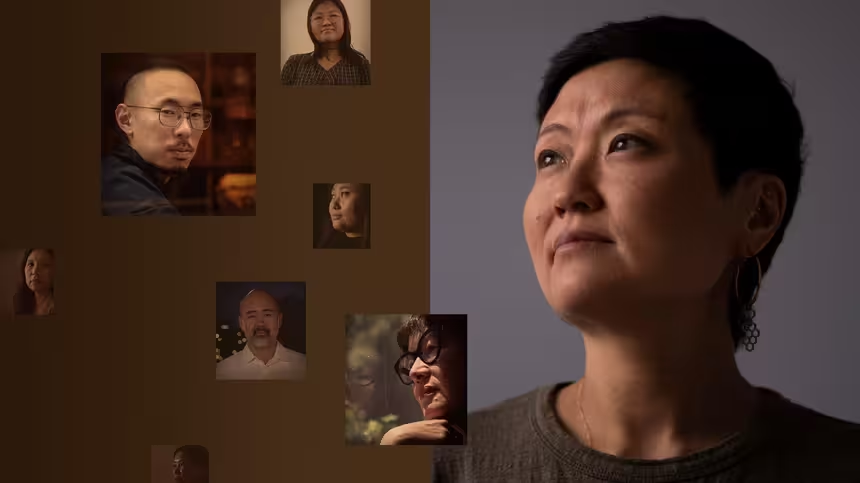
"Who Am I, Then?"
Explore this interactive that tells the stories of over a dozen Korean adoptees as they search for the truth about their origins — a collaboration between FRONTLINE and The Associated Press.Providing Support for PBS.org
Learn Moreabout PBS online sponsorship>> ¿Qué es esa (bleep) (bleep)?
(Bleep)!
>> I was woken up by an explosion.
I was looking out the window.
It was the loudest noise I have ever heard.
My building was shook.
>> Oye, oye!
(bleep) veo algo.
¿Qué esta pasando?
(Bleep), bleep!
>> I had my phone in my hand, and I sent a message, and said, "Hi, I think we’re under attack."
>> Aquí hay información de última hora.
Esta noche, se escuchan fuertes explosiones en Venezuela.
>> Everybody was asking everybody what was going on.
>> ¡Jesús, por Dios!
>> ¡Mamá, calmate!
¡Mamá, calmate!
>> Fighter jets and bombers took out Venezuelan air defenses, paving the way for Delta Force commados to close in on the compound.
>> It involved months of planning, special forces.
A sort of operation you would expect in a Hollywood movie, but not something that I expected the U.S.
government to attempt.
>> President Trump says Nicolas Maduro and his wife, Cilia Flores, have been captured and flown out of the country.
>> Maduro faced charges of drug trafficking, narco-terrorism and conspiracy to import cocaine.
>> My reaction to the capture of Maduro was just shock.
I turned on my phone and there’s like tons of messages from top editors at the AP, and I got straight to work.
>> NARRATOR: In the weeks since the capture of Venezuelan leader, Nicolas Maduro, teams from “Frontline” and the Associated Press have been on the ground in Venezuela.
>> Libertad!
Libertad!
>> NARRATOR: And the United States.
>> We got to find out what all this means.
(whispering): Oh my God.
That's a huge... Okay.
>> NARRATOR: Sitting down with former U.S.
officials, Venezuelan politicians, and experts charting President Trump’s long campaign to topple Maduro.
>> All options, always.
All options are on the table.
>> Maduro’s lieutenants are all still running the country.
>> NARRATOR: Investigating the regime loyalists who’ve been left in charge.
>> Delcy Rodriguez has been officially sworn in as interim president.
>> We just had a great conversation today and she’s a terrific person.
>> NARRATOR: And the Nobel-prize winning opposition leader who remains in exile.
>> Mr.
Trump appeared to sideline Maria Corina Machado.
He downplayed her support.
>> This is about a criminal structure that is the regime and the mandate of the Venezuelan people.
>> NARRATOR: Amid an uncertain future.
>> Secretary of State, Marco Rubio, is going to be on Capitol Hill today.
>> This hearing is supposed to focus on the Trump administration’s controversial actions in Venezuela.
>> Now for the first time in literally a decade, there is the opportunity that something could change.
>> ¡Nuestros hijos van a ser libres!
>> ¡Libres!
>> What I really fear is some kind of deal in Washington that leaves this regime in place permanently as long as they’re willing to do what we want on oil.
>> I get it, we all want something immediately, but this is not a frozen dinner you put in a microwave and in two and a half minutes it comes out ready to eat.
>> ¡Justicia!
>> It's 9:00 a.m.
on the East Coast, and if you're just joining us this morning, we have major breaking news.
Venezuelan dictator Nicolás Maduro has been captured by U.S.
forces.
(crowd cheering) (drumming) >> ¡Viva Venezuela libre!
¡Viva!
(cheering continues) >> NARRATOR: Within hours of the raid in Caracas, Venezuelan exiles celebrated in Miami.
(crowd cheering) (crowd clapping beat) >> ♪ Y ya cayó ♪ ♪ Y ya cayó ♪ ♪ Este gobierno ya cayó ♪ ♪ Y ya cayó, y ya cayó... ♪ >> NARRATOR: Around eight million Venezuelans fled abroad during the rule of Nicolás Maduro-- more than seven hundred thousand to the United States.
>> Yo tengo toda mi vida esperando por ver esto.
>> Ahora se hizo justicia.
Te digo que lloré esta mañana de la alegría.
>> Late last night and early today, at my direction, the United States Armed Forces conducted an extraordinary military operation in the capital of Venezuela... It was a force against a heavily fortified military fortress in the heart of Caracas to bring outlaw dictator Nicolás Maduro to justice.
This was one of the most stunning... >> NARRATOR: AP reporter Joshua Goodman is based in Miami and has been reporting on Venezuela for over a decade.
>> Initially, after the capture of Maduro, I was focused on who was in power in Caracas.
Maduro ran the country so ruthlessly that his absence was going to immediately create a void.
It was nominally filled by Delcy Rodríguez, his vice president and loyal aide during many, many years.
>> She's, I guess, the president.
She was sworn in as president just a little while ago.
She had a long conversation with Marco, and she said, "We'll do whatever you need."
She... I think she was quite gracious, but... she really doesn't have a choice.
>> Exigimos la inmediata liberación del Presidente Nicolás Maduro y de su esposa Celia Flores.
>> Delcy Rodriguez's reaction to Maduro's capture kind of followed the script that you would expect.
She denounced it as a kidnapping, a violation of the United Nations Charter.
>> ...jamás volveremos a ser esclavos, es que jamás volveremos a ser colonia de ningún imperio del tinte que sea... >> But within a matter of hours, she sort of switched her discourse a little bit.
And even though she continued to denounce Maduro's, quote, "kidnapping," she also very clearly extended an olive branch to the Trump administration.
>> Delcy Rodríguez has been officially sworn in as interim president.
She's indicated she'll cooperate with Washington, but described Maduro and his wife as hostages.
(wind howling, rooster crowing) >> Sucedió a pocas horas desde un operativo relámpago estadounidense durante la madrugada hasta la captura de Nicolás Maduro y su esposa... A esta hora hay muchas preguntas, más que respuestas.
>> ...ya las cuentas pasan de los 90 heridos y 80 muertes entre civiles y militares... >> NARRATOR: In Caracas, AP's Venezuela correspondent Regina Garcia Cano was covering the impact and reactions on the ground.
>> As the sun went up, the city remained in absolute silence.
(rooster crowing) >> Slowly, we started to see some businesses open, and people began to line up outside.
People looked stunned.
There were no celebrations.
At least not publicly.
>> Hay bastante incertidumbre, pues, corre en todo el país como tal.
¿Qué pasará mañana?
¿Qué pasará dentro de media hora?
Nadie sabe, pues, que sucede, pues.
Es una enigma lo que se está viviendo en este momento.
>> Esta operación militar, descrita como un golpe a gran escala, marca el fin de un capítulo turbulento en la historia de Venezuela, pero abre un capítulo incierto.
>> With Delcy becoming acting president, many, many questions were left unanswered.
How long is she going to be acting president?
Will there be elections soon, or in a year, or in two years?
Venezuelans want answers to those questions.
What's going to happen next?
>> Well, there's a lot of operational details that can't be discussed publicly, obviously, for obvious reasons, so... as we move forward we'll describe our process.
>> NARRATOR: Secretary of State Marco Rubio was quickly promoting a three-phase plan for Venezuela.
>> Step one is the stabilization of the country.
We don't want it descending into chaos... The second phase will be a phase that we call recovery, and that is ensuring that American, Western, and other companies have access to the Venezuelan market, a way that's fair.
Also, at the same time, begin to create the process of reconciliation nationally within Venezuela so that the opposition forces can be amnestied and released and... from prisons or brought back to the country and begin to rebuild civil society.
And then the third phase, of course, will be one of transition.
Some of this will overlap... >> The people of Venezuela are waking up to the same regime.
Do you not worry about that?
>> Well, first of all, the bottom line is that there is a process now in place, where we have tremendous control and leverage over what those interim authorities are doing and are able to do.
>> ♪ Patria querida, tuyo es mi cielo ♪ ♪ Tuyo es mi sol ♪ ♪ Patria, tuya es mi vida... ♪ >> I remember this.
>> NARRATOR: The origins of the U.S.
effort to topple Nicolás Maduro go back more than a decade.
>> This is it, this is it.
This is the moment that Nicolás Maduro became president.
>> NARRATOR: In 2012, Maduro was anointed by his predecessor, Hugo Chavez, on live television.
>> Chavez is dying of cancer, and he anoints his successor.
Watch.
>> Si algo ocurriera, repito, que me inhabilitara de alguna manera ustedes elijan a Nicolás Maduro como presidente de la República Bolivariana de Venezuela.
Yo se los pido desde mi corazón.
>> Maduro shows no expression, but it was the moment that set him up to become president.
♪ ♪ >> NARRATOR: Chavez saw the U.S.
as his arch enemy and had clashed with it over control of Venezuela's vast oil reserves.
He'd seized the assets of American oil companies doing business there.
>> Venezuela is a petrostate.
It depends exclusively on the sale of oil for income.
Hugo Chavez renegotiated oil contracts in Venezuela, and a lot of the companies didn't like the deal he was offering, and they sued.
And they, to this day, are owed billions of dollars from that expropriation.
>> NARRATOR: When Maduro came to power after Chavez's death, the oil industry was in disarray, and the economy was collapsing.
At the time, Juan Gonzalez was coordinating U.S.
policy on Venezuela for the Obama administration.
>> Nicolás Maduro was incredibly unpopular at the very beginning, and there were questions about whether he could endure and survive politically.
The time that Hugo Chávez left coincided with the collapse in oil and gas prices.
So Nicolás Maduro no longer had this pocketbook.
I think Maduro found himself in a position where he had to use increasing crackdowns, even manipulation of elections.
>> Si me quieren derrojar, vengan por mí.
Aquí estoy, con un pueblo y una fuerza armada.
Aquí estoy.
Listo.
>> The closure of the democratic space, and was characterized by increased corruption inside of the government, basically just to stay in power.
I think he had to keep a lot of people happy, so he had to give a lot of money out.
And yes, people started disappearing.
(weapons firing) >> NARRATOR: Maduro banned political opponents and arrested and detained thousands of political prisoners.
>> ¡Yo quiero democracia!
¡Quiero libertad!
¡Levantar a mis hijos!
(clapping) >> ¡Me están llevando sin ninguna orden!
♪ ♪ >> NARRATOR: Many would end up incarcerated at Helicoide-- the notorious headquarters of Venezuelan intelligence.
♪ ♪ By 2017, a mass exodus from Venezuela was underway that would continue through Maduro's rule.
>> We have many options for Venezuela.
And by the way, I'm not going to rule out a military option.
We have many options for Venezuela.
>> NARRATOR: In his first term, President Trump already had Maduro in his sights.
>> The people are suffering, and they're dying.
We have many options for Venezuela, including a possible military option, if necessary.
>> NARRATOR: Elliott Abrams served as Trump's special representative for Venezuela.
>> We said approximately five million times all options are on the table.
>> All options, always.
All options are on the table.
I think of all possibilities, all options are open.
>> And that was true in the sense that it's always true.
But there was no real military plan to do anything like this.
Partly, I think, because, I don't think at that point there would've been much support in the Pentagon, and there certainly wouldn't have been at C.I.A.
>> NARRATOR: Initially, President Trump imposed sanctions targeting the regime and its oil sector, part of a strategy known as "maximum pressure."
>> Today, we are announcing additional sanctions against... the repressive regime, targeting Maduro's inner circle and close advisors.
>> We had sanctions.
We isolated the regime diplomatically.
But it didn't work.
>> Donald Trump, con Venezuela no te metas.
Hands off Venezuela.
(applause) >> I think one of the pernicious effects of the maximum pressure campaign is that it actually fueled more corruption.
When Venezuela was restricted, for all intents and purposes, from trading with the rest of the world, they had to rely on these shadowy networks of oil tankers, relations with other countries like Iran, which were under sanctions.
And, when you're dealing outside of traditional markets, the opportunity for graft, for corruption, for inflating prices on government contracts just grows exponentially.
>> NARRATOR: Maduro used a parallel economy to try to get around the sanctions.
Central to the effort was his vice president, Delcy Rodriguez.
>> Vengo en nombre de la única Venezuela, de la Venezuela digna, la valiente, la que no se arrodilla ante poder imperial alguno.
>> Delcy Rodríguez makes herself indispensable to Maduro.
She's sort of the chief operating officer who is coordinating oil sales despite U.S.
sanctions.
She is attracting investment from around the world.
She is traveling the world as well, to cement relations with places like Russia.
And during this period, her power expands immensely.
She's also given control over the intelligence services, the SEBIN, the feared political police, report to her as vice president.
>> NARRATOR: Maduro also relied on another powerful player-- a Colombian businessman named Alex Saab.
>> Alex Saab se convierte en una especie de emisario personal del propio Nicolás Maduro, en una especie de ministro en la sombra.
>> NARRATOR: Roberto Deniz is an exiled Venezuelan journalist whose reporting uncovered how Saab used a network of companies to get around U.S.
sanctions, as well as cheat the state oil company, PDVSA.
>> La misión de estas empresas era comercializar petróleo sin que se supiera que era como el petróleo venezolano.
Pero había una escándalo mucho más grande detrás de toda esta operación.
Y es que nunca le pagaron a Venezuela el dinero que estaban recibiendo por esas exportaciones de petróleo.
En conjunto, estas compañias quedaron debiendo a la PDVSA 1.5 billones de dólares.
>> He's stolen enormous amounts of money for Maduro and his cronies.
Alex Saab was prolific in the way that he created shell companies around the world.
>> NARRATOR: Marshall Billingslea was at the U.S.
Treasury Department and helped lead an effort to investigate Alex Saab.
>> It was my role in the Treasury to do everything that I could to help protect the U.S.
financial system and to support our friends and our allies.
In the case of Alex Saab, this is an individual who was abusing the international financial system, and the things he was doing on behalf of Maduro were unconscionable.
>> NARRATOR: In 2020, Saab was arrested while on a business trip, and eventually extradited to the U.S.
on money laundering charges.
He pleaded not guilty, and was held in federal custody awaiting trial.
>> Preso y esposado, así pisó suelo estadounidense el presunto testaferro del presidente de Venezuela.
>> NARRATOR: At the same time, the Trump administration was stepping up the pressure on Maduro, charging him and members of his government with crimes including corruption and drug trafficking.
>> The U.S.
Justice Department announced indictments of Venezuela's President Nicolás Maduro and his top allies on charges of narco-terrorism.
Attorney General William Barr said they conspired to flood the U.S.
with cocaine and to loot their own country of billions of dollars.
>> NARRATOR: Sandy Gonzalez was one of the key investigators on the case.
>> I was assigned to a special unit of D.E.A.
whose sole focus is to investigate international drug traffickers, money launderers, narco-terrorists, and corrupt officials.
Venezuela has become-- at least during the time that I worked there and was investigating the drug trafficking activity there-- a really strategic location for cocaine trafficking organizations.
All of these organizations essentially had a... a paradise, where they could operate freely if they paid the right people.
>> Prosecutors say for more than 20 years, Maduro led the Cartel of the Suns, using Venezuela's military, legislature, and courts to traffic cocaine into the U.S.
>> The Cartel de los Soles is a name we did not come up with.
It was a name that we heard while we were working in Venezuela.
So, it's... it's a little bit complicated.
Certain people have different ways of describing it.
It could be described as a mafia of sorts... Um... but it's definitely a group of individuals in Venezuela, involved in the government, that participate in the drug trade, facilitate the drug trade, profit from the drug trade, and allow the drug trade to flourish in their country.
>> NARRATOR: In the summer of 2025, the Trump administration began referring to the Cartel de los Soles as narco-terrorists, and launched a wave of controversial strikes against alleged drug boats that would kill more than 100 people.
>> Today in the Caribbean, another boat incinerated by U.S.
missile, the tenth U.S.
strike since early September on what the administrations calls "drug boats," including three strikes this week alone.
>> The U.S.
military killed two people clinging to wreckage in the sea after they survived an initial air strike on their boat.
>> The U.S.
government offered little to no information about those strikes.
They claimed those on board were narco-terrorists.
>> If foreign terrorist organizations poisoning people with drugs, coming from a drug cartel, is no different than Al-Qaeda.
>> They offered no evidence to back up those claims.
>> Venezuela está enfrentando la más grande amenaza que se haya visto en nuestro continente en los últimos 100 años.
>> It was very apparent early on that the goal here was to pressure Maduro into resigning.
It was a fig leaf, the idea that this was a counter-narcotics mission, and it was really about forcing regime change in Venezuela.
>> We had reached the point at which there was too big a buildup in the Caribbean for the president to back off.
It was clear to me there's going to be a winner and a loser.
Is it going to be Trump or is it going to be Maduro?
(camera clicking) >> NARRATOR: Once in U.S.
custody, prosecutors unsealed a new indictment against Maduro, They accused him of involvement in a vast drug trafficking conspiracy with the Venezuelan military.
>> As it states in the indictment, it is a conspiracy.
So he had a role in that conspiracy.
And according to our laws, everyone involved in the conspiracy is... essentially as culpable as the next.
>> The country is now being led by Delcy Rodriguez.
In your view, is she someone who can dismantle those criminal networks that have blossomed under Maduro?
>> That's going to be interesting to see.
I don't think that you could just remove Nicolás Maduro from that equation and leave everything else status quo and expect things to change.
♪ ♪ >> NARRATOR: Within days of Maduro's capture, the AP got a tip about Delcy Rodriguez's own connections to drug trafficking allegations.
>> (whispering): (Bleep).
Wow.
>> My colleague, Jim Mustian from New York, he got some information about possible criminal investigations in the United States to Delcy Rodríguez.
Let me take a look.
Okay, let's see what this is.
(keyboard clacking) What does this mean?
Oh, she's got a NADDIS number.
(Bleep).
A NADDIS number is a big deal.
I have to understand this better.
I gotta call Jim.
We gotta-- we gotta find out what all this means.
(whispering): Oh my God.
That's a huge... Okay.
(inhales) Wow.
Okay.
I mean, this-- 11 cases.
Great work, great work.
Okay, um... let's find a place to work.
I need to work.
>> Perrier.
>> Oh, thanks.
I'm gonna tell-- I'm gonna call my editor.
(phone ringing out) >> (on phone): Hi, Josh.
>> Hey, can I patch in, uh, Jim?
>> (on phone): Good afternoon.
Her entry in the D.O.J.'s...
the D.E.A.
's file on her says, "Involved in drug trafficking and gold smuggling projects."
The language this source described Delcy as a priority target.
But the quote that we could probably use if we, if we needed to... I mean, this is-- I'm just going through my messages with the source, is listed as a priority target.
Um... That doesn't mean that, um, for example, Jim mentioned earlier, drug trafficking and gold.
You know, that doesn't mean that she herself was, was doing that.
It could just mean that she was mentioned in connection to that drug trafficking, gold trafficking investigation.
Now, what her role is, if any, you know, would be, you know, something that you would only learn in an indictment, and she has not been indicted as far as we know.
This is a major surprise because even though I think Venezuela has long been a target-rich environment for the DEA and other agencies, she somehow, somewhat uniquely had escaped being criminally charged herself.
>> The AP obtains documents claiming, quote, "The DEA has amassed "a detailed intelligence file on Rodriguez "cataloging her known associates and allegations "ranging from drug trafficking to gold smuggling."
>> La gobernante interinda de Venezuela, Delcy Rodríguez, lleva años en la mira de la DEA.
Según AP, Rodríguez incluso fue calificada el 2022 como objetivo prioritario.
>> NARRATOR: The Venezuelan government dismissed the story as fake.
Nobody from the Trump administration would agree to an interview.
But Secretary of State Rubio was questioned about the allegations in a Senate hearing.
>> The DEA has reportedly identified Delcy Rodriguez as a significant actor in the drug trade.
Do you agree with that?
>> ...Well, first of all, on the first point, I would say she's not indicted the way Maduro and his wife were.
>> I understand.
>> So I'm not going to speculate about newspaper articles and what law enforcement is working on.
If in fact there were such an investigation, you know, I mean, that's something that we would speculate on.
Suffice it to say that this was not a normal system.
We all should... stipulate to that, okay?
That regime, as everyone understood, was held together by corruption.
The glue that kept people together was not loyalty to Maduro.
It was the fact that these five guys had five separate oil fields that were assigned to them.
These people are drug runners.
>> No, I understand-- I understand that.
>> But that's going to be... >> I'm not defending the regime.
In fact, I'm concerned that we haven't really changed the regime enough... >> ...I acknowledge that we are dealing with-- I told you, with individuals that have been involved in things that in our system, would not be acceptable-- would not be acceptable to us in the long term.
By no means is our policy to leave in place something permanent that's as corrupt as you've described.
We are in the tran... in the transition and stabilization phase.
We are just acknowledging reality, and that is you have to work with the people that are in charge of the elements of government.
>> NARRATOR: One of those people was Venezuelan Interior Minister Diosdado Cabello, who was charged with drug trafficking in the same indictment as Maduro.
>> Diosdado Cabello, who is the Minister of the Interior, control of police, secret police, intelligence, is a criminal.
He's under indictment for drug trafficking.
He's the chief thug of the regime.
He's the guy who's really in charge of these prisons and their torture chambers.
>> ¡Que viva la revolución bolivariana!
>> And if there is a Democratic Venezuela, he will have no place in it, except maybe in prison.
So, he could be a spoiler.
He could be a break.
♪ ♪ (cars passing, horn honks) >> NARRATOR: Despite Cabello still being in place, Venezuelans were looking for signs the regime would ease its repressive rule and take steps towards democracy.
(dog barking) Five days after Maduro's capture, the government made a dramatic announcement: >> The Venezuelan regime announced Thursday it would release a significant number of political prisoners in the coming hours.
>> Caracas announced it would release a large number of detainees in what officials refer to as a goodwill gesture.
>> NARRATOR: But on the ground, there was no sign of a large number of releases.
>> ¡Libertad!
¡Libertad!
>> NARRATOR: On the night of the announcement, relatives gathered outside El Rodeo prison.
(dog barking) >> El Rodeo, which is outside Caracas, is significant because it holds the largest number of prisoners considered to be detained for their political beliefs.
>> NARRATOR: Just four prisoners had been freed so far.
The families were praying for more.
>> Nosotros vamos a iniciar esta oración porque tenemos mucha fe de que todos los que están allá adentro van a salir.
>> Amén.
>> Todos los que están allá adentro van a ser libres en el nombre poderoso de Jesús.
>> Amén.
>> Hey, there.
We're outside of Rodeo.
We know that they have been moving political prisoners from one facility to another, to another, to another.
So at this point, you know, it's a bit of a guess, um, you know, who, who's where.
>> Well, I mean it seems well short of hundreds of people, right?
I mean, this doesn't seem, at least for now, much of a gesture of reconciliation.
>> It is possible that more people than we know of have been released, we just haven't seen them.
(indistinct chatter) (phone dialing out) >> ¿Aló?
Bien, ¿cómo le va?
>> NARRATOR: Venezuelan lawyer Alfredo Romero, who works from a secret location, was also monitoring the releases.
>> Hay expectativas ahí de que van a liberar gente, tú verás, pero será en la noche, si acaso... Nuevamente, es un número que no dicen, una, una lista que no dicen, entonces no sabemos a quién van a sacar.
>> NARRATOR: His human rights group tracks the numbers of political prisoners.
>> Something that worries me is that in the past, they have released like 100 political prisoners, and then in one month or two months, they have actually incarcerated other 100 political prisoners.
That's what I've been calling the revolving door effect, or the revolving door of repression.
Using political prisoners as a way to intimidate the population.
>> ...en el cielo.
Danos hoy nuestro pan de cada día.
Perdona nuestras... >> La Libertad de presos políticos es como un primer paso antes del primer paso, porque el primer paso es el desmantelamiento del sistema represivo.
Ese es el primer paso.
>> NARRATOR: From the start, President Trump was pressed on the issue of Venezuela's political prisoners.
>> Are you going to demand that Delcy Rodriguez let opposition figures return or free any political prisoners?
>> We haven't gotten to that yet.
Right now, what we want to do is fix up the oil, fix up the country, bring the country back, and then have elections.
>> NARRATOR: In those early days, the president's focus was on oil.
>> President Trump invited a group of oil businessmen to the White House, a variety of profiles-- the large players like Exxon, Conoco and Chevron were there.
So we're going to discuss how these great American companies can help rapidly rebuild Venezuela's dilapidated oil industry and bring millions of barrels of oil production to benefit the United States, the people of Venezuela, and the entire world.
>> If you're talking about the massive projects that need to be invested in to rebuild the Venezuelan oil industry, we're talking about $100 billion in investment in a decade.
These type of investors, they want long-term horizons.
>> NARRATOR: Francisco Monaldi is an expert on the Venezuelan oil industry.
>> Exxon was not enthusiastic at all and basically said that the country was un-investable under the current circumstances.
>> We first got into Venezuela back in 19... the 1940s.
We've had our assets seized there twice.
And so you can imagine to reenter a third time would require some pretty significant changes from what we've historically seen here in what is currently the state.
>> Companies do not care if a country is democratic or not.
They care about the rule of law and respect over their contracts and its stability.
The issue in the case of Venezuela is that I think it's unlikely that they will get all those conditions without democracy.
(birds chirping) >> NARRATOR: Trump pushed Delcy Rodriguez to relax state control over the oil sector and make it more attractive to U.S.
investment.
She signaled a willingness to comply.
>> Yo quiero anunciar que hemos traído el proyecto de ley de reforma parcial de la Ley Orgánica de Hidrocarburo Pido a este cuerpo legislativo la aprobación de esta reforma parcial.
>> Delcy Rodriguez has been portrayed as someone eager, for example, to work with American oil companies.
So what, in your view, is her long game?
>> I think we should ask ourselves, what would I do or you do if you were Delcy Rodriguez?
What can I get away with?
Do the Americans want me out immediately?
No.
What do they seem to want, most of all?
Oil.
Okay, I can deal with that.
That doesn't undermine my staying power in office.
They want some prisoners out.
We can start doing that.
We'll do it slowly.
Maybe we can get away with that.
Maybe we survive all of this.
>> NARRATOR: A week after the capture of Maduro, the vast majority of political prisoners remained behind bars.
Regina Garcia Cano and AP photojournalist Ariana Cubillos were heading to a prison in San Francisco de Yare, an hour south of Caracas.
>> So we are waiting for the third day in a row outside a prison.
But so far, they've released no more than 20.
>> ¿Qué se hace más en el periodismo, esperar o tomar fotos?
>> Máxima prudencia y cordura.
>> NARRATOR: After hours of waiting, a car pulls out of the prison gates.
>> They were honking their horn.
People were applauding.
(car honking) So we follow the car... >> Mira la familia.
¿Cómo le llegamos?
The car stopped about a half a mile away from the prison and we found Diogenes and three relatives, including his mother, right at the intersection.
>> ¿Cómo te sientes en este momento?
>> Emocionado, contento, gracias a Dios.
Volver a disfrutar mi tiempo con mi familia.
>> His family believes he was detained because he shared a video on social media.
He was 17 at the time.
>> ¿Que mostró el video?
>> Sobre la... una marcha de la oposición.
>> ¿Antes de la elección?
>> Antes de la elección.
>> Señora, dígame cómo se siente.
>> Emocionada.
No lo esperaba.
Pero, como dicen, fue un éxito total.
La libertad que más anhelabamos nos llegó.
>> NARRATOR: The news about Maduro's capture hadn't yet reached Diogenes and his fellow inmates.
>> ¿Sabes que Maduro ya no es presidente?
>> ¿Sí?
(Bleep).
(laughter) Emoción alegre.
>> ¿No sabías nada de eso?
>> No, no.
>> Lo capturó Estados Unidos aquí dentro del país el sábado.
>> Hace una semana.
>> En una operación.
Está en una corte de Estados Unidos.
Ah.
Contento, contento.
>> Diogenes had been arrested in 2024, along with many others from the political opposition.
Maduro had been under pressure from the Biden administration to allow free and fair elections.
>> I think what Biden saw was an opportunity to try something new in Venezuela.
To reengage with Maduro, to talk about elections, to talk about sanctions, talk about immigration, >> NARRATOR: Both sides would make concessions.
Maduro agreed to release Americans being held in Venezuelan jails and promised to hold democratic elections.
>> Our focus was on getting the Americans out to create an opening for us to have a dialogue, but making clear that U.S.-Venezuela relations will only improve after there was actually a free and fair election.
>> NARRATOR: Biden promised to ease sanctions, and even agreed to free the indicted Maduro money man, Alex Saab.
>> Ahí lo vemos, saludando, un estrecho y fraterno abrazo también al presidente... >> Pensé que me ibas a dejar ahí.
Jamás.
>> Jamás.
>> Ni en esta vida ni en todas las vidas que vengan.
>> It was a hard decision.
The Department of Justice did not like the release of Alex Saab.
I wish that we hadn't had to release Alex Saab, but, I think the president of the United States has to make really tough calls and his number one priority is the safety of Americans.
>> You know, one of the things that happened in the Biden administration that I was unhappiest with was the release of Alex Saab.
Now, that's an example of taking pressure off the regime.
>> Has Maduro committed to you that he will allow all candidates to run in the next presidential election?
>> I've not spoken to Maduro.
He's committed to our... ...we've laid down specific requirements for a democratic election.
He's agreed to all of them.
Thank you.
(music playing) >> NARRATOR: Maduro’s commitment would quickly be put to the test.
In the election, he was being challenged by the popular opposition leader Maria Corina Machado.
>> ¡No tenemos miedo!
¡No tenemos miedo!
>> In Venezuela, voters took to the polls Sunday for a presidential primary election to decide who will challenge President Nicolás Maduro next year.
(cheers and applause) >> María Corina Machado decided to run for the democratic opposition primary.
(cheers and applause) Almost two million went to vote.
María Corina Machado got 92% of the vote.
>> NARRATOR: David Smolansky is one of Machado's top advisors.
People were not only electing a candidate, people were electing a leader.
>> NARRATOR: But Maduro’s government banned her from running in the presidential election, so she endorsed someone else as her proxy.
>> Edmundo González was a diplomat during the democratic years of Venezuela, but he was not known.
And when María Corina Machado did the rally with the Edmundo González poster, everyone knew in that moment who Edmundo González was.
But that happened in a matter of weeks.
>> The authoritarian regime of Nicolas Maduro is facing one of its toughest challenges in years.
>> If the polls are correct, the vote could mark the end of President Nicolas Maduro's 11-year grip on power of the crisis-stricken country.
¡Vamos a ganar!
¡Vamos a ganar!
♪ ♪ >> 28 de Julio de 2024, una suerte de esperanza silenciosa que se estaba manifestando de sentir que ese era el día definitorio, decisivo para propiciar un cambio político en Venezuela.
Y eso yo creo que se reflejaba desde el minuto uno de ese día.
Esas imágenes que veíamos de gente, desde la madrugada llegando a los centros electorales, era un indicativo de por donde iban las cosas.
En la medianoche del 28 de julio, el presidente del Consejo Nacional Electoral da un resultado donde anuncia como ganador a Nicolás Maduro.
>> Nicolás Maduro Moros, 51.20%.
>> Un resultado que no coincide con la evidencia que recolectó la oposición de las ACTAs de las máquinas de votación que usaron ese día.
Hubo protestas prácticamente en todo el país.
>> Hugo Chávez's statues were taken down by the people.
Maduro knew he lost-- they reacted with the most brutal repression.
(gunfire) More than 2,000 innocent Venezuelans were kidnapped, illegally detained, disappear.
(car horns honking) >> NARRATOR: Some of Machado's allies were arrested and would end up in Helicoide prison.
>> I think Maduro did cross the Rubicon after the election, because nobody could argue that he was a legitimate leader at that point.
>> What you're learning from this is there is no possible way through peaceful protests or through elections, to get rid of this criminal gang.
>> NARRATOR: Maria Corina Machado went into hiding.
(applause) In late 2025, she was awarded the Nobel Peace Prize, and escaped from Venezuela.
>> The Nobel committee says that they awarded the prize based on Machado's leadership and promotion of democratic rights for Venezuelans.
And this is a blow for President Trump, he's been pressuring leaders in Norway to award him the prize.
(crowd cheering) >> NARRATOR: Hours after Maduro was captured, President Trump was asked about Machado.
>> Yes?
>> Is the U.S.
aware of the location of opposition leader Machado, and have you been in contact with her?
>> No, we haven't, really.
No, we haven't.
I think it'd be very tough for her to be the leader.
She doesn't have the support within or the respect within the country.
She's a very nice woman, but she doesn't have the respect to be their leader.
>> Mr.
President, is it possible... >> I thought in that moment that when transitions begins, they are complicated.
And again, especially at the beginning could be messy.
>> ¿Quienes somos?
>> ¡Venezuela!
>> ¿Qué queremos?
>> (chanting): ¡Libertad!
>> NARRATOR: Twelve days later, Maria Corina Machado came to Washington.
>> We're at the White House, where right now, María Corina Machado, the opposition leader, is meeting with President Trump.
It's a hugely important meeting for her and the Venezuelan opposition.
They are completely marginalized from the negotiations over Venezuela's future.
>> I think no one has any doubt that the legitimacy, the credibility, and the popularity is on Maria Corina Machado.
If you had elections right now in Venezuela, she would win overwhelmingly.
>> NARRATOR: After a private meeting with the president... >> Maria!
>> NARRATOR: ...Machado emerged to crowds of supporters.
>> I presented the president of the United States the medal of the Peace... the Nobel Peace Prize, Machado calling the gesture a recognition for his unique commitment with Venezuela's freedom.
♪ ♪ >> NARRATOR: The next morning, she met with reporters.
>> What's your message to the president and, and to the United States when U.S.
policy is still to support the Chavismo government that still exists in Caracas?
>> This has nothing to do... ...with a tension or decision between Delcy Rodríguez and myself.
...this is about a criminal structure that is the regime and the mandate of the Venezuelan people.
...I have no doubt that President Trump, his administration, and the people of the United States support democracy, justice, freedom, and the mandate of the people of Venezuela... (applause) >> Why align with Delcy Rodriguez and the remnants of the Maduro regime and not with Machado who has the support of the Venezuelan people?
>> Well, if you ever remember a place called Iraq where everybody was fired-- every single person, the police, the generals-- everybody was fired and they ended up being ISIS.
Instead of just getting down to business they ended up being ISIS.
So I remember that.
But I tell you, I had a great meeting yesterday by a person I who I have a lot of respect for.
And she has respect obviously for me and our country.
And she gave me her Nobel Prize, but I'll tell you what, I got to know her.
I never met her before, and I was very, very impressed.
She's a really... this is a fine woman.
(reporters clamoring) >> NARRATOR: But for now, Trump would leave Machado on the sidelines, without a commitment about a future role for her in Venezuela.
>> ♪ Eran las 3 de la mañana, 3 de enero en el calendario ♪ ♪ Caracas dormía tranquila bajo su manto diario... ♪ >> ¡Free Maduro!
>> NARRATOR: Meanwhile, on the ground in Caracas, Delcy Rodriguez continued trying to shore up her own precarious position.
>> Delcy Rodriguez is walking a tightrope.
On one hand, she needs to rally her base.
>> ♪ ¡Liberen a Nicolas!
♪ >> Remind them that they're still trying to bring Maduro back.
On the other, she's facing the U.S., and she knows that she must meet many demands-- she's in a tough position for sure.
(cheers and applause) >> NARRATOR: In late January, she signed the law giving foreign oil companies greater freedom to operate in Venezuela.
(cheers and applause) President Trump quickly eased sanctions on the country's oil sector.
>> En este ley, está la pronta de Comandante Chavez.
Y afirma la soberanía sobre nuestros recursos energéticas.
>> This is an absolute betrayal of what Hugo Chávez wanted for the Venezuelan oil sector.
He would be absolutely shocked.
This is absolutely dismantling all the oil framework that he created that gave full control over the oil sector to the government.
>> Que viva la Venezuela soberana e independiente!
>> NARRATOR: It was a win for the Trump administration.
>> The thing I worry about most regarding Venezuela is, today, us.
I think that if American policy is to push in a reasonable, sensible manner toward a restoration of democracy, they will be able to do it.
And what I really fear is some kind of deal in Washington that leaves this regime in place permanently, as long as they're willing to do what we want on oil.
>> This hour, Secretary of State Marco Rubio is set to answer questions from senators on the Foreign Relations Committee.
>> NARRATOR: Testifying in the Senate, Marco Rubio acknowledged the regime's actions.
>> The authorities there deserve some credit.
They have passed a new hydrocarbon law that basically eradicates many of the Chavez-era restrictions on private investment in the oil industry.
It probably doesn't go far enough to attract sufficient investment, but it's a big step from where they were three weeks ago.
So that's a major change.
>> NARRATOR: He continued to urge patience with the transition.
>> One of the parts of the transition phase or the recovery phase is beginning to create space for different voices inside of Venezuelan politics to have an ability to, to speak out.
Part of that is the release of political prisoners... They are releasing them probably slower than I would like them to, but they are releasing them.
>> I think there's a chance that Marco Rubio pulls this off.
I want to recognize that, that he may be able to actually get this where in a year from now there's a democratic transition.
But I think there are also many more scenarios in which this can go horribly sideways.
>> The end state here is we want a, a... we want to reach a phase of transition where we are left with a friendly, stable, prosperous Venezuela-- and democratic-- in which all elements of society are represented in free and fair elections... We're not going to get there in three weeks.
It's going to take some time.
>> NARRATOR: As of now, Nicholas Maduro and his wife have pleaded not guilty and remain in U.S.
custody, awaiting trial.
And there are reports that his former operative, Alex Saab, may be joining them.
>> En las últimas horas se ha dicho que Alex Saab ha sido detenido en Venezuela... >>...la noticia no ha sido confirmada de forma oficial por el gobierno de Venezuela.
De pronto podría tener un pedido de extradición.
And this does mark a new level of collaboration between President Trump and interim president Delcy Rodríguez.
>> Que Delcy Rodríquez termine extraditando a Alex Saab a los Estados Unidos me parece, digamos, una señal muy fuerte de que, bueno, de que Delcy Rodríguez está dispuesta a hacer muchas cosas con tal de preservar el poder en medio de esta negociación con los Estados Unidos.
>> NARRATOR: At the same time, there is growing hope for Venezuela's political prisoners.
>> ...la ciudadana doctora >> NARRATOR: Around 400 have been released so far and at the end of January, Delcy Rodriguez made an historic promise.
>> Muy buenas tardes para todos los presentes... que han garantizado la estabilidad del estado venezolano, en situaciones de adversidad.
>> NARRATOR: Outside Helicoide, the regime's notorious prison, friends and relatives of those detained listened in.
>> Quiero hacer un anuncio para Venezuela.
Que hemos decidido impulsar una ley de amnistía general que cubra todo el periodo político de violencia política de 1999 al presente.
>> (chanting): ¡Libertad!
¡Libertad!
>> NARRATOR: Delcy Rodriguez had once helped Maduro suppress and imprison opponents.
Now she was promising a general amnesty that could free opposition leaders, journalists, and activists.
>> Dios es grande.
Dios nos escuchó.
>> NARRATOR: And to close Helicoide.
>> ...fue eso.
Valió la pena.
Valió todo.
¡Todos van a ser libres!
¡Venezuela libre!
(cheers) (horns honking) >> NARRATOR: Just this week, more than 30 political prisoners were released, including allies of Maria Corina Machado.
>> (chanting): ¡Ni uno, ni dos, libérenos a todos!
>> NARRATOR: But one was quickly rearrested, and many are still being held.
It remains to be seen how far the remnants of Maduro's regime will go.
>> ¡No tenemos miedo!
¡No tenemos miedo!
¡No tenemos miedo!
>> NARRATOR: Go to pbs.org/frontline for more reporting from the Associated Press.
>> Many, many questions were left unanswered.
Venezuelan's want answers to those questions.
>> She denounced it as a kidnapping, violation of the United Nations charter.
>> NARRATOR: And see more of our coverage of Venezuela.
Connect with FRONTLINE on Facebook and Instagram and stream anytime on the PBS app, YouTube, or pbs.org/frontline.
Captioned by Media Access Group at WGBH access.wgbh.org >> For more on this and other "FRONTLINE" programs, visit our website at pbs.org/frontline.
♪ ♪ FRONTLINE's "Crisis In Venezuela" is available on Amazon Prime Video.
♪ ♪
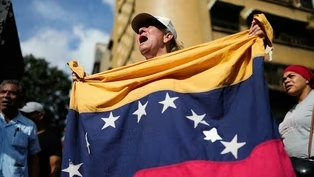
"Crisis in Venezuela" - Preview
Video has Closed Captions
Preview: S2026 Ep2 | 31s | What’s next for Venezuela after the dramatic fall of Nicolás Maduro? (31s)
Providing Support for PBS.org
Learn Moreabout PBS online sponsorship
- News and Public Affairs

Top journalists deliver compelling original analysis of the hour's headlines.

- News and Public Affairs

Amanpour and Company features conversations with leaders and decision makers.











Support for PBS provided by:
Funding for FRONTLINE is provided through the support of PBS viewers and by the Corporation for Public Broadcasting. Major funding for FRONTLINE is provided by the Ford Foundation. Additional funding...