
February 9, 2026 - PBS News Hour full episode
2/9/2026 | 56m 45sVideo has Closed Captions
February 9, 2026 - PBS News Hour full episode
Monday on the News Hour, global fallout from the Epstein files widens as his accomplice pleads the Fifth before Congress. The surge of immigration enforcement in Minnesota leads many residents to forego vital health care for fear of being detained. Plus, a reporter who gained access to a Texas migrant detention facility details the experiences of children and families there.
Problems playing video? | Closed Captioning Feedback
Problems playing video? | Closed Captioning Feedback
Major corporate funding for the PBS News Hour is provided by BDO, BNSF, Consumer Cellular, American Cruise Lines, and Raymond James. Funding for the PBS NewsHour Weekend is provided by...
February 9, 2026 - PBS News Hour full episode
2/9/2026 | 56m 45sVideo has Closed Captions
Monday on the News Hour, global fallout from the Epstein files widens as his accomplice pleads the Fifth before Congress. The surge of immigration enforcement in Minnesota leads many residents to forego vital health care for fear of being detained. Plus, a reporter who gained access to a Texas migrant detention facility details the experiences of children and families there.
Problems playing video? | Closed Captioning Feedback
How to Watch PBS News Hour
PBS News Hour is available to stream on pbs.org and the free PBS App, available on iPhone, Apple TV, Android TV, Android smartphones, Amazon Fire TV, Amazon Fire Tablet, Roku, Samsung Smart TV, and Vizio.
Providing Support for PBS.org
Learn Moreabout PBS online sponsorshipGEOFF BENNETT: Good evening.
I'm Geoff Bennett.
AMNA NAWAZ: And I'm Amna Nawaz.
On the "News Hour" tonight: Global# fallout from the Eps.. as his accomplice pleads# the Fifth before Congress.
GEOFF BENNETT: The surge of immigration# enforcement into Minnesota leads many## residents there to forego vital health# care, for fear of being detained.
VALERIE CARRILLO, Canopy Mental Health &# Consulting: I think everyone in Minneapolis,## including my clients, every single one of them,## are experiencing collective trauma,# and I am too right there with them.
AMNA NAWAZ: And a reporter who gained# access to a Texas migrant detention## facility details the experiences# of children and families there.
(BREAK) AMNA NAWAZ: Welcome to the "News Hour."
The fallout from the recent release of#the Epstein files is continuing.
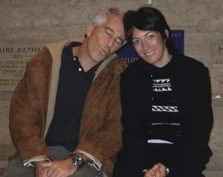
His longtime associate and convicted child sex#trafficker Ghislaine Maxwell declined today## to answer questions from a congressional# committee in a closed-door deposition.
GEOFF BENNETT: Maxwell, who was subpoenaed# by the House Oversight Committee last year,## said she was invoking her Fifth Amendment right to## avoid self-incrimination.
She appeared# by video from a prison camp in Texas,## where she's serving a 20-year prison sentence# for sex trafficking and other crimes.
Maxwell's deposition comes the same# day lawmakers were given access to## view the unredacted files.
That includes two# congressmen who led the congressional push## to release the Epstein documents.
That's# Congressmen Thomas Massie and Ro Khanna.
REP.
RO KHANNA (D-CA): It has exposed people in# the highest levels in technology, in finance, in## real estate.
It has exposed the establishment and# monarchies in other countries.
So our push is, how## do we expose this and have accountability, not how# do we score political points or have retribution?
GEOFF BENNETT: Our justice# correspondent, Ali Rogin,## has been tracking all of this and joins us now.
So, Ali, let's start with today's# developments.
What did we learn?
ALI ROGIN: There were a number of actions# today that really were efforts to pierce## through this shroud of secrecy that still# remains around many of these documents.
We did just hear from Congressmen Massie and# Khanna.
They said they have seen the names## of six men whose names were redacted# in the public version that they were## able to see today who they said would likely be# incriminated by their inclusion in these files.## They did not name the six men, but Massie said# one was a U.S.
citizen, one is a foreign national.
Four -- the other four, he said he could# not determine what nationality they were## based on their names.
He did say, though,# that one, presumably the one that we know## is a foreign national, is pretty# high up in a foreign government.
This is all happening as we're# learning that the FBI wrote a summary## in 2025 saying that there were -- quote --# "four or five Epstein accusers" who were## claiming abuse at the hands of men and# women.
Of course, we know that many more## survivors have come forward than four or# five, but that there was not enough evidence## to federally charge these individuals, so the# cases were referred to local law enforcement.
Meanwhile, as you mentioned, Ghislaine# Maxwell pleaded the Fifth today during## her deposition before the House Oversight# Committee.
But her lawyer did say that## she would -- quote -- "very much like to answer# questions if President Trump grants her clemency."
He added -- quote -- "Both President Trump# and President Clinton are innocent of any## wrongdoing.
Ms.
Maxwell alone can explain why# and the public is entitled to that explanation."
The last time, Geoff, President# Trump was asked about this,## he said he wouldn't rule in or out# granting Ghislaine Maxwell a pardon.
GEOFF BENNETT: And, separately, we know that# President Clinton has agreed to appear before## this committee at the request of the Republicans# who lead it.
Have those details been worked out?
ALI ROGIN: That's right.
We know so far that former.. Hillary Clinton are slated to sit# for separate closed-door videotaped## interviews before the -- depositions# before the House Oversight Committee.
But now Bill Clinton is saying that he does# not want that deposition to be videotaped,## but that he would participate in a public# hearing that people can watch in real time.
But House Oversight Committee chair James# Comer said today that this is the way that## he's conducted all of the depositions in# this investigation so far.
And he told us## today that Hillary Clinton's is scheduled for# February 27 and Bill Clinton for March 11.
GEOFF BENNETT: And there is an international# aspect to this, because you have U.S.
allies## that are dealing with their own version of the# Epstein scandal.
How is this landing overseas?
ALI ROGIN: Very differently.
There seem to be far bigger consequences for.. here in the United States.
The fallout in the U.K.# centers around Peter Mandelson, who was serving as## the U.K.
ambassador to the United States.
He# was appointed to that role by Keir Starmer.
Police are now investigating Mandelson for# alleged misconduct in public office tied to## e-mails he sent Epstein in which he shared# government information.
Mandelson maintains## he did nothing criminal, but the fallout# is already centering around Prime Minister## Starmer.
He's facing calls to resign,# including from members of his own party.
Already, his chief of staff and communications# director have resigned over this.
And, today,## he met with members of his own Labor Party,# presumably to try to shore up some support.## Also under police investigation# is Andrew Mountbatten-Windsor,## King Charles' brother.
The king said today through# a spokesperson that he -- quote -- "stands ready## to support the investigation" and that,# Geoff, his thoughts remain with the victims.
GEOFF BENNETT: And yet no# such reckoning stateside.
Why?
ALI ROGIN: That's exactly right.
And it's really -- although we shou.. just being mentioned in these files is not# a suggestion that there was any wrongdoing.
But the split screen#that is playing out between the political crisis in the U.K.
and business# as normal in the U.S.
is really striking.
And that's as new details are coming out# about President Trump and Commerce Secretary## Howard Lutnick's connection to Epstein and# things that they have told investigators.## We now know that Lutnick had even more# social interactions with Epstein than## had previously been revealed.
We covered# that last week on this show a little bit.
Now we know that Lutnick and Epstein both# signed documents to invest in a private## company on the same day.
And they traded# cordial messages for years about Manhattan## real estate.
Lutnick invited Epstein to a# fund-raiser for Hillary Clinton in 2015.
A spokesperson for the Department of Commerce# says this is a distraction and that the two men## met in 2005 and had -- quote -- "very limited# interactions with him over the next 14 years."
And, Geoff, on Trump himself, there# are new files reported on tonight by## The Miami Herald that President# Trump, not then-President Trump,## told investigators back in 2006 that -- quote# -- "Everyone knows he's been doing this,"## referring to Jeffrey Epstein, which, of course,# contradicts many of the things we have heard## publicly over the years from President Trump about# the nature of his relationship and when it ended.
GEOFF BENNETT: So much to track, and yet we can't## lose sight of the survivors.
What# are they saying about all this?
ALI ROGIN: That's exactly right.
Yesterday evening, to coincide with Super# Bowl Sun.. nonprofit World Without Exploitation released# a 40-second PSA featuring Epstein survivors.
WOMAN: We're standing together.
WOMAN: Standing.
WOMAN: Standing together.
WOMAN: Because this girl deserves the truth.
WOMAN: Because she deserves the truth.
WOMAN: Because we all deserve the truth.
ALI ROGIN: Geoff, this clip concludes with a# Q.R.
code inviting viewers to sign a petition## urging Attorney General Pam Bondi to# release evidence they say exists and## to provide an explanation for why millions# of pages remain withheld from public view.
GEOFF BENNETT: Ali Rogin, thank you# for this reporting.
We appreciate it.
ALI ROGIN: You bet.
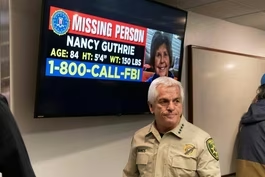
AMNA NAWAZ:## The day's other headlines begin in Arizona,# where the search for Nancy Guthrie,## mother of "Today Show" host Savannah# Guthrie, entered its second week.
And an apparent ransom# deadline is just hours away.
SAVANNAH GUTHRIE, Co-Host, "The Today Show": If# there's anything at all that seems strange to you,## that you report it to law enforcement.
We are in# an hour of desperation.
And we need your help.
AMNA NAWAZ: In a new plea today, Savannah Guthrie# credited law enforcement for working tirelessly,## but asked the public for# its help.
Over the weekend,## the Guthries said they are prepared# to pay for their mother's safe return.## Investigators to date have identified no# suspects or persons of interest in the case.
The U.S.
military boarded a sanctioned# oil tanker in the Indian Ocean today## after tracking the vessel from the# Caribbean.
The Pentagon posted video## of what it called a maritime interdiction# aboard the Aquila II, which experts say## departed Venezuela last month.
The Pentagon# did not say whether it had seized the ship.
Meantime, in Venezuela, opposition leader# Maria Corina Machado says an ally of hers## was kidnapped in Caracas less than 12 hours after# he was released from detention.
The country's top## prosecutor had called for Juan Pablo Guanipa to# be rearrested, but didn't say whether he had been.
Critics accuse Venezuela of backtracking# on its promises to the United States to## release political prisoners after# President Nicolas Maduro's removal.## The Trump administration left other# leaders of Maduro's regime in place.
Japan's Prime Minister Sanae Takaichi is# pushing her conservative agenda forward## after her party secured a supermajority# in Sunday's parliamentary election.
SANAE TAKAICHI, Japanese Prime Minister (through# translator): The people of our nation gave us## a powerful push forward, urging us to carry# through with a shift in policy, no matter what.
AMNA NAWAZ: Takaichi will be able to# fast-track many of her priorities,## which include cracking down on immigration,# tax cuts, increased government spending,## and boosting defense capabilities to stand# up militarily to China.
President Trump## congratulated Takaichi on social media,# calling her -- quote -- "highly respected## and very popular."
The two leaders# will meet in Washington next month.
In San Francisco, teachers walked off the job# for the first time in nearly half-a-century## with no set end date, closing public schools# for more than 50,000 students in the city.
(CHANTING) AMNA NAWAZ: The teachers in one of# the nation's most expensive.. are demanding a 9 percent pay raise# and greater help to deal with rising## health care costs.
The strike comes# after nearly a year of stalled talks.
Meanwhile, clear across the country,# a breakthrough.
New York City nurses## on a nearly monthlong strike say they# have reached a tentative three-year## deal for better staffing and pay# with two major hospital systems.## Nurses remain on strike with a third# hospital.
That's New York Presbyterian.
On Wall Street, stocks added slightly# to their rally last week.
The Dow Jones## industrial average barely budged, but# did not just small gain.
The Nasdaq## climbed by nearly 1 percent.
The S&P 500 rose by a# half-percent, inching closer to record territory.
The Seattle Seahawks basked in the glow# of victory today after beating the New## England Patriots last night 29-13 to# claim their second Super Bowl title.
Coach Mike Macdonald and game MVP Kenneth Walker# III posed with the Lombardi Trophy in Santa Clara,## California, today before the team# returned to their hometown fans.## Walker's standout performance on the ground# and the Seahawks' stifling defense held the## Patriots scoreless until the fourth# quarter, denying New England a record## seventh championship.
The Seahawks Super# Bowl parade will happen on Wednesday.
And, in Italy, Team USA has racked up two gold# medals to start after the Milan-Cortina Winter## Olympics opening weekend.
In the women's downhill# ski, Breezy Johnson won the U.S.
its first gold of## the Games, but her teammate, 41-year-old# Lindsey Vonn, crashed on her run and was## airlifted off the course.
Vonn was racing despite# tearing her left ACL just nine days prior.
Meanwhile, on the rink, U.S.
figure# skaters eked out a team win over Japan,## anchored by the so-called Quad God, Ilia# Malinin, who landed five quadruple jumps in## one of his routines.
He will skate again# in the singles events later this week.
Still to come on the "News Hour": Hong Kong# publisher and democracy advocate Jimmy Lai## is sentenced to decades in prison; we examine# the cultural impact of Bad Bunny's Super Bowl## halftime show; and Tamara Keith and Amy Walter# break down the latest political headlines.
GEOFF BENNETT: Despite last week's# announcement of a drawdown in federal## immigration enforcement agents in Minnesota,# tensions remain high in the Twin Cities.
AMNA NAWAZ: Some communities say they# have seen little change in the numbers## of arrests or sightings of federal officers.
And, as special correspondent# Fred de Sam Lazaro reports,## the crackdown has impacted nearly every aspect# of daily life, including many residents' health.
FRED DE SAM LAZARO: This is a new# routine for Viviana Salazar... VIVIANA SALAZAR, Volunteer:# I have already have a system.
FRED DE SAM LAZARO: ... filling boxes at a## Minneapolis food pantry for families# now too afraid to .. For weeks, networks of volunteers have sprung# up across the Twin Cities to bring supplies to## community members who fear that even venturing# to a grocery store could lead to their arrest,## as part of the massive federal immigration# crackdown known as Operation Metro Surge.
VIVIANA SALAZAR: I received a# message from a teacher saying,## my student had a glass of water for# dinner.
So that to me was heartbreaking.
FRED DE SAM LAZARO: When we met Salazar, she was# delivering food to a 45-year-old father who's been## in hiding for more than two months.
He declined# to be on camera, but spoke over the phone.
Day to day, what is the most difficult# things that you have to deal with?
MAN (through translator): The most# difficult thing is knowing what's## happening and not being able to go# out, locked in with fear that they## come knock on your door.
Because# of the fear and the worry, I cry.## It's the most heartbreaking thing to think about.# If you leave, you might not be able to come back.
FRED DE SAM LAZARO: The fear that is# forcing people to shut themselves in## extends far beyond just grocery# shopping.
Children are not being## sent to school.
Adults are not going# to work, complicating the challenge of## paying the rent.
And entire families# are putting off going to the doctor.
MAN (through translator): I have# type 2 diabetes and I have my pills,## but they're about to run out.
I have to# go pick up more, but I'm afraid to go out.
FRED DE SAM LAZARO: For years, researchers# have documented the possible health impacts## of immigration enforcement, from worsening chronic# conditions to poorer birth outcomes to heightened## anxiety.
The effects can be felt by both people# targeted in the raids as well as their neighbors.
At a press conference late last month,# dozens of Minnesota doctors spoke about## the challenge of providing# health care in this moment.
DR.
ROLI DWIVEDI, Minnesota Academy# of Family Physicians: I have been a## practicing physician for more th.. level of chaos and fear in the health care# for patients and for our health care teams.
DR.
BRYAN FATE, Children's Minnesota:# And it's not that people aren't sick.
FRED DE SAM LAZARO: Bryan Fate is a# pediatrician at Children's Minnes.. Emergency room visits at Children's are# down almost 25 percent, but when patients## do come in, they're often sicker.# Admissions have jumped about a third.
DR.
BRYAN FATE: I saw a girl who was about 5# years old last week.
She had sat at home for## essentially seven days with a fever# and an ear infection.
Pain was keeping## her up at night.
By the time that she had# presented to us, her eardrum had ruptured.
FRED DE SAM LAZARO: He's received accounts# from colleagues that paint a similar picture.
DR.
BRYAN FATE: There are cases of appendicitis# that have showed up late.
There are terrible## asthma exacerbations that came in late as well so# that, by the time you get there, the kid is really## struggling to breathe, 15-year-old with autism# who came in with abdominal pain.
And it turned## out that his mother had been detained about a week# earlier.
So he had about three meals in five days.
FRED DE SAM LAZARO: With the# number of families not coming in,## Fate says the situation is# eerily similar to the pandemic.
DR.
BRYAN FATE: This is not a virus causing# this.
It is an action of the government,## which can be redacted.
And I think there is a# feeling of helplessness there too.
We can do## our best to try and reach out to families and# to make things like telehealth more possible.
But, like vaccinations, kids are falling# behind on their healthy checkups.
When## families don't feel safe leaving the house,# when they have to balance the health of their## child with the safety of their family, no# family should have to make that decision.
FRED DE SAM LAZARO: Meanwhile,## fate says nonwhite hos.. At other hospitals, there are reports of federal## agents staying bedside with detainees and# trying to question or arrest patients.
WITNESS: I'm a physician.
MAN: I don't care.
FRED DE SAM LAZARO: Bystanders also# said officers prevented .. trying to treat Renee Good and Alex# Pretti right after they were shot.
The Department of Homeland Security told the "News## Hour" only that medics were -- quote# -- "on the scene" at both shootings,## but did not respond to other criticisms about how# Operation Metro Surge has impacted health care.
Across the Twin Cities, residents like Autumn## Brown say the crackdown has# strained their mental health.
AUTUMN BROWN, Minneapolis Resident: I# think most people's nervous systems are## really jacked up right now.
We're all living on# high alert.
And the human body can take a lot,## but our bodies aren't designed to be# on high alert for such a long stretch## of time.
It's absolutely wearing# on me.
It's wearing on all of us.
The terror is real.
And the care is# real.
And we feel that too every day.
FRED DE SAM LAZARO: One of the people trying# to provide that care is Valerie Carrillo.## She's a therapist at Canopy# Mental Health & Consulting,## which works with underserved# populations in the Twin Cities.
VALERIE CARRILLO, Canopy Mental Health &# Consulting: Clients of immigrant descent## are very hypervigilant right now and are taking a# toll from everything that's ha.. a daily stress-out.
I have seen those clients# physically in my sessions come in crying and## shaking and going through the emotions of having# that safety kind of pulled underneath from them.
FRED DE SAM LAZARO: Carrillo, whose family is# from Mexico, has carried her passport for months.
VALERIE CARRILLO: I think everyone in Minneapolis,# including my clients, every single one of them,## are experiencing collective trauma.# And I am too right there with them.
FRED DE SAM LAZARO: For Viviana Salazar,# also a U.S.
citizen of Mexican descent,## these food deliveries are how she's coping with# the realities of life in Minnesota right now.
Are you personally afraid for yourself?
VIVIANA SALAZAR: I am not afraid because I# don't look Mexican.
But my teenage daughter,## she has dark skin.
She has# black hair.
She has asked me:## "What am I going to do if they pull# me over?
Are they going to shoot me?"
And when she asked me that question,## my heart just broke.
I can't believe# we're living in this situation.
FRED DE SAM LAZARO: For the "PBS News Hour,"# I'm Fred de Sam Lazaro in Minneapolis.
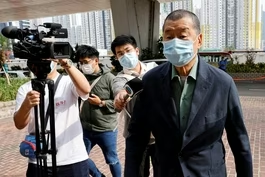
AMNA NAWAZ:## Hong Kong democracy advocate and former# media tycoon Jimmy Lai, who is 78 years old,## has been sentenced to 20 years in# prison by a Beijing-backed court.
GEOFF BENNETT: It is the longest sentenced# handed down under China's national security law,## legislation that has effectively# silenced dissent in a city that## for decades operated under British rule of law.
The U.S.
called the sentence by the China-backed# court and Lai's earlier conviction for so-called## collusion with foreign forces unjust.# Lai's children called it a death sentence.
Nick Schifrin has more.
NICK SCHIFRIN: Inside a Hong Kong court that# once proudly protected Western liberties,## authorities took an icon of# democracy away and confirmed## that criticism in this city will be# crushed with Chinese characteristics.
For decades, Jimmy Lai struggled for# Hong Kong's freedoms, an ever-present## force fighting to preserve the city's rule of# law.
He arrived in Hong Kong at the age of 12,## escaping communist China by stowing away# on a fishing boat.
He worked his way up## to become a media tycoon, one of the city's# most successful and powerful businessmen.
But in the summer of 2020, Lai became the# most prominent person arrested under Beijing's## sweeping national security law, which allowed# Beijing-backed authorities to punish people## for -- quote -- "provoking the hatred of Beijing"# or receiving any support from a foreign country.
That was Lai's conviction for -- quote# -- "conspiring to collude with foreign## forces" and for publishing -- quote# -- "seditious articles," sentiments## echoed today by China's Foreign Ministry.
LIN JIAN, Chinese Foreign Ministry Spokesperson# (through translator): His actions have gravely## endangered national security and severely# harmed Hong Kong's prosperity, stability,## and the well-being of its residents.
And,## therefore, he deserved to be severely# punished in accordance with the law.
NICK SCHIFRIN: And that makes Lai's detention and# sentence about more than the man; 30 years ago,## he founded Apple Daily, a tabloid willing to# criticize the Hong Kong and Beijing governments.## Today, six of its former employees were# also sentenced, further extinguishing Hong## Kong's press freedom, says Edward Li, another# former employee who's now in exile in Taiwan.
EDWARD LI, Former Employee, Apple# Daily (through translator): A former## Apple Daily colleagu.. and now you don't even have# the slightest bit left."
MAN: That criminalizes the exercise of# freedom of association and expression.
NICK SCHIFRIN: Today, the sentencing condemned by## the United Nations, other governments# and Secretary of State Marco Rubio,## who called it a -- quote -- "unjust# and tragic conclusion to this case."
It is especially tragic for Lai's# children.
Lai's daughter Claire## called the sentence heartbreakingly# cruel, saying, if it's carried out,## he will die a martyr behind bars.
His son# Sebastien today called it a death sentence.
I interviewed Sebastien last fall.
As you know, I interviewed your father in August# 2020, and this is my last question to him.
Are you resigned on a personal level to# being found guilty and spending a long time,## even perhaps the rest of your life, in prison?
JIMMY LAI, Founder, Next Digital: I don't# think about this because I don't want to## put the psychological burden on myself until# the time comes.
I'm not worried just because## my life is about myself.
It will be# meaningless.
Only when I detach from## myself and thinking of my life is about# something bigger and not about myself## that my life becomes meaningful.# And that makes me going every day.
NICK SCHIFRIN: What's your# response to watching that?
SEBASTIEN LAI, Son of Jimmy Lai: It's -- yes,## it's obviously very emotional.
And he# knew that despite obviously the danger,## to his life that he had something mattered# more.
And so he stayed and defended his## principles and defended his colleagues.
And# I'm so proud to call this man my father.
NICK SCHIFRIN: And, today, Sebastien# Lai appealed to President Trump to once## again push for Jimmy Lai's release# during an April trip to Beijing.
For perspective on all this, we turn to# longtime career diplomat and former U.S.## Ambassador to China during the Biden# administration Nicholas Burns.
He's## now professor of the practice of diplomacy and# international relations at Harvard University.
Nick Burns, thanks very much.# Welcome back to the "News Hour."
We have talked for years about# the erosion of democracy,## freedom of the media and press in Hong Kong,# and that rule of law in the city looks like## rule of law in mainland China.
And so what# makes this 20-year sentence so significant?
NICHOLAS BURNS, Former U.S.
Ambassador# to China: Nick, this is a travesty of## justice.
Jimmy Lai is a great man.
He is# the strongest voice for freedom, de.. press rights, individual rights in# either Hong Kong or China today.
And he was not judged by a jury of his peers,# but by a kangaroo court of judges appointed and## beholden to Beijing.
And so that's why this is# important.
There's a climate of fear in China## today.
There's increased repression# in this authoritarian dictatorship.
And he is the most prominent case.
And I# think it's very positive that Secretary## Rubio issued the statement today, positive# that President Trump raised the case of Jimmy## Lai with President Xi Jinping when they met# last autumn.
And I hope very much that the## Chinese are now going to come under a lot# of pressure, the government of Beijing,## to issue a humanitarian release of Jimmy Lai to# live in his remaining years wherever he wants.
I think that's what the United# States should be pushing for.
NICK SCHIFRIN: Lai's children have# said that he is of ill health.
But remind us, what did Beijing promise when the# United Kingdom handed over Hong Kong back in 1997?
NICHOLAS BURNS: I remember very distinctly,# Nick.
I was with our secretary of state,## Madeleine Albright, in Hong Kong on June# 30, 1997, when the United Kingdom handed## over control and rule in Hong Kong# to the People's Republic of China.
And the Chinese leadership told us privately# and they told the world publicly that there## would be 50 years of autonomy for the people# of Hong Kong, that their individual rights,## like freedom of speech and freedom of the# press, would be guaranteed.
And so of course,## this sentencing and the national security# law that has taken place in Hong Kong has## made the Chinese renege on all of their# promises to the people of Hong Kong.
And it's a very, very bitter result.# So they have gone back on their word,## as many people suspected that they would.
And# that's a warning.
That's a warning to the people## of Taiwan.
When the government of Beijing blithely# says, we will let you have the same freedoms that## you enjoy now, that won't be the case if# the Chinese succeed in taking over Taiwan.
NICK SCHIFRIN: The Hong Kong office of China's# Foreign Ministry today issued a statement, saying## that foreign media should -- quote -- "respect# the independents of Hong Kong's judicial process."
Is there any doubt that Hong Kong's# judicial process is beholden to Beijing?
NICHOLAS BURNS: None whatsoever.
In fact,## Hong Kong today is a fully owned subsidiary# of the People's Republic of China.
I was there in 2024 while I was in China# as ambassador.
I went to Hong Kong,## in fact, during the week when this odious# national security law was strengthened,## and saw the fact that freedom of# speech had largely disappeared then## and that businesspeople had been cowed, both# Western, as well as Hong Kong business people.
And there was very little, if any,# freedom of the press.
And I think## today's sentencing has really put# the lid on what was once a great,## great role that the Hong Kong citizens had in# living in a free society next to mainland China.
NICK SCHIFRIN: As you mentioned and# as Sebastien Lai mentioned today,## President Trump did bring Jimmy Lai up to# Xi Jinping late last year.
President Trump,## of course, is going to visit Beijing# in April.
Do you think there is any## leverage that the U.S.
could push# for Beijing to release Jimmy Lai?
NICHOLAS BURNS: I think that there's a strong## outcry by the democratic world# and the United Kingdom, certainly,## and the United States and elsewhere that this# is unjust, that Jimmy Lai should be free.
He's already lived, Nick, five years in solitary# confinement, and he's not well.
And so I think,## if the outcry is strong enough, and if our# government and the British government push## strongly enough, there is a chance that the# government in Beijing will decide that a## humanitarian parole may be is in their best# interest because this really shines a light## on the fact that the government of Xi Jinping is# increasingly oppressive, increasingly autocratic.
You see the number of businesspeople, the# number of military people who've disappeared,## brought up on charges of corruption.# And so the climate in China is very,## very severe right now, much# more so than 10 to 20 years ago.
NICK SCHIFRIN: Well, as you say, it's not# only Jimmy Lai.It's not only Hong Kong or## democracy or press freedom.
Business# leaders, Communist Party members,## Christian Uyghurs, I mean, they have# all been targeted by Xi Jinping's China.
And now we have, as you just alluded# to, the equivalent of the chairman## of the Joint Chiefs of Staff basically.# You see him there, General Zhang Youxia,## essentially disappeared or he's been fired# all of a sudden.
What do you make of this?
NICHOLAS BURNS: This is the most important purge# of a military leadership in China since 1971,## when Lin Biao, who was the successor# to Mao Zedong, failed in a coup attempt## and died in a plane crash.
There's# been nothing like it in China since.
General Zhang was a close friend and associate# of President Xi.
And the fact that he's been## purged and that nearly the entire military# leadership of the country has been brought## up on corruption charges, these are really# uncharted waters for President Xi.
And it## indicates that he obviously wants full# and absolute control of his government.
Maybe there's a sense of paranoia here,# that he feels that he can't allow other## people to have any degree of power.
He# has not named a successor.
And, in 2027,## next year, he will very likely# decide to try to have a fourth## five-year term in office.
And that means# probably he will be president for life.
So this is a very significant development,# both the sentencing today, but also the## purge of the military.
And on top of that,# Nick, the Chinese in November and December## launched a major arrest of religious# leaders, Christian leaders in China.
NICK SCHIFRIN: Absolutely.
Nick Burns, form.. NICHOLAS BURNS: Thanks, Nick.
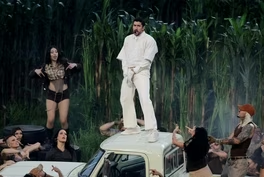
AMNA NAWAZ:## Last night's Super Bowl halftime show by# Bad Bunny delivered a powerful message## and made international headlines today.# The Grammy-winning Puerto Rican rapper,## singer and producer, whose full name# is Benito Antonio Martinez Ocasio,## is one of the most popular# musical artists on the planet.
His 13-minute set was historic, the very# first in Super Bowl history performed## nearly entirely in Spanish.
The# show was dense with symbolism,## including messages of Puerto Rican pride and# independence.
But it also quickly became a## magnet for criticism from the president# and others even before he took the stage.
To help us unpack it all, we're joined now by# Vanessa Diaz.
She's an associate professor at## Loyola Marymount University and the author of# the book "P FKN R: How Bad Bunny Became the## Global Voice of Puerto Rican Resistance.
This is# all part of our arts and culture series, Canvas.
Vanessa, welcome to the# show thanks for joining us.
VANESSA DIAZ, Loyola Marymount University:# Of course.
Thank you for having me.
AMNA NAWAZ: So you literally wrote# the book on Bad Bunny.
You teac.. a course on his cultural impact.
For anyone# unfamiliar, just how big a star is Bad Bunny?
VANESSA DIAZ: Bad Bunny right now is# the world's most streamed artist.
So## that just gives you a sense of the gravity.# This isn't someone who just is popular in his## hometown.
On a global level, Bad Bunny# is the number one artist.
And in fact,## he was three other years as well,# 2020 to 2022.
This isn't a new thing.
His popularity just keeps growing.
He# just recently got the first ever Grammy## Album of the Year for a Spanish-language album,## his album "Debi Tirar Mas Fotos."
And he# won two other Grammys last week.
So he has## broken records we never imagined possible# for a Spanish-language artist.
And he's## been doing that for some time.
So on a global# level, Bad Bunny is a massive, massive star.
AMNA NAWAZ: So your book situates Bad Bunny in the# legacy of what you call Puerto Rican resistance.## Walk us through some of the moments in which we# saw that play out during yesterday's performance.
VANESSA DIAZ: I think one of the most profound# moments where Bad Bunny showed himself to be## not just a figure of resistance, but carrying# the long tradition behind him, is when,## just before he started the song "El Apagon,"# he emerges from the fields with a flag,## a Puerto Rican flag over his shoulder.
And if you notice, the triangle in blue# is actually the light blue.
And the light## blue is a symbol of Puerto Rican independence.# That's the color of the flag before the U.S.
in## 1952 changed the color to the dark blue to# mimic the colors of the American flag.
And## so that light blue is really symbolic of# advocating for Puerto Rican independence.
And as he walked out with that flag, we saw those## folks who were the cane field workers in# the beginning climbing these electrical## poles.
And that was a reference to what was the# longest blackout in American history following the## devastating Hurricane Maria in 2017 that left# Puerto Rico without power for almost a year.
So that song "El Apagon" means "The Blackout.
"# And so it was these workers, cane workers now## climbing the poles to repair electrical# issues.
And in the wake of the hurricane,## one thing that was really striking was that# the U.S.
was not responsive.
And Puerto## Ricans with no experience often climbed these# electrical poles to start reconnecting wires,## risking their lives to try to bring# their communities electricity.
And all of that was part of the meaning# behind these things that some might not know.
AMNA NAWAZ: There were some special guest stars# as well performing with him.
We saw Lady Gaga and## Ricky Martin.
Tell us in particular about the# song Ricky Martin sang.
Why is that important?
VANESSA DIAZ: Oh, so Ricky Martin# took the stage to perform the song## "Lo Que Le Paso a Hawaii," which# is, "What Happened to Hawaii?"
And this song is perhaps the most# pointed political song on the entire## album "Debi Tirar Mas Fotos."
And it's# really about Hawaii and Puerto Rico as## two nations that were taken by the# U.S.
in 1898 and one became a state## and one is the commonwealth, some might# call it a colony, of Puerto Rico, right?
And so there's this tension around what should# happen to Puerto Rico.
And in that song,## Bad Bunny is saying he doesn't want us to be# like Hawaii, doesn't want Puerto Rico to become## a state.
And Bad Bunny had people at his residency# every Sunday night.
He had a guest sing that song.
And so this was a kind of nod to the residency and# also giving Ricky Martin, who had to cross over in## English to become the massive star that he became,# and to have him take the world's biggest stage and## be able to perform in his native language of# Spanish representing Puerto Rico and do this## political work he could never do as a mainstream# artist 25 years ago was very significant.
AMNA NAWAZ: We mentioned some of the criticism.# You saw the president describe the performance## as -- quote -- "an affront to the# greatness of America."
He said:## "Nobody understands a word this guy is saying."
As you also reported, Turning Point USA,# the conservative political group that was## founded by Charlie Kirk, held a counterprogramming# halftime show.
They billed it as the All-American## Halftime Show.
They saw upwards of some six# million viewers.
What do you make of that## sort of broader backlash both to his selection to# perform in the first place and the performance?
VANESSA DIAZ: I mean, from the moment Bad Bunny# was announced, there was immediate backlash.## And the reality is that has everything to do# not just with the current political moment,## but with the entire history of the U.S.# construing, in like a mainstream narrative,## construing Latinos as perpetual foreigners who# do not belong, who are a threat to the U.S.
And so this language of criticizing his# performance and calling him un-American## is just the perpetuation of these stereotypes,# despite the fact that he is an American citizen.## And I think that the fact that the halftime# show that Turning Point USA created was called## the All-American Halftime Show just goes to# show you that this isn't about citizenship.
This is actually about racism against Latinos.
And## that's just blatant to see because it# insinuates that Bad Bunny's halftime## show was not American.
And that was the# antithesis of what the performance was.
BAD BUNNY, Musician: God bless, America,# Chile, Argentina, Uruguay, Paraguay.
VANESSA DIAZ: He talked about the fact that# not only do Latinos belong here in the U.S.,## we are an integral part of American# culture, and that America, America,## as he says, is actually more than just# the U.S.
It's all of the Americas.
AMNA NAWAZ: Despite the criticism, you# may have seen the embrace that he and## NFL commissioner Roger Goodell shared# backstage after his performance.
The## NFL even shared that moment online,# clearly happy about their choice.
From a business and cultural perspective,# why was Bad Bunny a good choice for the NFL?
VANESSA DIAZ: Well, the NFL is a business# organization.
Their primary concern is,## is this good business?
And there's no doubt,# I don't think by anyone's -- there's no## doubt from anyone that this was# the smartest business decision.
Bad Bunny is the biggest artist in the# world.
He's the most streamed artist in## the world.
He is selling out stadiums all# over the world.
So I think that Bad Bunny## was not just a natural choice.
He was the# best choice from a business standpoint.## And so this just happens to be a moment# with something very political coincided## with a strategic business decision.# And I'm really happy about that.
AMNA NAWAZ: That is Vanessa Diaz, associate# professor at Loyola Marymount University.
Vanessa, thank you so much for# your time.
Good to speak with you.
VANESSA DIAZ: You too.
AMNA NAWAZ:## Since it reopened in March of 2025, the# ICE family detention center in Dilley,## Texas, has held around 3,500 people,# more than half of them children.## The center was first opened# in the Obama administration,## shuttered by President Biden in 2021, then# reopened under President Trump last year.
As reports of contaminated food and the spread# of measles have made national headlines,## ProPublica went inside the facility, and# through phone calls, letters and e-mails,## spoke to two dozen detainees about# the treatment of minors inside.
Mica Rosenberg of ProPublica joins me now.
Mica, welcome to the "News# Hour."
Thanks for joining us.
MICA ROSENBERG, ProPublica:# Thank you so much for having me.
AMNA NAWAZ: So, as you have been speaking with# these detainees for weeks now, half of them kids,## we should just point out these are some# of the kids you have been talking to,## 18-month-old Amalia and her family.
She's blowing# kisses to the screen here -- 13-year-old Gustavo.
I know they're sharing their experiences# with you.
Just tell us about what some## of the common threads are, some of the# common stories you have heard from them.
MICA ROSENBERG: Well, I think one thing# that really stands out in what's happening## in Dilley now is that, as you mentioned,# this facility opened up during the Obama## administration and families were housed# there, but they were mainly families who## were coming across the border and were# there supposedly for a short period of## time and hoping to be released into the United# States or to come here for the first time.
But what's happening now is, many of the# children that I spoke to are actually kids## who've been living in the United States for --# some for years, and their families were picked up## by ICE arrests in the interior,# some of them at regular check-ins.
And so a lot of the kids that I talked to had# really, in some cases, established U.S.
lives.## Some of them spoke perfect English.
Some of# them were in the middle of their high school## years when they were detained.
And so that's one# thing that was quite different than in the past.
AMNA NAWAZ: And we mentioned# those reports about measles## cases and some inedible food.
Did you# hear some of that from the kids inside?
MICA ROSENBERG: Yes, we heard -- one of the# things that we were trying to do with this## reporting was really to get the kids to talk# about their experiences in their own words.
And so one of the things that they did is,# some kids about what they were going through## drew pictures about their experiences, and# they talked about the repetitive food, some## of them saying that they were sick constantly or# getting sick, they maybe believed, from the water.
But some of the more vivid descriptions about# the conditions really came from their mothers,## who I spoke to over the phone or who e-mailed# me.
And they would talk to me about food that the## kids could see or they believed was contaminated# and that it was giving their children sickness.
And the administration says that these# conditions are not what they're described## as.
But this is from the firsthand experience# of the detainees inside.
One thing that we## did -- found is that there were over 300# kids who had been there longer than the## average of 20 days, which is what under a# longstanding legal settlement is supposed## to be the standard of how long kids# should be detained for and no longer.
AMNA NAWAZ: We know officials from the# administration have said the families## are getting top-notch care inside# Dilley.
They say they get medical## care and good food and learning# services, special caregivers.
You spoke with Alexander Perez,# 15-year-old from the Dominican## Republic who talked to you specifically# about school.
What did he tell you?
MICA ROSENBERG: Well, he said that# school is -- for the kids inside is## really only an hour a day.
There's -- the# classes are capped at 12 kids per class.
And they said that it really only# consisted of kind of worksheets, handouts,## and that because the different age groups are# mixed together -- and so a lot of the kids,## as I mentioned, who were sort of in# the middle of their school year were## really missing their education.
They# were worried about falling behind.
AMNA NAWAZ: Is it just a matter, Mica,# repetitive food and inadequate learning## or is there something more serious in terms# of the emotional or mental toll that you saw?
MICA ROSENBERG: I think their parents were# very worried that they were experiencing## more serious distress.
Mothers told me# about some kids who were self-harming,## who had cut themselves, other kids who had# spoken of suicide, kids who were very much## older than they should have been starting to wet# their bed, not being able to sleep well at night.
So these are more things that the mothers# told me about and the kids would talk## more generally.
So I think it's hard to# say what the long-term impact will be,## but I think it was -- it's been difficult on them.
AMNA NAWAZ: And I know you were able to speak# with some parents and kids after some of them## were released.
What did they tell you?
Were# they able to go back to their lives as normal?
MICA ROSENBERG: Well, a lot of it happened# relatively recently.
After I spoke to them,## they were released.
I did speak to one girl, Ariana, who was 14.. where she was welcomed by the# principal and her teachers,## who said that they had really missed her.
She# had worried about her grades and falling behind,## but they said that they would try and support her.
But she -- when she and her mother were detained,## they left behind two U.S.
citizen siblings,# a 2-year-old and a 5-year-old.
They were## detained in their regular check-in# and just didn't come home that day.
So## her siblings were really sort of traumatized by# that.
And her little brother said that he was## afraid to go to school because he was worried# that they wouldn't be there when he came back.
So I think it's a combination of how the# kids in detention are being impacted,## but also the ones who are left outside.
AMNA NAWAZ: That is Mica Rosenberg# of ProPublica joining us tonight.
Mica, thank you so much your# time and your reporting.
MICA ROSENBERG: Thank you so much for having me.
GEOFF BENNETT: A new poll shows what Americans# think of President Trump and his policies,## and it's not good news for the White House.
For more, we turn to our Politics# Monday duo.
That's Amy Walter of## The Cook Political Report With Amy# Walter and Tamara Keith of NPR.
It's always great to see you both.
So, Amy, the latest PBS News/NPR/Marist poll# .. the job that President Trump is doing,# with a majority strongly disapproving.
How significant is the intensity of that# opposition at this point in his term?
AMY WALTER, The Cook Political Report: Yes, well,## we also took this new poll fro.. Political Report poll tracker, which# is an aggregator of 21 national polls.
And what we found this week is# that the president actually is## at his lowest standing of his second# term at this point.
And it's really## driven by some key constituents that have# soured on him since he was first sworn in,## Latino voters, younger voters, independent voters.# Those were all critical to his success in 2024.
But the group that really is# the most fascinating to me,## and I think it's going to be really important# as we watch these next few months go forward,## are the voters that we always think# of as his core constituencies,## white working-class voters who have long# been very much behind the president.
We're seeing some significant slippage there, both# in the PBS poll and in The Cook Political Report## aggregator.
And these are the kinds of voters# that, you could argue that the slippage is really## driven by views on the economy, the frustration# about inflation and the cost of living.
And when you look at the battleground# states that are going to determine the## makeup of the House, but especially# the Senate, they run through places## where white working-class voters make up# a significant portion of the electorate.
GEOFF BENNETT: And, Tam, say more about that,## because President Trump expanded his# coalition in 2024, b.. expansion now appears to be slipping away.
Of# course, we don't know how enduring that is.
TAMARA KEITH, National Public Radio: Right.
GEOFF BENNETT: But it's a snapshot in time.
TAMARA KEITH: Right.
And the intensity of that di.. January 6 attack.
So there -- riot.
And so it's# pretty dramatic and it's a challenge for him.
And## as you say, he had expanded the base.
He didn't# win because of the base.
He won because of all## of these other people, independent voters, young# voters, Hispanic voters, as Amy's talking about.
On Air Force One over the weekend, we# reporters asked him a lot of questions## at one point.
He said something about# his base that I think really stands## out.
He is so focused on his base.# And with his base, the narrow base,## the titanium piece of the pie that he has had# since the beginning, he has strength still.
And what he says is "My base has# never been stronger.
My base is## me."
And then let's put an ellipsis# to get to the end of what he said.## "You could call it the America first# base.
They couldn't be more thrilled."
And that is who he's playing to.
And that is the# very reason that he's losing these other sort of## expansion voters that he had gotten.
And those are# -- the independent voters, these sort of expansion## voters, these are the people who are going to# decide the majorities in the House and the Senate.
GEOFF BENNETT: It sounds like the president is# trying to speak some support into existence?
AMY WALTER: Well, that's right.
That's right.
GEOFF BENNETT: This plays into a#.. AMY WALTER: Yes, which is, again, if# you are starting to lose -- he's not## doing worse with Republicans.
But his approval# rating among those white working-class voters## definitely has shrunk.
It's by about nine# points since the beginning of last year.
And, again, the economy is a big driver# of it.
The president likes to say the## economy is booming, everything's fine,# inflation has been tamed, it's a hoax,## this affordability thing that he's# been hearing about in the press.
But if you're a Republican on the ballot next# year, you can't afford that to be the message## that affordability is not such a big deal.# You want to talk about what you have done as## a Republican to help tame that.
Now, what# Republicans are hoping is that, in these## next few months here, as people filed their# taxes, they're going to get some nice refunds.
And there are studies out there showing# that Americans are going to get a bigger## refund this year than they did in 2025.# Are they going to remember that by the## time November rolls around?
That's a# really big question mark over that.
And our voters going to feel -- this is the other# frustration that they're having right now -- that## the president is rightly focused on affordability,# instead of being focused on a whole bunch of other## things that don't seem to have to do much with# bringing down the cost of stuff in their life?
GEOFF BENNETT: Yes, so the president# losing support on his handling of the## economy.
He's also losing support# for issues like the posting of that## racist meme on his social media# accounts attacking the Obamas.
I raise this because you mentioned# you were on Air Force One.
TAMARA KEITH: Yes.
GEOFF BENNETT: A.. the president all but admitted that it was he# who posted that meme online after the White## House initially denied wrongdoing and then# blamed it on a staffer.
Fill in the blanks.
TAMARA KEITH: Yes, so the White House was calling# this fake outrage.
It wasn't fake outrage.
There## were many Republicans who came to the president# and said, this is bad, you have got to remove it.
The fact that they removed it is an admission# of something they almost never admit, which is## that there was an error.
This was a mistake.
Now,# President Trump, his response was, yes, I saw the## beginning of the video, but I didn't see the end# of the video and, really, he thought he was just## posting what, based on viewing it, is an election# denial conspiracy theory from the 2020 election.
But that's what he said he wanted to post.# What he actually posted was that with this## racist meme sort of embedded in it.
And he# said, though, he told his staff to put it## out.
He also said, there's no reason to# apologize.
In an answer to me, he said,## no, he wasn't firing anyone.
He# said he didn't make a mistake.
And, in fact, he said he's the# least racist president that we## have had in a long time, which is quite a claim.
GEOFF BENNETT: This would not be the# first time where the White House seeks## to clean up something for the president# and then he undoes the cleanup job... which speaks to this question#of, if the White House comes up with messaging, how good is that messaging if# the president can't stick to it?
AMY WALTER: Right.
And there is -- they# need him to stay on message for their own,## but they also need him to be in# front to keep the base motivated.
GEOFF BENNETT: Amy Walter,# Tamara Keith, always a pleasure.
TAMARA KEITH: Thanks.
AMY WALTER: Thank you.
GEOFF BENNETT: And that's the "News Hour" for#tonight.
I'm Geoff Bennett.
AMNA NAWAZ: And I'm Amna Nawaz.
On behalf of the entire "News Hour"# team, ..
The cultural impact of Bad Bunny's Super Bowl halftime show
Video has Closed Captions
Clip: 2/9/2026 | 8m 19s | The cultural impact of Bad Bunny's Super Bowl halftime show (8m 19s)
Epstein files fallout grows as Maxwell pleads Fifth
Video has Closed Captions
Clip: 2/9/2026 | 7m 22s | Epstein files fallout grows as Ghislaine Maxwell pleads Fifth before Congress (7m 22s)
Jimmy Lai sentenced to 20 years by Beijing-backed court
Video has Closed Captions
Clip: 2/9/2026 | 11m 6s | Jimmy Lai sentenced to 20 years in prison by Beijing-backed court (11m 6s)

Minnesota ICE operation impacts medical care, mental health
Video has Closed Captions
Clip: 2/9/2026 | 7m 21s | How the ICE operation in Minnesota is affecting medical care and mental health (7m 21s)
News Wrap: Search for Nancy Guthrie enters second week
Video has Closed Captions
Clip: 2/9/2026 | 5m 8s | News Wrap: Search for Nancy Guthrie enters second week (5m 8s)

Reporter details life for children in Texas migrant facility
Video has Closed Captions
Clip: 2/9/2026 | 6m 14s | Reporter details life for children and families detained in Texas migrant facility (6m 14s)
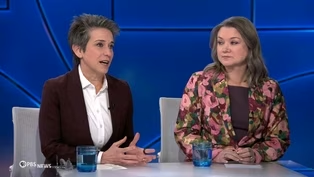
Tamara Keith and Amy Walter on Trump's low approval ratings
Video has Closed Captions
Clip: 2/9/2026 | 7m 3s | Tamara Keith and Amy Walter on Trump's low approval ratings (7m 3s)
Providing Support for PBS.org
Learn Moreabout PBS online sponsorship
- News and Public Affairs

FRONTLINE is investigative journalism that questions, explains and changes our world.

- News and Public Affairs

Amanpour and Company features conversations with leaders and decision makers.












Support for PBS provided by:
Major corporate funding for the PBS News Hour is provided by BDO, BNSF, Consumer Cellular, American Cruise Lines, and Raymond James. Funding for the PBS NewsHour Weekend is provided by...