
What the Iran talks mean for Lebanon and regional conflict
Clip: 6/22/2026 | 7m 55sVideo has Closed Captions
Two views on what the latest Iran talks mean for Lebanon and regional conflict
For two views on the U.S.-Iran negotiations in Switzerland and the agreement that ended the war, Nick Schifrin speaks with Mouin Rabbani, a non-resident senior fellow at the Middle East Council on Global Affairs, and Jonathan Conricus, a former spokesperson for the Israeli Defense Forces.
Problems playing video? | Closed Captioning Feedback
Problems playing video? | Closed Captioning Feedback
Major corporate funding for the PBS News Hour is provided by BDO, BNSF, Consumer Cellular, American Cruise Lines, and Raymond James. Funding for the PBS NewsHour Weekend is provided by...
What the Iran talks mean for Lebanon and regional conflict
Clip: 6/22/2026 | 7m 55sVideo has Closed Captions
For two views on the U.S.-Iran negotiations in Switzerland and the agreement that ended the war, Nick Schifrin speaks with Mouin Rabbani, a non-resident senior fellow at the Middle East Council on Global Affairs, and Jonathan Conricus, a former spokesperson for the Israeli Defense Forces.
Problems playing video? | Closed Captioning Feedback
Where to Watch PBS News Hour
PBS News Hour is available to stream on pbs.org and the PBS app.
Providing Support for PBS.org
Learn Moreabout PBS online sponsorshipNICK SCHIFRIN: We now have two views on the U.S.-Iran negotiations and the agreement that ended the war.
Mouin Rabbani is a former U.N.
official and is a non-resident senior fellow at the Middle East Council on Global Affairs.
And Jonathan Conricus is a retired Israeli lieutenant colonel who led forces in Lebanon and Gaza and served as the IDF's international spokesperson.
He's now a senior fellow at the Foundation for Defense of Democracies.
Thanks very much.
Welcome, both of you, to the "News Hour."
Mouin Rabbani, let me start with you, and let me start with today's news that came out of Vice President Vance, that it was lifting sanctions on Iran, selling oil for 60 days.
What's your response to that announcement?
MOUIN RABBANI, Senior Fellow, Middle East Council on Global Affairs: Well, I think this is an indication that the memorandum of understanding is beginning to produce serious negotiations between the United States and Iran.
I think we have to disabuse ourselves of the illusion that an agreement can be reached within the next 60 days, but at least it could set the basis for constructive diplomacy and create the space and the additional time that will be required to reach an agreement ultimately between the U.S.
and Iran.
I think it's a positive and hopeful sign.
NICK SCHIFRIN: Jonathan Conricus, the U.S.
lifting sanctions on Iran selling oil sets the basis for diplomacy?
Do you agree?
LT.
COL.
JONATHAN CONRICUS (RET.
), Former International Spokesperson, Israel Defense Forces: No, and I think that history teaches us that paying bloodthirsty murderers and terrorists, whether they are of a country or just a terrorist organization, never ends well.
When you pay terrorists money, they are usually emboldened, and I will not be surprised to see that the money that the Iranian regime will make out of this very, very generous American concession won't go for the benefit of the Iranian people.
It will go towards armament, weapons, trying to fund Hezbollah and Hamas and other terrorist organizations.
And I don't think that much positive will come out of it.
NICK SCHIFRIN: Mouin Rabbani, the other major news from the U.S.
today was the announcement of a mechanism of deconfliction.
That's the phrase that J.D.
Vance used for regional cease-fire, essentially for the war in Lebanon.
And the vice president gave an example.
He said that a low-level Hezbollah operative who, of course, has been fighting Israel who was not following orders, but fired a drone at Israel and then Israel fired back.
So is this a step in the right direction?
And what do you think about Vance's characterization of the war?
MOUIN RABBANI: Well, I think the establishment of a deconfliction cell regarding Lebanon is also a positive development, and it shows that we're making the transition from the general political statements that were included in the memorandum of understanding, that we're transitioning to serious, detailed, technical discussions and actual implementation.
And the purpose of this deconfliction cell, the unstated premise, is that Israel appears determined to continue and, where possible, to escalate its military aggression in Lebanon in order to both continue with its objectives in Lebanon and in order to seek to derail U.S.-Iranian diplomacy.
And this is essentially the U.S.
and Iran together putting the shackles on Israel and preventing it from carrying out those intentions and those plans.
NICK SCHIFRIN: Jonathan Conricus, is Israel trying to derail this diplomacy?
LT.
COL.
JONATHAN CONRICUS: I think what Israel is trying to do is to defend itself and live in peace in its internationally recognized borders without the attack of Iranian proxies, Hezbollah being the most dangerous and best armed one.
Hezbollah is now in trouble, and that's why their masters, the Iranian regime, is, they're rushing to defend and try to save Hezbollah.
And that is what this is about.
This is not about the territorial sovereignty of Lebanon.
It's not about the Lebanese people.
The Lebanese people, by the way, are represented by the Lebanese government.
And the Lebanese government says very clearly that they don't want Hezbollah as an armed foreign entity in their country, and that Hezbollah doesn't have the legitimacy to fight against Israel.
And communications was never a problem.
There already is a mechanism.
I have been part of it.
I was a liaison officer to U.N.
peacekeepers in Lebanon, and I was part of the mechanism that carried messages between Israel and the Lebanese armed forces.
But the problem is that, with an organization like Hezbollah, a jihadi organization that is sworn to destroy the state of Israel and kill as many Jews as they can, the problem was never, how can we communicate?
The problem is, why do they exist on our northern border and why has Iran been able to provide them with weapons and money, as they have been for over so many years?
And why is this now happening?
And why is this connection being made between the Strait of Hormuz and Lebanon?
I think the Lebanese people, Israelis, and many other people are going to regret if this is the way things go forward.
NICK SCHIFRIN: Mouin Rabbani, why do we need another mechanism?
What difference can it make?
MOUIN RABBANI: Well, look at what happened with the previous mechanism that was established in November 2024 as part of the cease-fire agreement that was reached then.
It was thoroughly ineffective.
Israel violated that cease-fire on a daily basis, killing hundreds of Lebanese, conducting assassinations in the heart of Beirut.
And so the purpose of this new deconfliction cell, as it's called, is to find a more effective alternative that can actually restrain Israel this time around.
You know, the question was just posed, why does Hezbollah even exist?
Well, there's a very simple reason, and that is because, in 1982, Israel conducted a failed campaign to destroy the PLO in Lebanon in its invasion of Lebanon at that time.
And that set the basis for the establishment and emergence of Hezbollah.
It's certainly true that Hezbollah would like to see Israel dismantled, and it's equally true that Israel has an official policy of destroying Hezbollah.
That's why it's been fighting in Lebanon and occupying a good part of Lebanese territory.
NICK SCHIFRIN: Jonathan Conricus, you're shaking your head.
Just in the last minute that we have.
LT.
COL.
JONATHAN CONRICUS: Yes., Let's remind our American viewers that Hezbollah is a U.S.-designated terror organization with buckets of American blood on their hands, let alone Israeli blood, and they are nothing of the like.
Hezbollah are a proxy organization of the Islamic Republic of Iran.
They are foreign.
They serve foreign interests, those of Iran.
They do not represent Lebanon.
And that's not me saying it.
That is the democratically elected government in Lebanon that says so.
And, frankly, it makes me puzzled why the U.S.
is conducting two parallel processes, one, the negotiations with the Islamic -- With the Islamic state of Iran regarding Hormuz and linking it with Lebanon, but then also, parallel to that, trying to make peace between Israel and Lebanon.
These two processes, these two tracks cannot work together.
They are mutually undermining each other, and I really hope that the ones where the sovereign state of Israel, speaking with the sovereign state of Lebanon without Iranian interference, is the one that will prevail, for the benefit of everybody in the region.
NICK SCHIFRIN: We will have to leave it there.
Mouin Rabbani, Jonathan Conricus, thanks very much to you both.
MOUIN RABBANI: Thank you.
Lt Col.
Jonathan Conricus: Thank you
Beset by algae, Reflecting Pool set to undergo more repairs
Video has Closed Captions
Plagued by algae and peeling paint, Reflecting Pool set to undergo more repairs (3m 31s)
DOJ memo questions protections for people with disabilities
Video has Closed Captions
New Justice Department memo questions decades of protections for people with disabilities (5m 49s)

The legacy of Alan Greenspan, 'maestro' of the U.S. economy
Video has Closed Captions
Remembering the legacy of Alan Greenspan, 'maestro' of the U.S. economy (6m 39s)

Music industry titan and hitmaker Clive Davis dies at 94
Video has Closed Captions
Music industry titan Clive Davis, who turned artists into stars across genres, dies at 94 (3m 21s)

News Wrap: SCOTUS reinstates murder conviction in Patz case
Video has Closed Captions
News Wrap: Supreme Court reinstates murder conviction in Etan Patz case (6m 52s)

Scientist tracks melting glaciers for nearly half a century
Video has Closed Captions
The scientist and his family tracking melting glaciers for nearly half a century (6m 11s)
Tamara Keith and Amy Walter on GOP’s new rifts over Iran
Video has Closed Captions
Tamara Keith and Amy Walter on new rifts between Trump and GOP leaders over Iran (8m 7s)

UK’s Starmer resigns, succumbing to political pressure
Video has Closed Captions
Starmer resigns as UK’s prime minister, succumbing to political pressure (3m 40s)
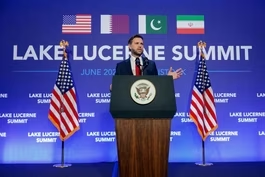
Vance touts progress in Iran talks as U.S. pauses sanctions
Video has Closed Captions
Vance touts progress in Iran talks as U.S. temporarily lifts oil sanctions (4m 21s)
Providing Support for PBS.org
Learn Moreabout PBS online sponsorship New Episode
- News and Public Affairs

Today's top journalists discuss Washington's current political events and public affairs.

- News and Public Affairs

FRONTLINE is investigative journalism that questions, explains and changes our world.
 New Episode
 New Episode
 New Episode
 New Episode
 New Episode
 New Episode
 New Episode
 New Episode
 New Episode
Support for PBS provided by:
Major corporate funding for the PBS News Hour is provided by BDO, BNSF, Consumer Cellular, American Cruise Lines, and Raymond James. Funding for the PBS NewsHour Weekend is provided by...