
July 13, 2026 - PBS News Hour full episode
7/13/2026 | 57m 46sVideo has Closed Captions
July 13, 2026 - PBS News Hour full episode
July 13, 2026 - PBS News Hour full episode
Problems playing video? | Closed Captioning Feedback
Problems playing video? | Closed Captioning Feedback
Major corporate funding for the PBS News Hour is provided by BDO, BNSF, Consumer Cellular, American Cruise Lines, and Raymond James. Funding for the PBS NewsHour Weekend is provided by...
July 13, 2026 - PBS News Hour full episode
7/13/2026 | 57m 46sVideo has Closed Captions
July 13, 2026 - PBS News Hour full episode
Problems playing video? | Closed Captioning Feedback
Where to Watch PBS News Hour
PBS News Hour is available to stream on pbs.org and the PBS app.
Providing Support for PBS.org
Learn Moreabout PBS online sponsorshipGEOFF BENNETT: Good evening.
I'm Geoff Bennett.
Amna Nawaz is away.
On the "NewsHour" tonight: The U.S.
reinstates its blockade of the Strait of Hormuz after another round of strikes with Iran.
South Carolina's governor selects Lindsey Graham's sister to serve out the rest of his term.
We look back on the late Republican senator's life and career.
And the outbreak of an intestinal illness linked to certain produce is spreading.
We break down what you need to know.
DR.
OMER AWAN, University of Maryland School of Medicine: People should be worried, but they don't -- as long as we take the precautions that we need, we can all stay safe and healthy.
(BREAK) GEOFF BENNETT: Welcome to the "News Hour."
The U.S.
is striking Iran for the third consecutive night, and Iran said a short time ago it had fired a cruise missile at a U.S.
Navy ship.
The attacks come after President Trump formally notified Congress that the U.S.
and Iran have resumed fighting.
Mr.
Trump also said today he would again blockade Iran and the Strait of Hormuz and impose a 20 percent tax on ships passing through the strait, a move his own administration denounced when Iran proposed a similar tax.
Liz Landers starts us off on this busy day.
LIZ LANDERS: Over the weekend, war reignited.
American cruise missiles lit up the night sky.
U.S.
Central Command said it hit more than a dozen military targets, including the Bandar Abbas naval base using unmanned sea drones.
The U.S.
says the attack will degrade Iran's ability to attack commercial shipping.
But Iran also launched a wave of missiles across the Gulf region.
This U.S.
military base in Kuwait went up in flames.
No U.S.
personnel were injured, according to Central Command, the tit for tat exchange exploding tensions over the embattled Strait of Hormuz, which both sides claim to control.
DONALD TRUMP, President of the United States: Well, we're taking over the strait.
LIZ LANDERS: On an early morning phone call with FOX News, President Trump reiterated that the U.S.
will be, in his words, the guardians of the strait.
DONALD TRUMP: We had a deal.
It was a done deal.
And then they broke it.
They always break it.
We have had 10 deals with these people.
And so we're just going to hit them very hard.
And we're going to -- we're going to keep the strait, and we will probably run it.
We will become the guardian of the strait.
Maybe we will call it the guardian angel of the strait.
And we should be reimbursed for that.
LIZ LANDERS: On TRUTH Social, the president specified that the U.S.
would charge a 20 percent toll on cargo from every country that passes through the strait.
A spokesperson for the U.N.
shipping agency says there is no legal basis for such a tax.
U.S.
Central Command also announced that U.S.
forces will resume the naval blockade of ships entering and exiting Iranian ports starting tomorrow afternoon.
Iran too was defiant.
The Foreign Ministry insisted that Iran manages traffic and even has the right to potentially charge fees, not the U.S.
Iran's military also issued a warning: EBRAHIM ZOLFAGHARI, Iranian Military Spokesperson (through translator): Any cooperation with the United States and any logistical support for that country's aggressor military will be regarded as an act of war against Iran's sovereignty and national security.
Should the war spread across the region, the flames of war will engulf every country in the region.
LIZ LANDERS: Iran's foreign minister, Abbas Araghchi, mocked President Trump's proposed fee for passage in the strait, writing: "Twenty percent is too much" and Iran -- quote -- "will be fair."
The United States and Iran both agreed to a memorandum of understanding in mid-June that allows for free flow of commercial shipping in the strait for 60 days.
But the agreement also said -- quote -- "Iran will conduct dialogue with the Sultanate of Oman to define the future administration and maritime services in the Strait of Hormuz."
The United States committed to lift and remove the naval blockade within 30 days.
It also included a provision that both nations would respect the other's sovereignty.
Both sides have accused the other of violating the memorandum in recent weeks.
Today, Iran's Foreign Ministry spokesman said the deal has entered a -- quote -- "state of crisis."
ESMAEIL BAGHAEI, Iranian Foreign Ministry Spokesman (through translator): If we look at the 14 provisions, the Americans have in one way or another mutilated various parts of it in this short period.
From the outset, we have said that commitments would be met with commitments.
We will fulfill our obligations only as long as the other side abides by its commitments.
LIZ LANDERS: Despite the United States' military superiority, MIT Professor Caitlin Talmadge explains that completely eliminating the Iranian ability to threaten shipping could be impossible with a U.S.
strategy largely reliant on airpower.
CAITLIN TALMADGE, Massachusetts Institute of Technology: In the history of airpower, there has never been a military campaign in which bombing alone has produced the sort of democratic regime change that we heard the administration talking about as one of its goals in the opening days of the war.
In almost all cases where airpower achieves successful results, it's used in combination with other tools, particularly ground forces.
And even when it is used in combination with other tools, it doesn't always achieve decisive results.
LIZ LANDERS: Talmadge says, with both the United States and Iran claiming victory and making demands of the other, is a formula for a standstill.
Could this go on indefinitely?
CAITLIN TALMADGE: Yes, it might be the case that this is the new equilibrium, where there is continuing low-level, relatively low-level back-and-forth conflict over the strait, and with respect to U.S.
regional allies and U.S.
bases, and neither side is able to actually bring it to some sort of decisive conclusion.
And we should remember that there are real constraints on both sides' ability to potentially bring it to a decisive conclusion.
Iran is the weaker military power.
It does not have the ability to evict the United States from the region.
It is still highly vulnerable to U.S.
attacks.
But on the other hand, the United States' willingness to escalate is limited because of the costs and dangers involved in going to ground forces, because of limits on its munitions in a continuing airpower campaign, and because of the higher oil prices that are involved in continuing a naval blockade.
So they may not be able to have one of them checkmate the other.
It could go on like this.
LIZ LANDERS: The president hinting this afternoon during a radio interview that he will strike that site called Pickaxe Mountain, saying that the United States will -- quote -- "probably give Pickaxe a shot relatively soon."
We connected with David Albright with the Institute for Science and International Security, and he told us that Pickaxe Mountain is a nuclear-related site under construction that is supposed to hold centrifuges for enriching uranium, and that it was large enough to also hold certain nuclear weaponization activities like converting the enriched uranium gas into metal and shaping it into bomb components, Geoff.
GEOFF BENNETT: So, Liz, tell us more about the letter the president sent to Congress notifying lawmakers of resumed military action between the U.S.
and Iran.
LIZ LANDERS: We obtained this today, but this was actually sent on Friday of last week, July 10.
And it was sent by the president to Chuck Grassley, who's the Senate -- most senior senator in that body.
And this comes as we laid out in our story that the U.S.
and Iran have been exchanging frequent fire in and around the Strait of Hormuz.
So the president sends these formal notices to Congress about U.S.
military actions to be in compliance with the war powers resolution.
The president has to notify Congress within 48 hours of U.S.
troops being deployed into hostilities.
So this resolution also -- the resolution also says that the president has to wind down activities, unilateral activities that a president takes within 60 days.
So the president notified Congress a few months ago when all of this started.
That put a 60-day timeline on things.
And then the administration told them 60 days afterwards that things had wound down.
That was clearly not the case, Geoff.
We have seen these strikes since then.
And so now the president is notifying them.
It seems like he thinks that he is restarting the clock on the 60 days.
GEOFF BENNETT: OK, Liz Landers, thanks, as always.
LIZ LANDERS: Of course.
GEOFF BENNETT: The late Senator Lindsey Graham will be succeeded in the U.S.
Senate, at least temporarily, by his sister Darline.
South Carolina Governor Henry McMaster announced the appointment this afternoon, and the newly designated senator said she's ready to continue the work of her brother.
DARLINE GRAHAM NORDONE, Sister of Lindsey Graham: I think this is what Lindsey would have wanted, and I plan to honor him in this way.
Now, to Lindsey, I miss you more than I can even put into words, but I'm going to do this.
I got it.
GEOFF BENNETT: Lindsey Graham died Saturday of an aortic dissection and cardiovascular disease.
He had served more than 30 years in Congress, becoming one of the nation's most prominent voices on foreign policy, and later one of President Trump's top allies.
Our congressional correspondent, Lisa Desjardins, has more on Lindsey Graham's life and impact.
ANNOUNCER: Please welcome the United States Senator from South Carolina the Honorable Lindsey Graham.
(CHEERING) LISA DESJARDINS: Senator and security hawk, Lindsey Graham was a powerful study in contrasts, often unshakable, yet repeatedly capable of reversal.
Known for his humble beginnings... NARRATOR: Lindsey Graham was the first in his family to go to college.
LISA DESJARDINS: ... Graham's parents both died while he was a student, leaving him to run their family business, a local bar, and raise his younger sister, Darline.
He spoke with Judy Woodruff about it in 2015.
SEN.
LINDSEY GRAHAM (R-SC): Most people, Judy, are one car wreck away from needing somebody's help.
So I don't take anything for granted much anymore.
LISA DESJARDINS: After law school, he joined the Air Force, serving as a prosecutor and defense attorney, including in Iraq and Afghanistan.
His 33-year career brought him a Bronze Star and a belief in military power to deter.
In 1994, as Newt Gingrich swept into control of the House, Graham won his first seat in Congress.
The 39-year-old displayed Moxie, taking the mic on his first day in office.
SEN.
LINDSEY GRAHAM: What the American people need to know and what I want you to know at home is that what we're talking about doing the first day is to change the way this institution operates.
Gibbs Knotts is a political scientist and provost of Coastal Carolina University.
GIBBS KNOTTS, Provost, Coastal Carolina University: Lindsey Graham was a great campaigner, but he also really kind of dug into public policy, and got to know all the ins and outs of a particular issue.
I think that resonated really well here in South Carolina.
LISA DESJARDINS: In a moment that would regain attention decades later, Graham made a national name for himself as a sharp, plainspoken manager in the 1999 trial of Bill Clinton.
Then, when Senator Strom Thurmond retired at the age of 101, Graham became his successor, cementing his defense hawk identity.
As support of president George W. Bush's war in Iraq dropped, Graham tripled down his backing.
SEN.
LINDSEY GRAHAM: This speech is for the troops.
(CHEERING) SEN.
LINDSEY GRAHAM: By every measure, the surge of troops into Iraq has worked.
LISA DESJARDINS: Then, in 2013, Graham and his close friend Arizona Senator John McCain tackled another politically perilous, but critical issue, immigration.
As one of the so called Gang of Eight, Graham helped push immigration reform through the Senate, aiming to block illegal immigration with more border agents while offering a path to citizenship for those already in the country.
The bill died in the House and hovered above Graham at a key moment as he joined a near platoon running for president in 2015 and especially came out swinging against Donald Trump.
SEN.
LINDSEY GRAHAM: He's a race-baiting, xenophobic, religious bigot.
He doesn't represent my party.
He doesn't represent the values that the men and women who wear the uniform are fighting for.
LISA DESJARDINS: Graham would drop out before the first 2016 vote was cast.
And when Trump entered the White House, Graham reversed, reaching out and ultimately becoming one of his closest allies and golf buddies.
Graham also rose, becoming Senate Judiciary chairman, overseeing contentious bold-print fights as Democrats relentlessly opposed Trump's Supreme Court nominees, none more than Brett Kavanaugh, whom Graham fiercely defended after he was accused of a brutal sexual assault.
SEN.
LINDSEY GRAHAM: This is the most unethical sham since I've been in politics.
LISA DESJARDINS: Graham's embrace was critical to Trump and reflected the base, but he did break with Trump on January 6 after the Capitol was attacked by a pro Trump mob.
SEN.
LINDSEY GRAHAM: Trump and I, we've had a hell of a journey.
I hate it to end this way.
Oh, my God, I hate it.
From my point of view, he's been a consequential president, but, today, first thing you'll see.
All I can say is, count me out.
Enough is enough.
LISA DESJARDINS: But another flip, as Graham soon would actively campaign with and earn praise from Trump in 2024.
GIBBS KNOTTS: I think Lindsey Graham had some of his famous shifts in part to be -- continue to be relevant.
I mean, he wanted to be an effective senator when there was a Democratic president and also when there was a Republican president.
LISA DESJARDINS: Graham remained his own man on foreign policy, one of the loudest Republican supporters of Israel, including the U.S.
decision to attack Iran this year.
Critics saw him as a warmonger, but Graham didn't change.
SEN.
LINDSEY GRAHAM: The day this regime no longer can wreak terror and havoc is a good day.
And we're close to that.
LISA DESJARDINS: And while others wavered, Graham remained a fiery advocate for U.S.
aid to Ukraine.
Graham visited the country just prior to his passing.
At home in June, Graham won an expensive primary and saw himself as entering a fifth term, thanks in part to Trump's backing.
In the past two days, Trump and others paid tribute to Graham.
DONALD TRUMP, President of the United States: I don't know how you find anybody like him.
He was so intent.
SEN.
JOHN THUNE (R-SD): He was confident that the United States could be a force for good.
And he gave everything he had to ensuring that we would be.
BENJAMIN NETANYAHU, Israeli Prime Minister: Israel has lost one of the great champions of the American-Israeli alliance.
And, frankly, I have lost a beloved friend who I have had for many decades.
LISA DESJARDINS: Graham ended what would be his final victory speech last month with one thought, and it was for his state.
SEN.
LINDSEY GRAHAM: I'm going to enjoy tonight as a gift from God and the people of South Carolina.
I'm going to bed tonight the most grateful person on the planet.
LISA DESJARDINS: Lindsey Graham was 71.
GEOFF BENNETT: And Lisa joins us now.
Lindsey Graham's death came as a shock, a surprise to all of Washington, certainly.
What have you been hearing in response?
LISA DESJARDINS: That's right.
Those who agreed or disagreed with him, this was a shock for all of them.
Graham in South Carolina had a particular hold.
One South Carolinian I was texting with today said they had had hope that maybe Graham would end up in the Cabinet or that another GOP president would raise him up into the Cabinet.
Would Graham have said yes?
Unclear.
But one Democrat who did not agree with Graham said he was a force.
There was no ignoring him in the Senate, and also added that he had a devilish sense of humor, which came out a lot.
I noticed -- I have covered him for decades, including in South Carolina.
And I noticed in the past few years he'd become increasingly frustrated.
He seemed more prone to sort of lash out at the press in particular.
But the last time I talked to him just a couple of weeks ago, he was a very happy warrior.
And I think that he definitely leaves a big legacy.
But this is a problem for Ukraine.
He's one of their biggest advocates.
There is some push to get through the sanctions bill for Russia that he wanted in tribute to him.
GEOFF BENNETT: So his sister fills his seat temporarily, and then what happens?
LISA DESJARDINS: Right.
Now, she begins tomorrow.
That's good news for Senate Republicans.
But after that, South Carolina will move quickly to find a new Republican nominee.
Let's look at the dates here in particular.
She will serve -- as for what's going to happen here is that they will vote in less than a month for their new nominee, and then there will be a run-off if they need one on August 25.
So this is going to move within just weeks to figure out who will be the new nominee, and likely in this Republican senator -- in this Republican state, they will have an advantage to likely become the next senator.
There are many people in South Carolina who would like a chance at this job, and these are four of them right here.
That's the lieutenant governor, Pamela Evette, Congresswoman Nancy Mace, Governor Henry McMaster, and Congressman Ralph Norman.
Interestingly, Geoff, all four of those, what do they have in common other than just ambitious?
All of them are leaving their current jobs and may be interested in this Senate opening.
GEOFF BENNETT: And this happened, this all unfolded as the nation was watching and focused on the health of another Republican senator, Mitch McConnell, made some news over the weekend.
Bring us up to speed.
LISA DESJARDINS: That's right.
We talked about this last week.
McConnell was admitted to a hospital, as our viewers know, on June 14.
And over the weekend, his office posted this statement.
I want to read some of it to you.
"Last month, I took a fall, which landed me in the hospital.
My doctors have confirmed that I didn't break any bones or suffer a concussion.
I didn't have a heart attack or a stroke.
I don't have any tumors or hemorrhages, but I was briefly unconscious and was taken to the hospital.
While receiving excellent care over the past several weeks, I have also had to deal with a mild case of pneumonia."
His staff also posted this photo of him with a newspaper in the corner to show that it was a current photo.
That's in rehab.
We do not know when he's going to return, and it's possible he may not know yet either, depending on how his recovery goes.
GEOFF BENNETT: So what's this all mean for Senate votes going forward, since Republicans have a slim majority?
LISA DESJARDINS: Senate-designate Nordone, as she is right now, does help Republicans a lot.
Texting with my leadership sources, they're very happy that she will be sworn in, we believe, tomorrow.
However, they still have the problem of Mitch McConnell being absent indefinitely.
So this leaves the Senate with a ratio of 52 Republicans to 47 Democrats at a very critical time.
The Senate's only supposed to be in session for another seven weeks or so.
And in that time they have got a fund government, runs out again September 30.
They still have a defense bill.
They still have the issue of the SAVE Act over them for Republicans.
Nordone comes into all of that as someone who doesn't have any political office in the past.
She has been a campaigner.
We know she's worked with the disabled, but she's going to be someone who actually will be in a very tense, fast-moving Senate potentially.
GEOFF BENNETT: Lisa Desjardins.
Lisa, thank you.
LISA DESJARDINS: You're welcome.
GEOFF BENNETT: In the day's other headlines: A federal judge in Florida issued a scathing ruling today regarding President Trump's lawsuit against the IRS, saying it was filed for, as she put it, an improper purpose.
Judge Kathleen Williams, an Obama appointee, also referred the lawyer who brought the case to the Florida bar for possible disciplinary action.
President Trump had sued the IRS for $10 billion over the leak of his tax information by an agency contractor.
The DOJ settlement of the case included the creation of a $1.8 billion so-called anti-weaponization fund, which was scrapped after bipartisan criticism.
In Maine, Democratic lawmakers are calling for an investigation after ICE agents shot and killed a motorist earlier today.
Bystander radio shows officers administering aid to the victim in the city of Biddeford, south of Portland.
Bullet holes can be seen in the windchill.
Immigration advocates say the victim was a 26-year-old from Colombia.
Senator Angus King says Homeland Security Secretary Markwayne Mullin told him an agent fired in self-defense after a man tried to use his vehicle as a weapon.
King also says the man killed was not the target of the warrant agents were serving, as was also the case in last week's fatal ICE shooting of Lorenzo Salgado Araujo in Houston.
The agents involved were not wearing body cameras.
DHS has not yet commented on the shooting.
Ukraine is joining nine other nations in creating a coalition to protect Europe from the threat of Russia's ballistic missiles.
The air defense arrangement was announced today at a gathering of world leaders in Paris.
It's seen as an alternative to the U.S.
Patriot missile system.
Ukraine's President Volodymyr Zelenskyy attended the summit, seeking greater European support to counter Russian attacks.
He says this new coalition would help deter further aggression from Russian President Vladimir Putin.
VOLODYMYR ZELENSKYY, Ukrainian President (through translator): Right now in Ukraine, it happens that we do not have missiles to shoot down ballistics.
This is a fact.
This is the truth.
That is exactly why we have started a new anti-ballistic program.
GEOFF BENNETT: For his part, President Putin promised more strikes against Ukraine in response to recent drone attacks on Russian oil targets.
Moscow launched more than 100 drones and missiles across Ukraine overnight.
Ukrainian officials say at least two people were killed and dozens more injured.
In Thailand, an investigation is under way into a fire that consumed a Bangkok bar, killing at least 27 people and injuring dozens more.
Eyewitness footage shows the blaze bursting from the bar's door.
Local officials say the fire erupted late Sunday night, Bangkok time.
Thai authorities say many of those killed were found in windowless bathrooms, where they may have been seeking shelter.
One of the bar's workers describes how he tried in vain to save his brother.
KAEWUDON PONGPANEE, Fire Victim (through translator): I took a fire extinguisher with another staff, and we tried to spray it towards the front entrance.
I tried stepping forward to the fire, but I couldn't get near it.
I heard people crying for help, and so I was even more determined to save my brother, but I couldn't get in.
There was smoke, soot, and the heat.
I couldn't get inside.
GEOFF BENNETT: Bangkok officials say most of the victims died from smoke inhalation.
The fire was the city's deadliest in 17 years.
An American aid worker who tested positive for Ebola is now in stable condition at a hospital in Germany.
The individual had been working in the Democratic Republic of the Congo, which has now confirmed more than 1,900 cases and at least 702 deaths from the outbreak.
Dozens of health workers at one hospital have gone on strike over their working conditions and unpaid salaries.
And the virus continues to spread, with health officials saying it's now in two more provinces.
Today, the University of Oxford launched its first human trial of a vaccine aimed at reining in the outbreak.
California and 11 other states are challenging Paramount's takeover of Warner Bros.
Discovery.
In a lawsuit filed today, they argue the $81 billion deal would extinguish competition and threaten jobs in the media industry.
The Justice Department has already signed off on the deal, which would combine the likes of HBO Max and CNN with CBS and Paramount+, among others.
A Paramount spokesperson said today the company plans to -- quote -- "vigorously defend the transaction."
Meantime, on Wall Street, stocks struggled over renewed worries about Iran.
The Dow Jones industrial average lost about 140 points to start the week.
The Nasdaq dropped more than 400 points.
The S&P 500 also ended in negative territory.
And acclaimed New Zealand actor Sam Neill has died.
He's perhaps best known for big screen moments like this as the daring paleontologist Dr.
Alan Grant from the "Jurassic Park" franchise.
(SCREAMING) SAM NEILL, Actor: Don't move.
He can't see us if we don't move.
GEOFF BENNETT: Over a five-decade career, Neill appeared in more than 150 films and TV shows, ranging from art house favorites like "The Piano" to other blockbusters, including "The Hunt for Red October."
In 2022, Neill was diagnosed with a rare type of blood cancer.
While he ultimately recovered, the experience led him to reflect on his life and career.
SAM NEILL: I just wanted to live longer because life's good.
And I feel very blessed with the life I have had.
It's sort of -- I have sort of rambled between things, just sort of muddled along.
But most of it's been a great pleasure.
GEOFF BENNETT: His family says he died cancer-free and described his passing as sudden and unexpected.
Sam Neill was 78 years old.
Still to come on the "News Hour": the death of a Mississippi teen after a July 4 boat trip raises questions -- we speak with his family's lawyer; Tamara Keith and Amy Walter weigh in on the legacy of the late Senator Lindsey Graham; and a new book chronicles how Major League Baseball's All-Star Game was born.
Family members are pressing for answers in the death of 18-year-old Nolan Wells in Mississippi.
Wells disappeared during a Fourth of July boat trip with a group of high school friends to an island off the Gulf Coast.
Wells, who was Black, was the only member of the group who did not return to the mainland.
His body was found in the water days later.
The friends he was traveling with are white.
Authorities say there are no signs of foul play and that Wells drowned, though the investigation remains ongoing.
His family is seeking an independent autopsy and calling for a full and transparent investigation into the circumstances surrounding his death.
CHRISTINE WONSLEY, Mother of Nolan Wells: I would hope that any parent who, God forbid, would be in our situation, I would hope that you would do the same thing.
I would hope that you would ask for any help, receive any help to get answers, because, at the end of the day, that's all we want.
We just want to know.
We just want to know what happened and why our baby didn't come home.
Like, that that's our biggest thing.
GEOFF BENNETT: We're joined now by the family's attorney, Ben Crump.
Mr.
Crump, thank you for being with us.
What's the latest you have heard from state or local officials about where the investigation stands and what they believe happened to Nolan Wells?
BENJAMIN CRUMP, Attorney For Family of Nolan Wells: The only thing we have heard is what was suggested at the very beginning before any forensics was done, seemed like before any interviews or interrogation of any of the witnesses who were on the boat, and that is, they don't believe it's any foul play.
They think it was an accidental drowning.
That has been the suggestion.
And that's very troubling for Christine and Elmore, the parents of Nolan Wells, and many of us in the Black community, because we believe that they are trying to sweep this matter under the rug, especially when you think about the history of the state of Mississippi when it comes to Black people being killed in highly questionable situations, and nobody ever having any accountability.
GEOFF BENNETT: Local officials said that the friends are cooperating with the investigation.
Is that true?
And what explanation, if any, have his friends given for leaving the island without him?
BENJAMIN CRUMP: You know, we don't know the level of cooperation the friends are engaging in because they all have retained attorneys.
But what Nolan's family and friends feel like, had the roles been reversed, and these had been three young Black men, and there was only one young white man, and he ended up dead, that the investigation would be much more zealous.
There would be interrogations.
They would be separated.
They would be held for all kinds of crimes and misdemeanors until somebody started to talk, that they would challenge the narrative that has been presented, and that being that Nolan voluntarily said he's going to stay behind, and his parents and friends outright reject that.
They said that is not of Nolan's character or disposition.
And had he done so, would he have ever not wanted his cell phone?
We're talking about an 18-year-old kid.
And, so, so many things are troubling and in conflict when they listen to these narratives try to explain why Nolan Wells went out with them on the boat, they all came back alive, and Nolan was washed up on the shore unalive.
GEOFF BENNETT: You shared a photo on social media that appears to show Nolan Wells at a land-based pool party in Jackson County on July 5.
We have the photo there on the screen, and there's a red circle, and he is in one of those red circles.
And, now, this was a day before he was found dead.
How does this photo call the timeline into question?
BENJAMIN CRUMP: Well, so many people -- and that's the thing that gives us hope that we will finally get to the truth of what really happened, because so many young people are talking and they're sharing photographs and they're sharing videos, and they're calling our call center and telling us that they were on Horn Island.
And so I think the photograph that you're displaying is one that was presented to Nolan's mother and to my office that we shared on social media to simply say that, if people have any information about who's in this photograph, when it was taken, where they were located at when they took this photograph, it would be very helpful, because there are many things in that photograph that we think can help build to what was the atmosphere on that July 4 weekend.
GEOFF BENNETT: There are certainly at this point more questions than answers.
What does his family, what does Nolan Wells' family want the public to understand about him beyond the circumstances of his untimely death?
BENJAMIN CRUMP: You know, everybody, not just his mother and father, but everybody who's talked about Nolan Wells, talks about what angel of a person he was, how he was this gifted college football player, student athlete, how he was so considerate during school that he would always try to help people no matter who they were.
They said Nolan's smile would just bright up - - brighten a room.
They talked about how Nolan was a person who was responsible.
So that's why they dispute him saying, I'm just going to stay on the island.
And we think about the conflict and statements between the young lady he was talking to, who said she he told her that he was going to get back into the boat with the boys, and then the boys said that Nolan said he was going to stay and talk with her.
Obviously, the statements conflict with one another, and that's one of many contradictions and conflicts that are glaring in this case.
And so we're just trying to ferociously search for the truth.
GEOFF BENNETT: Attorney Ben Crump, thank you for joining us this evening.
We appreciate it.
BENJAMIN CRUMP: Thank you.
GEOFF BENNETT: For more on Senator Lindsey Graham's impact and what his passing means for South Carolina and the Senate, we're joined now by our Politics Monday duo, Amy Walter of The Cook Political Report With Amy Walter and Tamara Keith of NPR.
It's good to see you both.
AMY WALTER, The Cook Political Report: Good to be here.
GEOFF BENNETT: So Lindsey Graham held the South Carolina Senate seat for some 25 years.
Strom Thurmond before him held it for nearly half-a-century.
To what degree does Graham's death mark a real generational turning point for South Carolina politics?
AMY WALTER: Yes, and he was a generational turning point... GEOFF BENNETT: Right.
Yes.
AMY WALTER: When he was elected in 2002 not just to represent South Carolina after the -- Senator Thurmond, but this was still a state that was transitioning from one that was a Democratic state into one that was going to become a Republican stronghold.
So he was on the front end of that when he was elected in 1994 to the House.
And then, during his tenure, especially in these last 10 years, he really served as a bridge between the two wings of the Republican Party, between the Trump wing and the sort of traditional wing.
I think, when people saw the rift between Senator McCain and Donald Trump in Donald Trump's first term, the assumption was that Lindsey Graham was going to fall into that same camp, right?
These were both interventionists.
They had a very strong belief about the role of America's military and strategic role in the world, and that Graham would join with McCain in being sort of horrified at the direction that the president was taking the party and potentially the country.
But, instead, what Lindsey Graham saw was an opportunity.
And you could make the argument that in some ways he was able to actually make that case, especially on the issue of Ukraine, which, without his voice, it's unclear if this administration would have continued to push money and aid to Ukraine.
So I think what his passing suggests is, he's one of the last of the generation of Republicans left in Congress that were there in an era before Donald Trump.
GEOFF BENNETT: And now, at this point, Tam, there will be a temporary successor, and then there will be an election, as Lisa walked us through the process.
Given Trump's dominance over the Republican Party and South Carolina politics in particular, I think the real question now is not will Graham's successor align with Trump, but what kind of Trump-aligned Republican emerges from this race?
And I think the answer is, whoever it is going to be a reliable vote for Donald Trump and his agenda.
Lindsey Graham has been a reliable vote for President Trump.
And President Trump has a lot of sway when it comes to determining who wins Republican primaries, though I will note that in the governor's race in South Carolina, there was a run-off.
The candidate that President Trump had initially endorsed was looking like she was losing, so he went and endorsed both of them.
So sometimes his power in primaries is more based on his ability to read the room.
AMY WALTER: Yes.
But I would absolutely expect that the president's going to weigh in on who the successor will be.
AMY WALTER: It's not just going to play out in sort of an open environment.
TAMARA KEITH: He weighed in on who the temporary successor would be.
AMY WALTER: That's right.
GEOFF BENNETT: That's right.
That's right.
Well, look, after a month of uncertainty about Mitch McConnell's health, the Kentucky senator said Sunday that another fall had sent him to the hospital.
He issued -- his office issued a statement, and there was this photo of him sitting alongside his wife, the former transportation secretary, with what appears to be the Sunday edition of The Washington Post.
How should politicians balance the legitimate right to medical privacy with the public's right to know whether they're capable of doing the job?
TAMARA KEITH: Yes, so there is no law that says that politicians have to disclose their health issues.
That is also true for the president of the United States, and there's been a lot of focus on that, but that's true in the Senate and the House as well.
And we just had a House member who was gone for three months, four months, without any explanation until he was back.
While there isn't a legal obligation, I think arguably there is a moral obligation.
You're there to represent your voters, and if they don't know where you are, that's pretty significant.
And there's another thing here.
These are public figures.
They in some ways surrender their right to be private citizens when they become public figures representing the public.
GEOFF BENNETT: Amy?
AMY WALTER: Yes, it feels a little bit like the argument would be similar to one you would make at your own place of business.
If you just disappeared, Geoff, for three months and didn't tell anybody why you were gone... GEOFF BENNETT: I hope somebody would ask a couple questions.
TAMARA KEITH: We would ask.
AMY WALTER: First of all, we would be very worried.
But we would also hope that you told someone, maybe in H.R., what was going on.
Now, H.R.
shouldn't tell everybody in the office what exactly is happening, but you should at least be transparent.
And I think that's where people get really frustrated.
It's not so much that, oh, my gosh, somebody is taking time and spending it in the hospital and not telling us exactly what's going on with them physically.
It's that we didn't get any reason to understand that you were gone in the first place.
And that -- I think it becomes a bigger challenge.
TAMARA KEITH: And it foments conspiracy theories, which we have seen in spades, both with McConnell and then with Lindsey Graham.
AMY WALTER: Yes, a hundred percent.
TAMARA KEITH: I think it is notable how quickly his office put out word of the reason, the cause of his death, for this very reason, because, in the absence of information, when there's a vacuum in this current political climate, things really spin up quickly.
GEOFF BENNETT: We've got a couple of minutes left.
You were in Maine this past weekend covering the Maine Senate race.
We've covered the Graham Platner implosion a lot on this program this past week.
What were Democrats in Maine telling you?
TAMARA KEITH: I got a lot from Democrats in Maine, very mixed feelings, mixed.
Some of them are mad at the Democratic establishment for the fact that Graham Platner is out of the race.
Many of them are worried that this process may not lead to a candidate who can sort of recapture that energy or keep that momentum going.
But others remain optimistic that somehow this wasn't about one man, it was about a movement and about progressive policies and about shaking things up.
I think that we'll know in the next two weeks whether the state Democratic Party process is open and transparent enough to end exciting enough to get voters motivated in May.
GEOFF BENNETT: You just answered the question I was going to put to Amy.
AMY WALTER: About are they motivated enough?
GEOFF BENNETT: Well, I was going to ask if Democrats are hampered by all of this, or is there time to reset?
AMY WALTER: I think there is.
I mean, I think there's been so much focus on Platner and this idea of building a movement that we've moved away from the central issue here for the 2026 midterm elections, which is, Democrats are fired up.
They've been showing up in all kinds of states to show up and vote really as a rebuke of Donald Trump.
Maine is a blue state.
It is even bluer now in an anti-Trump moment that we're living through.
They don't need a movement.
They need people to focus this election less about -- making the conversation less about Platner and much more about Trump.
GEOFF BENNETT: Amy Walter, Tamara Keith, thanks, as always.
AMY WALTER: You're welcome.
TAMARA KEITH: You're welcome.
GEOFF BENNETT: Thirty-one states are now reporting cases of a parasitic intestinal disease that is making life miserable for those who contract it.
And while the U.S.
has seen outbreaks of cyclosporiasis in the past, the some 4,000 reported cases this summer are much higher than normal and raising real concerns about the illness.
William Brangham has more on what you need to know.
WILLIAM BRANGHAM: Right now, officials can't pinpoint the exact source or sources of this outbreak.
It's a food or waterborne disease caused by a parasite, cyclospora.
And pinpointing precisely where it's coming from is a challenge.
Michigan is bearing the brunt with more than 2,600 reported cases, including 44 that have landed people in the hospital.
Joining us to explain what all this means and how to stay healthy is Dr.
Omer Awan.
He's at the University of Maryland School of Medicine.
Dr.
Awan, thank you so much for being here.
To start off with, if I were to ingest this parasite, how do I know that I have got it?
What are the symptoms people should look out for?
DR.
OMER AWAN, University of Maryland School of Medicine: Well, the typical symptoms, William, are things like nausea, fatigue, bloating, and of course, explosive, watery diarrhea.
And that's the symptom that's been getting a lot of attention because this is really different, because most stomach bugs usually the watery diarrhea lasts about two or three days.
With the cases of cyclosporiasis the diarrhea can last weeks, if not months.
And that's what makes this so problematic.
And if you have diarrhea for more than perhaps two or three days, you should really talk to your doctor, get tested, and get treated so that you can feel better.
WILLIAM BRANGHAM: And I understand that the incubation period for the for the parasites' eggs, once they're in your body, it can take days or even a week or more for you to start showing symptoms, which seems like it makes it very difficult to identify what thing it was that you ate or drank that caused the problem.
DR.
OMER AWAN: That's exactly right.
The incubation period can be anywhere from two days to 14 days.
So that's two weeks.
So many of us don't really remember what we ate two weeks ago.
I mean, I can't even remember what I ate two weeks ago, so it's very problematic.
And it makes it challenging to really know and track down what's causing these cases.
And that's exactly why the CDC and the United States don't know exactly what the source is for all these thousands of cases, because we don't know exactly what food, what produce, or what brand is leading to all these cases that we're seeing here currently in the United States.
WILLIAM BRANGHAM: I mean, as we have mentioned, this is not a new bug.
We have seen outbreaks of this before, but this one seems particularly large.
Do you have a sense as to why this one's so big?
DR.
OMER AWAN: Well, one of the reasons is exactly what we just stated, William, that we don't know what the source is.
We don't know what the exact produce is or the brand of the produce.
Now, historically, most cases have been related to contaminated food from produce, things like lettuce, cilantro, basil, raspberries even.
But we haven't pinned that down.
And because we haven't pinned it down, that means that these cases are likely to disseminate.
People are still eating the contaminated food that's leading to so many cases.
The other is the incubation period that we talked about.
Because the incubation period can be two weeks, even if we were to stop and contain the source today, there would still be increased cases a week from now, two weeks from now, because of this incubation period.
And then, finally, what I would say is that this usually peaks in the summer.
Cyclosporiasis usually thrives on heat and humidity.
And we typically see a lot of cases from may to August, certainly not the magnitude that we're seeing currently, but we do see cases in these summer months.
WILLIAM BRANGHAM: Some critics have pointed out that CDC last year stepped back from some of its foodborne sort of poison pathogen surveillance.
Is that contributing to this problem at all or not?
DR.
OMER AWAN: I would say absolutely it is, William, for a couple of reasons.
One is remember that the HHS and the federal government laid off a lot of CDC employees.
Many of them were the very employees that would track these particular outbreaks.
And the other is that, from July of 2025 last year, the CDC has no longer required reporting cyclosporiasis.
It's become optional to report this to the CDC's Foodborne Disease Active Surveillance Network.
So this is precisely why we don't have a good handle of exactly the number of cases.
If you remember, the CDC has reported less than 1,000 cases, but we know that there are more than 3,000 or 4,000 cases.
I mean, there are more than 2,006 hundred cases in Michigan alone.
So the states have more of an accurate representation than actually even the federal government, the CDC.
So these two reasons are really the main reasons why our response outbreak has really been hampered for cyclosporiasis.
WILLIAM BRANGHAM: You mentioned that people should go see their doctor if they have these symptoms.
We should say this is not a fatal illness, and there is an antibiotic treatment for it.
But what kinds of things should people do to try to protect themselves?
DR.
OMER AWAN: The good news is that there are treatments available.
You typically take an antibiotic known as Bactrim for about seven to 10 days.
Overwhelmingly, most people feel much better, their symptoms resolve with maybe a week treatment of antibiotics.
There's a lot of commonsense tactics that people can use.
One, of course, is just washing your hands for 20 seconds, making sure that we wash produce with running water, making sure you really scrub that produce, refrigerating produce as soon as you get back from the grocery store.
But, ultimately, the only way you can really eliminate cyclosporiasis is by cooking it, cooking it at temperature of 158 degrees Fahrenheit.
If you do that, you eliminate it.
But just by doing those simple commonsense measures, you can significantly reduce your chances of getting cyclosporiasis.
WILLIAM BRANGHAM: Dr.
Omer Awan of the University of Maryland Medical School, thank you so much for being here.
DR.
OMER AWAN: My pleasure.
Thanks, William.
GEOFF BENNETT: Tomorrow, baseball's best will showcase their talents on the field in Philadelphia during Major League Baseball's All-Star Game.
What fans might not know is that the midsummer classic traces its origins back to an event in Boston more than a century ago.
It's a little known chapter in baseball history that's the subject of a new book.
Senior arts correspondent Jeffrey Brown has that conversation.
JEFFREY BROWN: In September 1917, a star-studied cast of players, including Babe Ruth, Ty Cobb, and Shoeless Joe Jackson, came together to play a ball game with an unusual purpose, to raise money for a late player and sports writer named Tim Murnane.
A new book makes the case that game would lay the foundation for the modern All-Star Game.
It's titled "One Day in September: Baseball, Brotherhood, and the Birth of the All-Star Game."
Author Scott Reich joins me now.
Welcome to you.
So maybe perhaps to understand what this game is all about, tell us a little bit about Tim Murnane.
He was a player first, but then he was quite a renowned sportswriter in his time, right?
SCOTT REICH, Author, "One Day in September: Baseball, Brotherhood, and the Birth of the All-Star Game": He certainly was.
He became essentially the Godfather of the early baseball era, the conscience of the game, arguing for rule changes and strong character development, somebody who felt that baseball was much more than a sport; it was a place where we could develop a nation and the civic infrastructure needed to support a pastime.
JEFFREY BROWN: And he did this as a sports writer for The Boston Globe?
SCOTT REICH: Yes, he wrote as a sportswriter for 30 years at The Boston Globe.
He also wrote several books, including a book that he wrote, released several editions of called "How to Play Baseball," in which he would teach people not only the mechanics of the game and strategy, but also lessons on life.
And so he became this beloved figure, not only in the greater Boston area, but around the country, because his column would often be syndicated.
And he was a respected voice who had been connected to the game from its very birth all the way until his death in 1917.
JEFFREY BROWN: So he passes away from a heart attack, I understand.
And the idea was to honor him and also, importantly, raise money for his family.
The stars came out for this game, but it sounds a very unusual way.
They came on their own time and on their own dime.
SCOTT REICH: They did.
Murnane died of a heart attack at 65.
He had gotten married a second time and had young kids later in life, and he had very little money when he died.
And baseball felt that, given all he had done for the game, that it would be an opportunity to pay it forward and back to him by creating a memorial fund.
So they scheduled this game at Fenway Park.
And what's truly magical about it is that the rest of the league, both American and National Leagues, played on that day, but their best players left the teams, missed their games, and on their own dime took overnight trains to be in Boston so they could pay homage to this godfather and create a situation where they could raise money for his family.
JEFFREY BROWN: So set the scene a little.
It's 1917.
World War I has begun?
What is the place of baseball in the culture at this moment?
SCOTT REICH: In 1917, in April of that year, Woodrow Wilson asks Congress to declare war, and there's a very serious question about whether baseball should go on at all, because, given the importance of what was happening overseas and young men being shipped to fight, but they ultimately kept playing.
And so baseball became not only a reminder of what the country had been before the war, but a sense -- a place of continuity, a place where people could still feel that life was somewhat normal, and that's what people celebrated on Murnane Day.
Despite the war that was going on, there was a chance for people to come together, to gather in public and combine spectacle and civic obligation in a fresh way that synthesized earlier benefit games and created a truly special skills competition that preceded a game, in which the Boston Red Sox, who were the defending champions with Babe Ruth on the mound playing against this galaxy of all stars.
JEFFREY BROWN: So, you mentioned the skills competition.
So this event had some things around it that feel very familiar even today, like a hitting competition and a race around the bases, I gather.
Other celebrities attended?
SCOTT REICH: Certainly.
So, Babe Ruth, surprise, won the home run derby.
It was a fungo hitting contest.
They had most accurate throw, race around the bases, longest throw, as you described, incredible entertainment before the game.
Huge celebrities of the day came, including the great Will Rogers, who, if you can believe it, rode a horse literally on the field at Fenway Park with a big rope in his arms, literally lassoing the players, and to great comic relief.
Fanny Brice of the Ziegfeld Follies was selling programs, conveniently forgetting to give change to customers so she could swell the coffers of the memorial fund.
John L. Sullivan, the great heavyweight boxing champ, was coaching first base in his pugilistic pose, pretending to fight every runner that got on base.
So it was really a who's who of that era with all members of Congress and mayors and business leaders.
It was just a tremendous tribute not only to what Murnane had done in terms of his contributions to the game, but the values that he imparted in the community broader than baseball.
JEFFREY BROWN: So the official All-Star Game, as we have come to know it, didn't start until much later.
In what ways do you say that this game sort of laid a foundation for what that became?
SCOTT REICH: No question it laid a foundation.
The first game, as you said, was years later.
It was in 1933 in Chicago.
The only reason that it came about was because The Chicago Tribune, in connection with the city hosting the World Fair, wanted to do something to liven people's lives up a little bit, given that the Depression was everywhere.
And so they said, let's bring the best and the brightest baseball players that we can find.
And a lot of those players had been certainly alive, and many of them had participated even in the first game, including Babe Ruth.
And Ruth hit a home run-in the first official All-Star Game.
So you can draw a direct line between those two.
And, of course, when we think about the modern skills contest with the home run derby the night before the All-Star Game, that traces its origin to a day like this that popularized it.
JEFFREY BROWN: Clearly, the game has changed.
The culture has changed.
What lessons do you think there might be for us today from what happened in 1917?
Why did you want to write a book that we could learn about it?
SCOTT REICH: I wrote this book because I think it's important to remember times where we really come together as a community.
We live in a very divided nation.
And the opportunity to recognize our common humanity and to pay tribute to somebody who had done something for everybody else, I think, really resonates in any time and place.
And, for me, what especially inspired me was this idea that, for a few hours, people could put aside whatever was going on in their lives and agree that, for a little while, they were going to care about the same thing in the same place.
And, of course, we still go to games, and there are people who are incredibly generous and philanthropic and compassionate.
But there is something special about doing so in that era without all the technological disruptions and the chance for people to pay it forward, fathers and mothers bringing children, watching them buy programs for a good cause.
This was a time when people gathered and revealed something not only about our pastime, but about who we are as Americans.
And it's always worthwhile to remember that.
JEFFREY BROWN: All right, the book is "One Day in September: Baseball, Brotherhood, and the Birth of the All-Star Game."
Scott Reich, thank you very much.
SCOTT REICH: Thank you.
GEOFF BENNETT: And that's the "News Hour" for tonight.
I'm Geoff Bennett.
For all of us here at the "PBS News Hour," thanks for spending part of your evening with us.
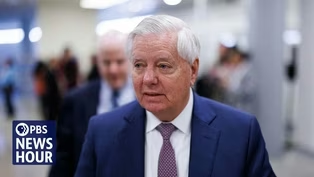
Lindsey Graham's career and influence on American politics
Video has Closed Captions
Lindsey Graham's career and influence on American politics (10m 47s)
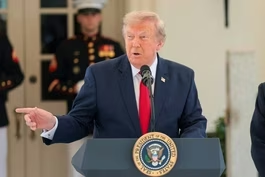
News Wrap: Judge says IRS lawsuit filed for improper purpose
Video has Closed Captions
News Wrap: Judge says Trump's lawsuit against IRS filed for 'improper purpose' (6m 21s)
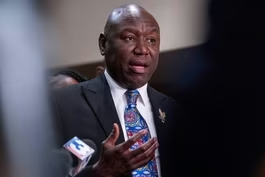
Nolan Wells' family presses for transparent investigation
Video has Closed Captions
Nolan Wells' family presses for transparent investigation into his death (7m 32s)

'One Day in September' traces baseball's first All-Star Game
Video has Closed Captions
'One Day in September' chronicles how baseball's All-Star Game was born (7m 2s)
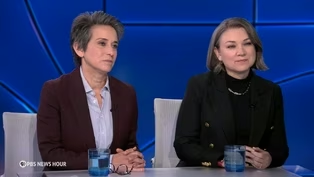
Tamara Keith and Amy Walter on Lindsey Graham's passing
Video has Closed Captions
Tamara Keith and Amy Walter on Lindsey Graham's passing (7m 34s)

Trump says U.S. 'taking over' strait as Iran war reignites
Video has Closed Captions
Trump says U.S. 'taking over the strait' as conflict with Iran reignites (7m 37s)

What we know about cyclosporiasis outbreak's link to produce outbreak
Video has Closed Captions
What we know about the cyclosporiasis outbreak linked to produce (6m 16s)
Providing Support for PBS.org
Learn Moreabout PBS online sponsorship New Episode
- News and Public Affairs

Today's top journalists discuss Washington's current political events and public affairs.

- News and Public Affairs

FRONTLINE is investigative journalism that questions, explains and changes our world.
 New Episode
 New Episode
 New Episode
 New Episode
 New Episode
 New Episode
 New Episode
 New Episode
 New Episode
Support for PBS provided by:
Major corporate funding for the PBS News Hour is provided by BDO, BNSF, Consumer Cellular, American Cruise Lines, and Raymond James. Funding for the PBS NewsHour Weekend is provided by...