
Episode 1: A Necessary War | Introduction
Between 50 and 60 million people died in World War II. This is how The War begins.
From
Episode 1: A Necessary War | Introduction
Clip: Episode 1 | 5m 35sVideo has Closed Captions
Between 50 and 60 million people died in World War II. This is how The War begins.
The Second World War brought out the best and the worst in a generation. From 1939 to 1945, between 50 and 60 million people died, most of them civilians, and more than 405,000 Americans in uniform lost their lives. The opening of The War by Ken Burns sets out the scale of the conflict and introduces the four American towns at its heart.
From
Problems playing video? | Closed Captioning Feedback
Problems playing video? | Closed Captioning Feedback
Corporate funding is provided by General Motors, Anheuser-Busch, and Bank of America. Major funding is provided by Lilly Endowment, Inc.;PBS; National Endowment for the Humanities; CPB; The Arthur Vining Davis...
Episode 1: A Necessary War | Introduction
Clip: Episode 1 | 5m 35sVideo has Closed Captions
The Second World War brought out the best and the worst in a generation. From 1939 to 1945, between 50 and 60 million people died, most of them civilians, and more than 405,000 Americans in uniform lost their lives. The opening of The War by Ken Burns sets out the scale of the conflict and introduces the four American towns at its heart.
From
Problems playing video? | Closed Captioning Feedback
Where to Watch The War
The War is available to stream on pbs.org and the PBS app.
Buy Now
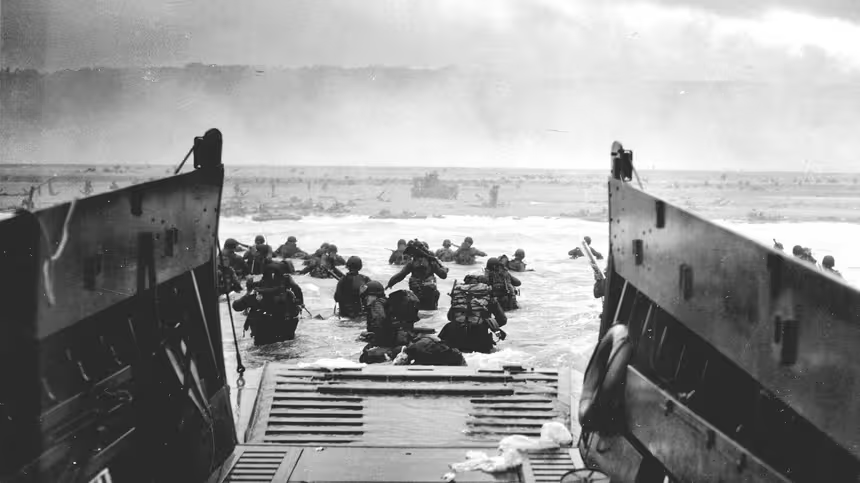
The War - A Timeline
Explore a multimedia timeline following events from World War II battles, diplomatic actions, and developments on America's homefront, from 1939 - 1945.Providing Support for PBS.org
Learn Moreabout PBS online sponsorship- I don't think there is such a thing as good war.
There are sometimes, necessary wars and I think one might say, just wars and that, I never questioned the necessity of that war and I still do not question that it was something that had to be done.
(somber music) - [Narrator] The greatest cataclysm in history grew out of ancient and ordinary human emotions.
Anger and arrogance and bigotry, victimhood and the lust for power.
And it ended because other human qualities, courage and perseverance and selflessness, faith, leadership and the hunger for freedom, combined with unimaginable brutality to change the course of human events.
The second World War brought out the best and the worst in a generation and blurred the two so that they became at times, almost indistinguishable.
In the killing that engulfed the world, from 1939 to 1945, between 50 and 60 million people died.
So many and in so many different places, that the real number will never be known.
More than 85 million men and women served in uniform, but the overwhelming majority of those who perished were civilians.
Men, women and children, obliterated by the arrhythmic of war.
(somber music) The United States of America was relatively fortunate.
More than 405,000 soldiers and sailors, airmen and marines died.
But that figure represented proportionally fewer military causalities that was suffered by any of the other major combatants.
American cities were not destroyed, American civilians were never really at risk.
But without American Power, without the sacrifice of American lives, the struggles of outcome would have been very different.
The American economy only grew stronger as the fighting went on and by the time it ended, the United States would be the most powerful nation on Earth and a once isolated and insular people, would find themselves at the center of world affairs.
The war touched every family on every street, in every town in America.
Towns like Luverne, Minnesota.
Sacramento, California.
Waterbury, Connecticut.
and Mobile, Alabama.
and nothing would ever be the same again.
- I'm not sure I can speak about why human beings in general go to war, I think that's a pretty large category.
I can only speak about why 18 year olds from Minneapolis go to war.
They'd go to war because it's impossible not to, because a current is established in the society, so swift, flowing toward war that every young man who steps into it is carried downstream.
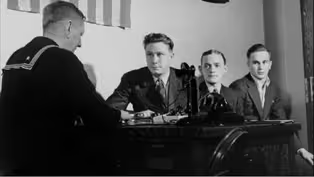
Video has Closed Captions
Clip: Ep1 | 2m 12s | For a Minneapolis teenager in 1941, enlisting was a chance to become someone new. (2m 12s)
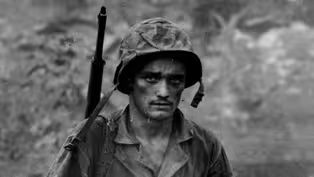
Video has Closed Captions
Preview: Ep1 | 30s | Watch a preview of Episode One: A Necessary War. (30s)
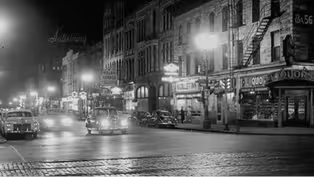
Video has Closed Captions
Clip: Ep1 | 4m 39s | Three WWII veterans on propaganda, pacifism and the real reasons they went to war. (4m 39s)
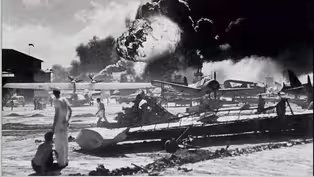
Daniel Inouye Remembers the Pearl Harbor Attack
Video has Closed Captions
Clip: Ep1 | 2m 47s | Future U.S. Senator Daniel Inouye watched Japanese planes streak overhead on Dec. 7, 1941. (2m 47s)
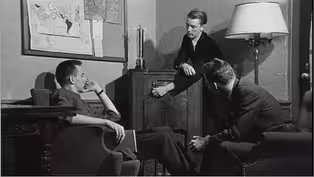
Video has Closed Captions
Clip: Ep1 | 1m 29s | Dec. 8, 1941: Americans gather by their radios as FDR asks Congress to declare war. (1m 29s)
Four American Towns Before Pearl Harbor
Video has Closed Captions
Clip: Ep1 | 11m | Mobile, Sacramento, Waterbury and Luverne: four American towns on the eve of World War II. (11m)
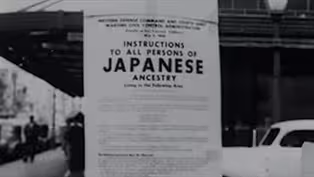
Made Into an Enemy: Executive Order 9066
Video has Closed Captions
Clip: Ep1 | 7m 14s | Executive Order 9066 forced more than 110,000 people of Japanese ancestry from their homes. (7m 14s)
Providing Support for PBS.org
Learn Moreabout PBS online sponsorship







Support for PBS provided by:
Corporate funding is provided by General Motors, Anheuser-Busch, and Bank of America. Major funding is provided by Lilly Endowment, Inc.;PBS; National Endowment for the Humanities; CPB; The Arthur Vining Davis...